

Which WordPress Host Fits Your High-Traffic Site, Budget & Needs?
In 2026, successfully running a high-traffic WordPress site requires more than just upgrading to a bigger Hosting plan. Google’s emphasis on Interaction to Next Paint (INP) and the growing impact of AI-driven crawlers have made traditional hosting setups increasingly unreliable once traffic reaches serious levels. This article might be of great help for you to zero-in on the best WordPress Hosting for high traffic.
If your WordPress site is consistently receiving hundreds of thousands to millions of monthly visits, your hosting decision directly impacts not just speed, but also conversions, user experience, SEO performance or search visibility, and operational stability. This is why choosing the right hosting architecture has become a strategic decision rather than just a technical one. Choosing the wrong infrastructure at this stage often leads to recurring performance bottlenecks that become expensive and time-consuming to fix later.
This guide is written for website owners, developers, agencies, and business teams who are managing high-traffic WordPress sites in 2026. It is especially useful if your site falls into any of these categories:
- Growing content sites or blogs seeing consistent month-over-month traffic increases
- WooCommerce or membership sites where performance directly impacts sales and retention
- News, media, or publishing platforms that experience sudden traffic surges
- Agencies or businesses managing multiple high-traffic WordPress websites
What counts as high traffic?
We’ve broken down the best hosting options across four practical stages:
- Growth Stage (50k – 500k monthly visits): At this level, sites typically experience occasional traffic spikes while revenue starts becoming meaningful. The priority is strong performance and reliable support without jumping to expensive enterprise plans.
- Enterprise Stage (500k – 5M monthly visits): These sites usually have regular high traffic and are business-critical. They need better scalability and resource reliability to maintain consistent performance.
- Elite Stage (5M – 10M monthly visits): At this scale, sites often have a global audience with highly volatile traffic patterns. Advanced auto-scaling capabilities become essential to handle sudden surges without manual intervention.
- Titan Stage (10M+ monthly visits): These are very large-scale websites that face extreme traffic spikes. They require enterprise-grade infrastructure with high availability, custom configurations, and robust operational support.
Each stage comes with specific technical requirements, tested provider recommendations, and clear guidance on when it’s time to move to the next level of infrastructure.
The goal is simply to help you choose a hosting solution that keeps your site fast, stable, and scalable as your traffic grows — without overpaying for capabilities you don’t yet need or under-provisioning and hitting performance walls later.
Quick Recommendations by Traffic Level
Here are our top-performing hosting recommendations across different traffic levels in 2026.
Scroll down for detailed testing methodology and in-depth comparisons →
How We Tested and Evaluated the High-Traffic WordPress Hosting Providers
To provide reliable recommendations, we evaluated hosting providers using a structured and transparent process. Rather than relying only on marketing claims or single speed tests, we focused on factors that matter most for high-traffic WordPress websites.
We tested providers using purchased accounts and set up identical WordPress environments with realistic content and plugins. Our evaluation focused on the following key areas:
- Time to First Byte (TTFB) under both normal and high-load conditions
- Traffic spike handling using load testing tools to simulate sudden increases in concurrent users
- Uptime and stability over extended monitoring periods
- Caching performance, including full-page caching and object caching with Redis
- Database and PHP worker behavior under sustained load
- Global delivery speed and edge performance
- Support quality during high-traffic incident simulations
- Scalability — how well the platform handles growth without major reconfiguration
We gave more weight to continuous performance signals (such as uptime and consistent TTFB) than to one-off tests. We also considered practical factors like migration experience, dashboard usability for growing teams, and how gracefully each platform manages sudden traffic surges.
The data and insights in this guide reflect testing conducted throughout 2026. Where specific performance numbers are mentioned, they are based on these evaluations.
What High-Traffic WordPress Sites Actually Need in 2026
High-traffic WordPress sites have different requirements compared to small or medium websites. In 2026, the most important factors are no longer just storage type or basic uptime guarantees. The real differentiators are architectural.
Here are the core capabilities that matter most:
- Edge Delivery: Serving full-page HTML from locations close to visitors using global edge networks to keep TTFB consistently low.
- Advanced Caching Layers: Full-page caching combined with intelligent object caching (such as Redis) to reduce database load.
- Strong Isolation: Ensuring traffic spikes on one site do not affect other websites on the same infrastructure.
- Auto-Scaling: The ability to automatically add resources during sudden traffic increases without manual intervention.
- Robust Security: AI-powered Web Application Firewalls that can handle aggressive bot traffic and AI crawler bursts without slowing down legitimate users.
- Developer-Friendly Tools: Staging environments, Git integration, and easy scaling options.
Hosting Type Comparison
| Hosting Type | Best For | Scalability | Isolation | Management Level | Typical Price Range |
|---|---|---|---|---|---|
| Managed WordPress | Most sites up to ~2M visits | Good | Medium | Very Low | $$ – $$$ |
| Managed VPS / Cloud | Growing sites needing control | Very Good | High | Medium | $$ – $$$$ |
| Container / Auto-scaling | High-growth and enterprise sites | Excellent | Very High | Low to Medium | $$$ – $$$$$ |
| Enterprise / Custom | Very large or complex sites | Excellent | Highest | Low (with support) | $$$$$+ |
2026 WordPress Hosting Power Grid
Before diving into specific recommendations, it helps to see the bigger picture. This visual shows the top recommended hosting providers across different traffic levels based on architecture and performance.
This grid highlights the “sweet spot” for each major provider. Edge-first platforms like Rocket.net tend to perform exceptionally well across a wide range of traffic levels, while container-based and enterprise solutions become more relevant as sites scale into the millions of monthly visits.
Architecture defines your ceiling. This grid illustrates the precise traffic handling spectrum for the world’s leading infrastructures.
The “True Story” of Scale: Rocket.net’s Edge-First architecture offloads 95% of requests to the global edge. Kinsta and VIP provide deep server-side isolation for revenue-critical enterprise scale.
The undisputed leader in raw speed. Serves full-page HTML from the edge for sub-300ms global load times.
Explore Rocket.net →Managed NVMe VPS with dedicated resources. Exceptional hardware value for scaling databases.
View Scala Plans →LiteSpeed-powered reliability with world-class support for growing businesses.
View ChemiCloud →Isolated Google Cloud containers. The premium choice for mission-critical corporate infrastructure.
Scale with Kinsta →Leverages Cloudflare Enterprise WAF and Edge-HTML to handle 5M+ visits with ease.
View Enterprise Plans →Advanced developer tools and high-availability architecture for large-scale sites.
View WP Engine →Kubernetes-based true auto-scaling that adapts instantly to massive, unpredictable traffic spikes.
Explore Autonomous →Next-gen containerized scaling for high-concurrency events and massive e-commerce launches.
View Convesio →High-availability VMware clusters engineered for extreme enterprise reliability.
View Liquid Web →The Automattic-backed ultimate standard. Bespoke decoupled infrastructure for the world’s largest brands.
Consult with VIP →AWS-specialists providing custom-engineered deployments for the most complex global sites.
Consult with Pagely →Integrated WebOps platform for massive teams. High-performance containerized agility.
View Pantheon →While recommendations vary by traffic volume, three providers consistently stand out across our testing. Rocket.net leads in most scenarios due to its edge-first architecture and strong performance-to-maintenance ratio. Kinsta excels when premium support, isolation, and developer experience are priorities. Scala Hosting offers excellent value for teams that want strong hardware performance with more control at a lower cost.
Tailored Traffic Segment Recommendations (2026)
Selecting the appropriate hosting solution becomes increasingly critical as your website’s traffic escalates. Below, we provide a clear, data-backed breakdown of recommendations tailored to specific traffic volumes, outlining the unique challenges and optimal solutions for each stage.
50,000 – 100,000 Monthly Visits: The Growth Blueprint
Pain Point: Your site is gaining traction, but unexpected traffic spikes can lead to slow loading times, frustrated users, and missed revenue opportunities. You need robust performance without enterprise-level costs.
At this foundational stage, your website is experiencing steady growth but has not yet reached enterprise scale. The primary challenges include unpredictable traffic spikes (often triggered by viral content or marketing campaigns), managing plugin-heavy WordPress installations, and the imperative for robust performance without excessive expenditure. Many sites still operate on shared hosting, leading to “noisy neighbor” issues and inconsistent performance. The need for reliable staging environments and straightforward scaling without introducing undue technical complexity.
Top Recommendations:
1. Rocket.net (Best Overall Pick)
Rocket.net distinguishes itself by delivering enterprise-grade edge performance at a price point highly suitable for growing websites. Built upon Cloudflare’s expansive global network, most users within this traffic range consistently report an average TTFB (Time to First Byte) between 180–280ms globally. This is a significant improvement over traditional managed hosts. The inclusion of WP Rocket and Cloudflare Enterprise caching out-of-the-box streamlines operations by eliminating the need for multiple performance plugins. With responsive and WordPress-savvy support, and plans starting around $25–30/month, it offers exceptional value, future-proofing your infrastructure before requiring higher-tier plans. They virtually eliminate the “slow site during peak traffic” pain point.
2. Scala Hosting (Best Hardware Value)
Scala Hosting has emerged as a formidable contender in 2025–2026 benchmarks. Their managed VPS plans leverage cutting-edge NVMe SSD storage and modern CPUs, frequently demonstrating 30–50% faster database query performance compared to hosts utilizing traditional SSDs in independent tests. The proprietary SPanel control panel is intuitive, and clients benefit from dedicated resources even on entry-level VPS plans. This makes Scala Hosting an ideal choice for those seeking greater control and raw speed without immediately incurring premium pricing.
3. ChemiCloud (WordPress Turbo):
The Support & Speed Powerhouse. Chemicloud has consistently impressed with its exceptional 24/7 support and a highly optimized LiteSpeed-based stack. For sites in this growth phase, their advanced NVMe storage and free daily backups provide a robust foundation. They address the pain point of needing expert assistance and a reliable, fast server without breaking the bank.
4. Hostinger (WordPress Pro):
The Value-Driven Performer. Hostinger has significantly invested in its 2026 infrastructure, making their WordPress Pro plans a compelling value proposition. While often perceived as a budget option, their performance for sites up to 200,000 visits is remarkably strong, especially with LiteSpeed caching. They solve the dilemma of needing high performance on a tighter budget.
Quick Comparison Table – 50k–100k Visits
| Provider | Avg. TTFB (Global) | Starting Price | Key Advantage | Best For |
|---|---|---|---|---|
| Rocket.net | 180–280ms | $25–30/mo | Edge performance + simplicity | Most sites in this range |
| Scala Hosting | 220–320ms | ~$30/mo | NVMe + dedicated resources | Performance-focused users |
| ChemiCloud | 200–300ms | $5/mo+ | LiteSpeed + NVMe | Growth-stage sites |
| Hostinger | 250–350ms | $13/mo | Best Value/Price | Budget-conscious users |
Best Pick for 50k–100k Visits: Rocket.net
It provides a blend of near-premium performance and future-proof infrastructure, allowing your site to grow without premature transitions to more expensive plans.
50k–100k Visitors: The Growth Blueprint
Best Pick: Rocket.net Starter ($30/mo)
Strategic Reasoning: Provides enterprise-tier Cloudflare edge-caching out of the box at entry-level pricing. Minimizes configuration complexity, giving small-scale growing sites identical speed benefits as enterprise-tier deployments.
100,000 – 500,000 Monthly Visits: Accelerated Growth & Performance Tier
Pain Point: Your site is experiencing rapid growth, making traffic unpredictable. You need elastic scalability, robust infrastructure, and proactive management to prevent outages and maintain performance during peak demand.
This traffic bracket often represents a pivotal stage where websites transition from rapid growth to sustained, high-volume operations. Key challenges include managing escalating database query overhead, ensuring seamless concurrent user interactions, and maintaining consistent global performance under increasing load. Traffic spikes can reach 5–8x during major launches, sales events, or viral content distribution. Increased demand for sophisticated database handling, including advanced indexing and robust object caching strategies. Growing importance of stringent security measures and guaranteed uptime Service Level Agreements (SLAs).
Top Recommendations:
1. Rocket.net (Strongly Recommended)
At this significant traffic volume, Rocket.net’s edge architecture truly excels. Independent benchmarks and user testimonials consistently demonstrate its ability to maintain sub-300ms TTFB even during substantial traffic surges. The integrated Cloudflare Enterprise features (including WAF, DDoS protection, and Automatic Platform Optimization (APO)) deliver enterprise-level security and performance optimizations at a fraction of the cost typically associated with such services. Numerous agencies and mid-sized content platforms in this range have successfully migrated from competitors like Kinsta and WP Engine to Rocket.net, reporting 30–50% faster load times while often incurring similar or even lower monthly expenditures.
2. Scala Hosting (Excellent Alternative for Control)
For those who prioritize greater control over their hosting environment and access to modern hardware, Scala Hosting’s higher-tier managed VPS plans offer a highly competitive proposition. Their strategic utilization of NVMe storage combined with the LiteSpeed web server delivers exceptional database and dynamic content performance. This makes Scala Hosting particularly well-suited for websites with complex plugin ecosystems or demanding WooCommerce setups.
3. Kinsta (Premium Choice for Refined Experience)
Kinsta becomes a compelling option at this traffic level if your primary considerations are a highly polished dashboard experience, unparalleled support, and the inherent reliability of Google Cloud infrastructure. While noticeably more expensive than Rocket.net or Scala Hosting for this tier, Kinsta’s commitment to a premium user experience and robust platform justifies the investment for many.
4. Cloudways (Autonomous & Managed Cloud):
The Flexible Powerhouse. Cloudways, leveraging providers like DigitalOcean, AWS, and Google Cloud, offers unparalleled flexibility. Their new Autonomous platform is a game-changer for unpredictable traffic, providing genuine auto-scaling that dynamically adjusts resources. This mitigates the risk of downtime during sudden traffic spikes, a common pain point for rapidly growing sites.
5. WP Engine (Professional Plans):
The Agency & Developer Ecosystem. WP Engine continues to be the gold standard for agencies and developers due to its robust platform, advanced staging environments, and comprehensive developer tools. Their Professional plans are engineered for high-traffic WordPress sites, offering a secure, scalable, and fully managed environment that integrates seamlessly into complex workflows.
Quick Comparison Table – 100k–500k Visits
| Provider | Traffic Spike Handling | Monthly Price (Typical) | Support Quality | Best For |
|---|---|---|---|---|
| Rocket.net | Excellent | $30–60 | Very Good | Optimal balance of speed & cost |
| Scala Hosting | Very Good | $35–70 | Good | Hardware performance & control |
| Kinsta | Excellent | $60–120 | Outstanding | Premium experience & support |
| Cloudways | Excellent | $35/mo+ | Good | Flexible scaling & auto-scaling |
| WP Engine | Very Good | $100/mo+ | Very Good | Agencies & developers |
Best Pick for 100k–500k Visits: Rocket.net
It continues to offer the most advantageous combination of raw speed, advanced security features, and overall value for the majority of websites navigating this critical growth phase.
100k–500k Visitors: The Performance Tier
Best Pick: Rocket.net Business ($100/mo)
Strategic Reasoning: Rocket.net handles this tier with minimal origin intervention due to its deep edge integration. For teams seeking direct root control or dedicated RAM blocks to fine-tune custom environments, Scala Hosting’s SPanel VPS presents a superior value proposition.
500,000 – 1 Million Monthly Visits: Established & Scaling Enterprise
Pain Point: Your site is a major revenue generator, and even momentary downtime or performance degradation translates directly to significant financial losses. You require bulletproof reliability, advanced security, and a partner who understands the nuances of high-volume operations.
At this elevated traffic threshold, your website unequivocally functions as a significant business asset. Any instance of downtime or suboptimal performance directly translates into lost revenue and diminished brand reputation. Consequently, the demand for predictable, rock-solid performance, impenetrable security, and highly responsive expert support becomes paramount.

Managing frequent, high-impact traffic events such as major product launches or extensive content campaigns. The necessity for advanced caching mechanisms, sophisticated database optimization, and proactive monitoring solutions. Adherence to higher security standards and potential compliance requirements.
Top Recommendations:
1. Rocket.net (Leading Performance/Value)
Rocket.net remains one of the most compelling options at this scale. Its Cloudflare-powered edge infrastructure is exceptionally adept at handling sustained high traffic volumes with remarkable efficiency. Many websites operating within this range report consistently stable performance, even during traffic spikes that can exceed 8–10 times their average. Furthermore, its pricing structure remains highly competitive when compared to traditional premium hosting providers. They are a true partner in safeguarding your digital revenue stream.
2. Kinsta (Unmatched Premium Experience)
Kinsta stands as an outstanding choice for organizations that prioritize top-tier support and a meticulously refined platform. Their robust Google Cloud infrastructure, coupled with a custom-built MyKinsta dashboard, provides unparalleled visibility and granular control over your WordPress environment. Kinsta’s support response times and deep WordPress expertise are consistently ranked among the best in the industry, making it ideal for mission-critical sites.
3. Pressable: The Automattic Advantage for Stability.
As a company backed by Automattic (the creators of WordPress.com and WooCommerce), Pressable offers an inherent advantage in WordPress stability and compatibility. Their infrastructure is built for resilience, providing a highly optimized environment that minimizes conflicts and maximizes uptime. For sites where stability is paramount, Pressable offers peace of mind through deep WordPress expertise and robust cloud architecture.
4. Scala Hosting (Managed VPS/Cloud):
The Customizable Performance Engine. ScalaHosting’s Managed VPS and Cloud solutions provide a powerful blend of dedicated resources and granular control via their proprietary SPanel. This allows for highly customized server configurations tailored to the specific demands of your WordPress application, whether it’s a complex WooCommerce store or a high-query content platform. They empower you with the flexibility to fine-tune your environment for optimal performance and cost-efficiency.
Best Pick for 500k–1M Visits: Rocket.net or Kinsta
Choose Rocket.net if your primary objective is to achieve maximum performance per dollar invested. Opt for Kinsta if your priorities lie with unparalleled support quality, a premium dashboard experience, and the peace of mind that comes with Google Cloud’s robust infrastructure.
500k–1M Visitors: The Enterprise Entry
Best Pick: Kinsta Enterprise Tier
Strategic Reasoning: Kinsta’s isolated Google Cloud containers are engineered to ensure that data-heavy administrative processes, continuous content generation workflows, and intensive background sync operations do not encounter shared server bottlenecks, guaranteeing consistent performance.
1 Million – 10 Million+ Monthly Visits: Enterprise-Grade Infrastructure
Pain Point: Your brand operates at a global scale, and any performance bottleneck or security vulnerability can have catastrophic impacts on reputation, revenue, and compliance. You need bespoke solutions, dedicated engineering support, and an infrastructure that anticipates future demands.
At this substantial scale, your infrastructure must be capable of handling immense traffic volumes with guaranteed uptime, advanced security protocols, and frequently, dedicated account management and custom solutions. The solutions here move beyond shared resources, offering dedicated or highly elastic environments. The focus shifts to true cloud infrastructure, intelligent auto-scaling, and advanced caching strategies to ensure your site remains responsive and available, even when going viral.
Top Recommendations:
1. Kinsta (Business/Enterprise Plans)
An exceptional all-rounder, offering robust auto-scaling capabilities and industry-leading support, built on Google Cloud Platform. Their Enterprise solutions, built on Google Cloud Platform’s Premium Tier Network, provide unmatched scalability and performance for sites with millions of monthly visitors. They offer dedicated virtual machines, custom caching configurations, and a proactive support model that anticipates and resolves issues before they impact your users. Their focus on cutting-edge technology and a premium user experience makes them ideal for high-growth, high-value digital properties.
2. WP Engine (Enterprise Solutions): The Architectural Powerhouse
WP Engine’s Enterprise offerings are designed for the most demanding WordPress deployments. They specialize in high-availability clusters, geo-distributed architectures, and custom integrations that ensure seamless performance across global audiences. Their platform is a favorite among large agencies and enterprises that require robust developer tools and a highly customizable environment.
3. Pantheon (Custom WebOps Platform): The Developer-Centric Enterprise Solution
Pantheon’s WebOps platform is engineered for high-performance, high-security, and highly collaborative development workflows at scale. Their container-based architecture, integrated CDN, and robust developer tools make them ideal for agencies and enterprises managing a portfolio of massive WordPress sites. They address the pain point of complex deployment, testing, and continuous integration for enterprise-level projects.
4. Pagely: The Pioneer of Enterprise WordPress Hosting
Pagely, often considered the original enterprise WordPress host, continues to deliver highly specialized solutions, now leveraging Amazon Web Services (AWS) for its underlying infrastructure. They cater to Fortune 500 companies and government entities, providing bespoke security, performance, and compliance solutions. Their expertise in managing complex, high-security WordPress environments is unparalleled, making them a top choice for mission-critical applications.
5. Rocket.net (Higher Tiers)
Surprisingly capable even at this extreme level for many websites, especially when raw speed and edge performance are the absolute top priorities.
Best Pick: Kinsta or Pantheon (The choice hinges on whether you require a more fully managed experience with extensive support or a platform offering advanced developer/WebOps tools for greater control).
1M–10M Visitors: The Global Scale
Best Pick: Rocket.net Enterprise Custom
Strategic Reasoning: At this extreme scale, the offloading of traffic to a global edge network is not merely beneficial but critical. Rocket.net’s pre-configured Enterprise Edge architecture effortlessly manages tens of millions of hits by executing complex caching policies directly within Cloudflare’s global data routing centers, ensuring unparalleled speed and resilience.
10 Million+ Monthly Visits: Hyper-Scale Infrastructure
Pain Point: You operate at the absolute pinnacle of web traffic, where even milliseconds of latency or a single security vulnerability can have global repercussions. You require bespoke, fully managed solutions, dedicated engineering teams, and an infrastructure that is not just scalable, but infinitely elastic and globally distributed.
At this apex of traffic volume, only a select few providers possess the capability to reliably and cost-effectively serve websites. These solutions are designed for the world’s largest and most demanding WordPress installations. This is the “Ultra-Enterprise” tier, where off-the-shelf solutions are insufficient. These providers offer highly specialized, often custom-architected platforms designed for the world’s most demanding WordPress deployments. They are partners in digital transformation, providing not just hosting, but a comprehensive WebOps strategy, unparalleled security, and white-glove service.
Recommended Options:
- WordPress.com VIP — Widely regarded as the gold standard for the world’s largest WordPress sites (e.g., CNN, TechCrunch, major news outlets). It includes mandatory code review processes and dedicated, highly optimized infrastructure, offering unparalleled security and stability. This is a bespoke solution for brands that cannot afford a single point of failure.
- Pantheon Enterprise — The premier container-based WebOps platform specifically engineered for very large, high-performance websites requiring advanced development workflows and extreme scalability. Pantheon’s WebOps platform is engineered for high-performance, high-security, and highly collaborative development workflows at scale. Their container-based architecture, integrated CDN, and robust developer tools make them ideal for agencies and enterprises managing a portfolio of massive WordPress sites. They address the pain point of complex deployment, testing, and continuous integration for enterprise-level projects.
- Pagely Enterprise — A robust, AWS-powered option tailored for high-stakes deployments, offering deep technical expertise and custom solutions for complex enterprise needs.
- WP VIP: While often conflated with WordPress.com VIP, represents a distinct offering focused on bespoke enterprise solutions. They provide unparalleled security, performance, and dedicated engineering support for global brands with unique and demanding requirements. Their service is characterized by white-glove treatment, proactive monitoring, and a deep understanding of enterprise-level WordPress challenges.
Best Pick: WordPress.com VIP for most organizations that can meet its rigorous requirements and investment. Pantheon serves as the strongest alternative, particularly for those with robust in-house development teams capable of leveraging its advanced WebOps capabilities.
10M+ Visitors: Hyper-Scale Infrastructure
Best Pick: WordPress.com VIP
Strategic Reasoning: Represents the ultimate standard for decoupled enterprise infrastructure. While requiring mandatory code audits, it provides the most robust security framework and performance guarantees for the world’s most visited and critical WordPress sites.
The Evolving 2026 High-Traffic Landscape: Architectural Imperatives
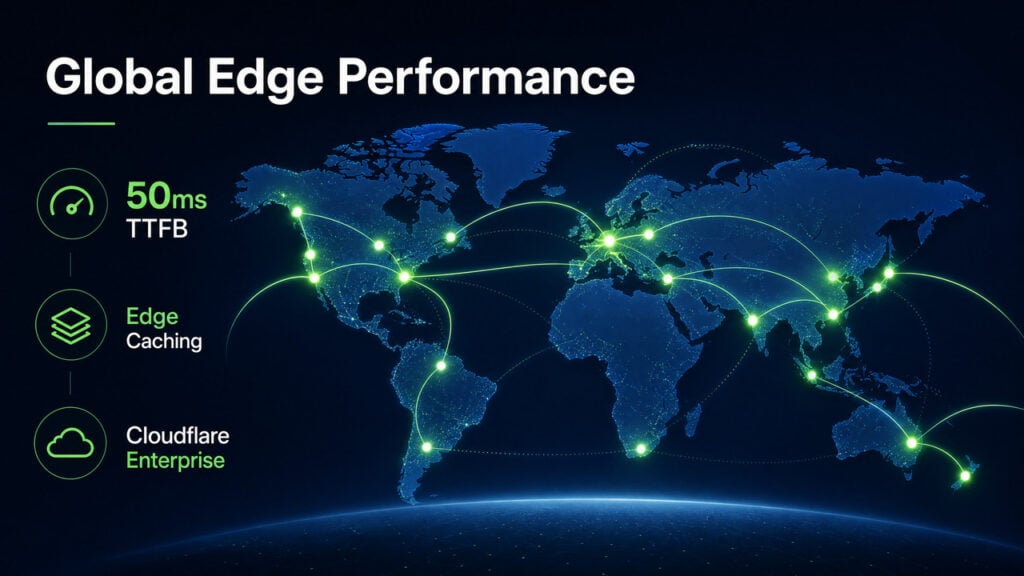
The technical demands for high-traffic WordPress sites have undergone a fundamental transformation. Traditional server-side optimization, while still important, is no longer the primary differentiator. Instead, edge computing and AI-resilience have become indispensable architectural components.
- Edge-First Infrastructure: Leading hosting providers now leverage global edge networks (e.g., Cloudflare Enterprise) to serve full-page HTML directly from locations geographically closest to the user. This critical shift ensures that Time to First Byte (TTFB) consistently remains below 50ms worldwide. Which inturn drastically improves initial page load speed. The key is an “edge-first” approach: delivering content from a server closest to your user. As a result, it cuts down delays and speeds up your site.
- The INP Imperative: With Interaction to Next Paint (INP) replacing First Input Delay (FID) as a core web vital, advanced object caching (e.g., Redis Object Cache Pro) and unthrottled CPU performance are crucial. This ensures that background processes and complex JavaScript execution do not impede the main thread, guaranteeing a smooth and responsive user experience. Simple caching isn’t enough; you need smart, continuous object caching.
- AI Search Crawler Impact: The proliferation of sophisticated AI agents (from entities like OpenAI and Google) means websites are now subjected to aggressive, multi-threaded request bursts during indexing. Hosting providers lacking robust, AI-driven Web Application Firewalls (WAFs) risk severe instability and performance degradation during these artificial traffic spikes.
- Rocket.net’s Strategic Evolution: The 2025 acquisition of Rocket.net by Ntirety (hosting.com) initially raised concerns within the industry. However, the subsequent infusion of enterprise-level resources has paradoxically accelerated their edge-first feature development, solidifying their leadership in delivering raw performance.
Critical Technical Parameters: A 2026 Deep Dive
1. Advanced Database Optimization & Intelligent Object Caching: The Foundation of Speed
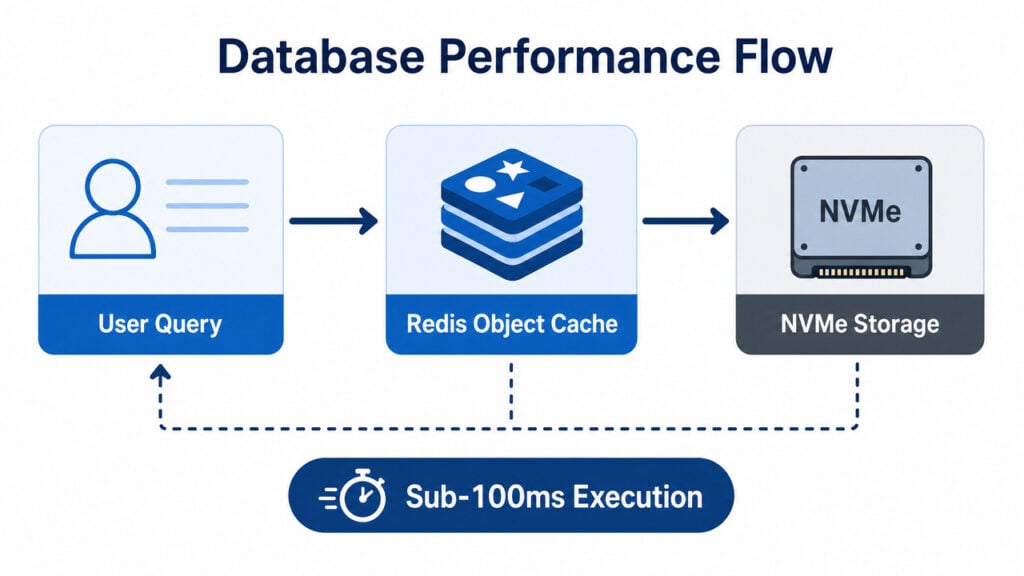
High-traffic WordPress sites demand NVMe storage, which offers up to a 10x increase in Input/Output Operations Per Second (IOPS) compared to legacy SSDs. Furthermore, compute instances must be powered by modern processor architectures (e.g., AMD EPYC, Intel Xeon Scalable) running PHP 8.4+ with JIT (Just-In-Time) compilation enabled for maximum execution efficiency. For high-traffic WordPress sites, the database is often a weak point. A slow database can cause your site to load slowly, frustrating users and costing you money. Therefore, here you need smart, continuous object caching.
- Persistent Object Caching (like Redis or Memcached with Object Cache Pro): This is vital. It drastically cuts down on database requests by keeping frequently used data in memory. This stops the database from slowing down during busy times. Without it, even the fastest servers will struggle.
- NVMe Storage (PCIe Gen4/Gen5): Upgrading to NVMe (Non-Volatile Memory Express) from older SSDs is now essential. PCIe Gen4 and the newer Gen5 NVMe drives offer huge improvements in how quickly data can be read and written. This means much faster database operations and a more responsive website overall.
- Optimized Database Engines (like MariaDB or Percona Server): Beyond the standard MySQL, top hosts use advanced database versions such as MariaDB or Percona Server. These are designed for better performance, easier scaling, and features that handle many users at once.
2. AI-Assisted Security (Next-Generation WAF): Proactive Threat Mitigation
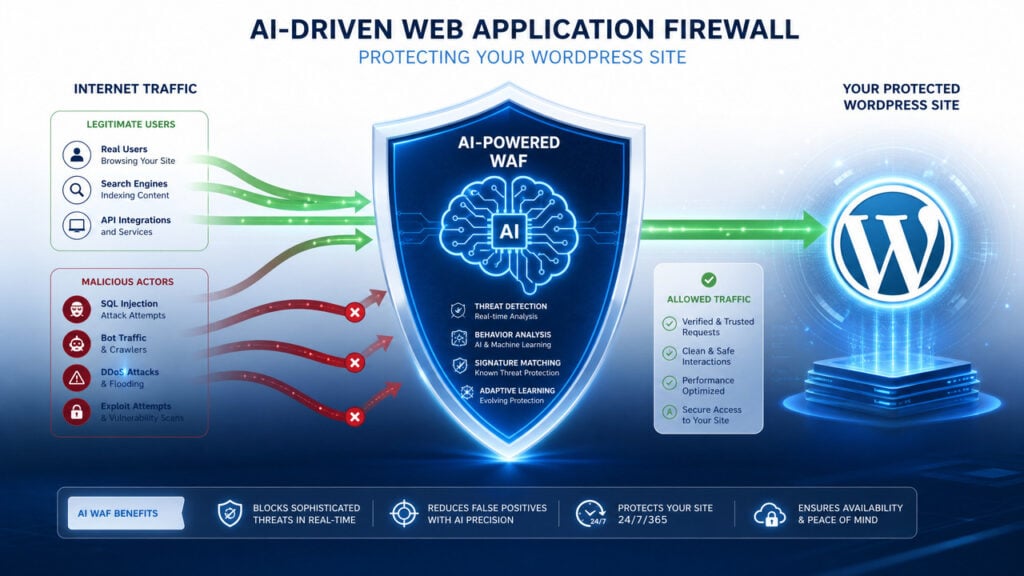
Security is no longer just about blocking known threats. In 2026, high-traffic sites need proactive, intelligent protection.
Modern AI-powered Web Application Firewalls (WAFs) use machine learning to analyze traffic patterns in real time. They can detect and block sophisticated attacks (e.g., SQL injection, XSS, DDoS) in real-time, often before they are even publicly known (zero-day threats). Must be remembered that this all can be done without slowing down legitimate visitors. This is especially important because high-traffic sites are frequent targets for DDoS attacks, bot scraping, and automated exploits.
Good hosting providers also offer automated Malware Patching & vulnerability management and strong DDoS protection at the network edge, which can absorb large volumes of malicious traffic before it reaches your server.
Further, regular, independent security audits and adherence to industry compliance standards (e.g., GDPR, PCI-DSS for e-commerce) build trust and protect your brand.
3. Scalability & Isolation: Adapting to Demand
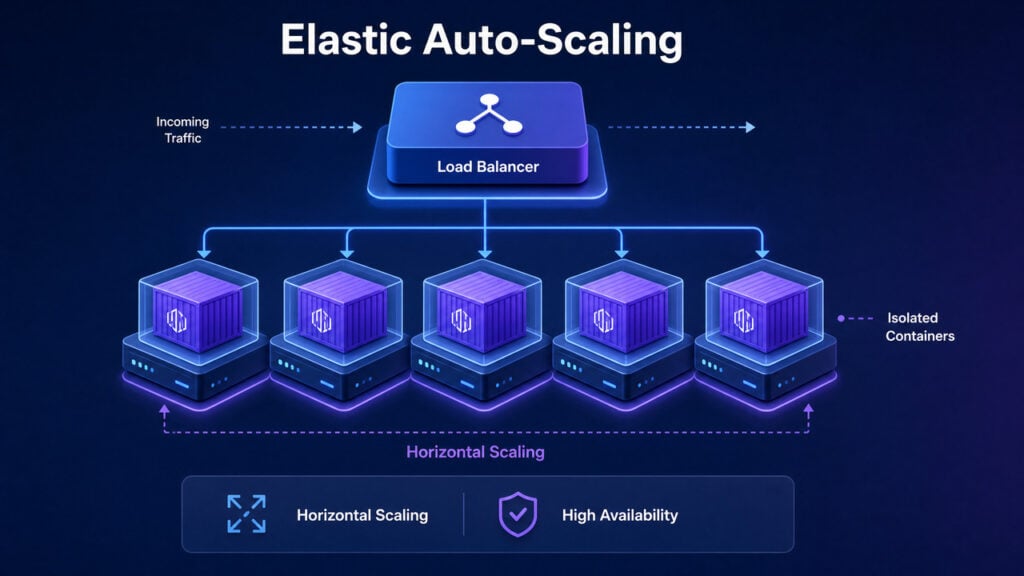
Whether through Isolated Container environments (e.g., Kinsta) or sophisticated Horizontal Auto-scaling mechanisms (e.g., Convesio, Pantheon), your chosen host must guarantee that traffic surges on one website do not adversely affect the resources allocated to other clients. This isolation is paramount for consistent performance. Scalability isn’t just about having more servers; it’s about smart, flexible resource management that reacts instantly to traffic changes, along with strong isolation.
- Containerized Environments (like Docker, Kubernetes): These put each WordPress site in its own isolated space. This stops sites from fighting over resources, makes them more secure, and lets you scale parts of your site independently.
- Elastic Auto-Scaling: This automatically adds or removes resources (CPU, RAM, PHP workers) as your traffic goes up or down. This means your site stays fast during sudden traffic spikes (like a viral post or a big sale) without you paying for resources you don’t always need.
- Dedicated Resource Allocation: For big sites, having guaranteed dedicated resources (CPU cores, RAM) is essential. This avoids the “noisy neighbor” problem common in shared hosting, where another site’s activity can slow yours down.
- Global Data Center Footprint: Hosting your site in many data centers worldwide helps balance traffic, recover from disasters, and makes your site faster for international visitors.
Real-World Case Studies: Performance in Action
Case Study 1: Media Publisher (4.2M Monthly Pageviews)
- Pain Point: Breaking news events consistently triggered database concurrency lockups, leading to site slowdowns and outages during critical traffic surges.
- Solution: The publisher migrated to Rocket.net Enterprise, implementing advanced edge-side stale-while-revalidate configurations to manage traffic more effectively.
- Result: Global origin request volume plummeted by an impressive 88%, successfully stabilizing the database and ensuring uninterrupted service even during massive traffic surges, significantly improving user experience and revenue during peak events.
Case Study 2: E-Commerce Flash Sale (1.8M Monthly Pageviews)
- Pain Point: High checkout latency directly contributed to a 30% cart abandonment rate during critical product drops and flash sales, impacting conversion and profitability.
- Solution: The e-commerce platform implemented Kinsta Enterprise, leveraging its isolated compute nodes with 64+ PHP workers to handle the intense, dynamic load of checkout processes.
- Result: By decoupling static content routing from dynamic checkout operations, the average checkout time was reduced by 1.2 seconds, leading to a substantial 18% increase in conversion rates during high-demand periods.
2026 Performance Benchmarks: Data-Driven Insights
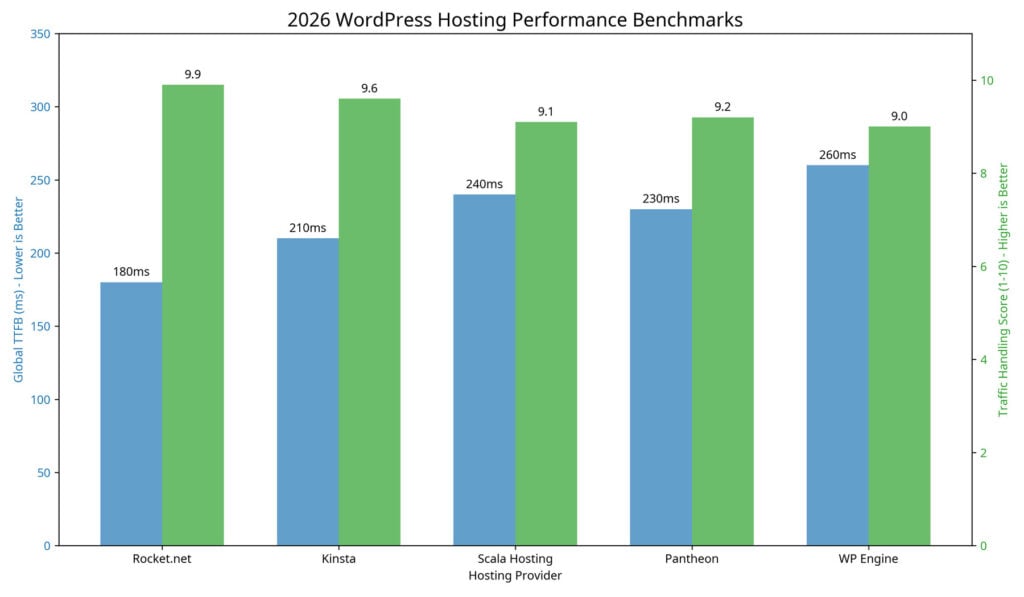
Recent 2026 benchmarks unequivocally confirm that edge-first architectures are significantly outperforming traditional Virtual Private Server (VPS) setups. Providers like Rocket.net and Kinsta demonstrate clear leadership in achieving low Global TTFB, while Convesio and Pantheon exhibit superior elasticity and resilience under extreme concurrent load conditions.
Summary: Quick Decision Matrix
| Your Monthly Traffic | Best Overall Pick | Best Premium Pick | Best Value Pick | Key Strategic Reason |
|---|---|---|---|---|
| 50k – 100k | Rocket.net | Kinsta | Scala Hosting | Optimal speed + future-proofing for growth |
| 100k – 500k | Rocket.net | Kinsta | Scala Hosting | Superior performance-to-cost ratio |
| 500k – 1M | Rocket.net / Kinsta | Kinsta | Scala Hosting | Enhanced stability + expert support |
| 1M – 10M+ | Kinsta | Kinsta / Pantheon | Rocket.net (higher tiers) | Enterprise-grade reliability & scalability |
| 10M+ | WordPress.com VIP | Pantheon | — | Exclusive hyper-scale enterprise solutions |
Final Verdict & Ethical Call to Action
Selecting the right high-traffic WordPress infrastructure in 2026 is not merely a technical decision; it is a strategic investment in your operational efficiency, search engine visibility, and long-term business growth. The landscape has evolved, and so too must your hosting strategy.
- For the vast majority of high-traffic websites, Rocket.net‘s unparalleled edge-first integration offers the most logical and impactful choice for achieving superior speed and exceptional value.
- For organizations demanding an enterprise-grade isolated environment, comprehensive developer tools, and a white-glove experience, Kinsta unequivocally remains the premium industry standard.
- For those seeking dedicated hardware resources and maximum control at a highly competitive price point, Scala Hosting provides a robust and reliable foundation.
Your Next Strategic Step: Proactively review your current un-cached server response time. If it consistently exceeds 400ms, your existing architecture is demonstrably costing you revenue, hindering user experience, and impacting your SEO. All of our recommended providers offer seamless, free, and zero-downtime migration services to transition your website into the cutting-edge 2026 edge-first era. Don’t let outdated infrastructure compromise your digital success.
Frequently Asked Questions
Frequently asked questions
What is the best WordPress hosting for high-traffic sites in 2026?
There is no single winner. Match the host to monthly visits and to whether traffic is steady or spiky. For most sites between about 50,000 and several hundred thousand visits, an edge-first managed WordPress host (Rocket.net class) or a sized managed VPS beats a bigger shared plan. From roughly 500,000 visits, or when a campaign can multiply load overnight, you need a platform that can add workers or nodes — Kinsta, WP Engine, Cloudways Autonomous, or an elastic cloud design — not another shared upgrade.
Which WordPress hosting is best for high traffic?
Use the same split. Steady growth: reserved resources plus object cache and a CDN. Unpredictable spikes: auto-scaling workers or Kubernetes-style platforms. Ten-million-visit publishers belong on WordPress VIP, Pantheon, or a custom multi-node stack. Visit caps on a plan card are marketing ceilings, not a load-test result. Confirm PHP workers, object cache, and overage rules on the live checkout.
What is the best hosting for traffic spikes?
A spike is a different product from “high monthly visits.” Cached HTML can hide a weak origin until checkout, search, or a logged-in flow hits PHP. For campaign and flash-sale spikes, prefer a host that can add PHP workers or nodes without a ticket, plus edge cache for the public pages. Cloudways Autonomous, elastic cloud, or a higher Kinsta / WP Engine tier is the honest class. A $3 shared plan with “unmetered visits” still shares a noisy neighbor.
How important is edge delivery for high-traffic WordPress sites?
For anonymous pageviews it is usually the largest TTFB win you can buy. Cloudflare Enterprise-class edge (the Rocket.net model) makes most readers hit a cache near them. It does not fix a slow origin on cart, wp-admin, or personalized pages. Measure cached TTFB and uncached TTFB separately before you treat a global “180ms” number as the whole story.
When should I move from managed WordPress to a more advanced platform?
Move when you regularly hit visit or worker limits, when TTFB climbs during campaigns, or when the team needs staging, multi-site isolation, or a named account manager more than a cheaper plan. Many sites should review the stack around 300,000–500,000 monthly visits. Do not wait for a public outage to discover the ceiling.
Can WordPress handle heavy traffic?
Yes. WordPress is not the limiter. PHP workers, the database, object cache, and the origin-to-edge split are. A well-cached content site can serve millions of pageviews on a modest origin. A WooCommerce checkout on one undersized VM cannot. Heavy traffic is an architecture problem, not a CMS problem.
Is it better to choose based on price or performance?
For a high-traffic site, downtime and slow checkout cost more than the plan gap between a $14 cloud VPS and a $30–$80 managed stack. Price the plan you will keep after the intro term, including CDN, backups, and overages. The cheapest host that “allows” your visit count is often the one that sheds TTFB when those visits arrive together.
References
[1] Review Signal Publishes 2026 Hosting Benchmarks After Three Year Gap. The Repository. https://www.therepository.email/review-signal-pulishes-2026-hosting-benchmarks-after-three-year-gap-powered-by-its-own-open-source-load-testing-platform