DigitalOcean Alternatives in 2026: Lower Price or Simpler Billing
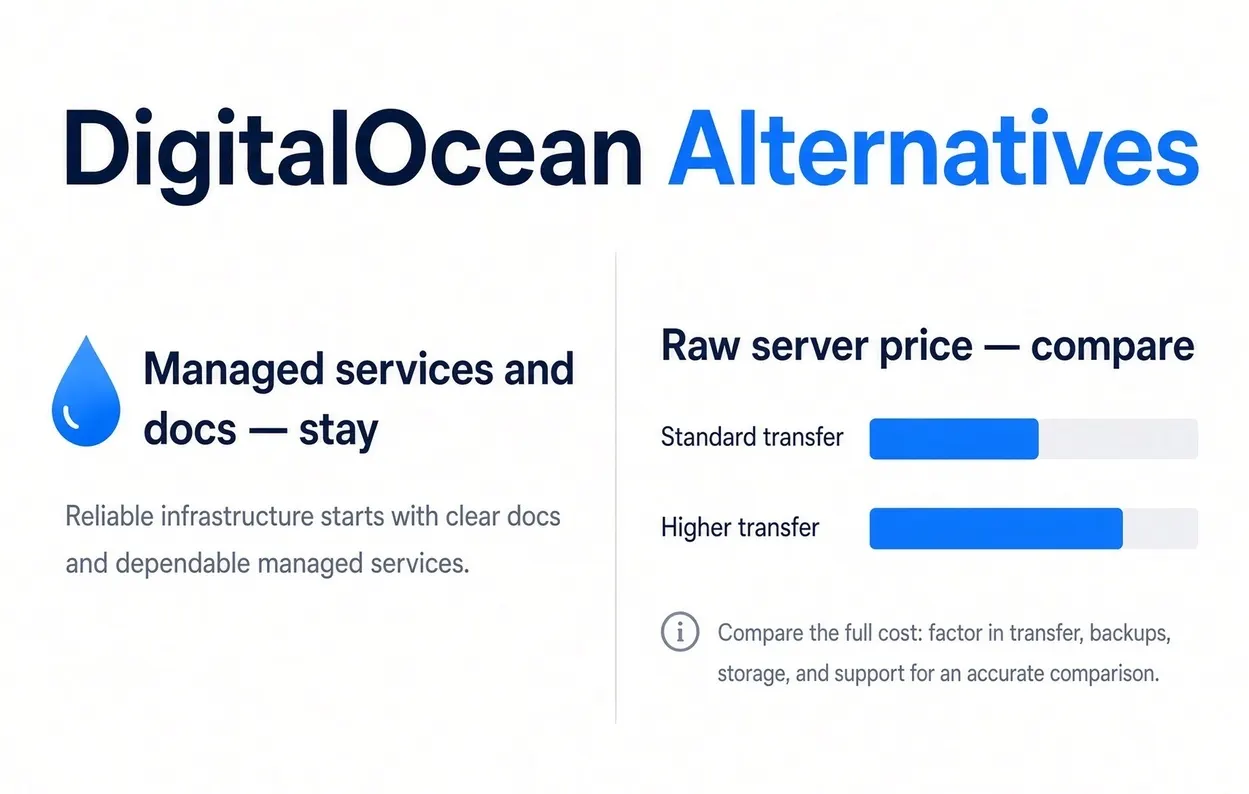
Most pages that rank for “DigitalOcean alternatives” treat the product as a cheap server price. That is the wrong comparison. DigitalOcean keeps people because the tutorials are clear, the panel is simple, and managed databases or App Platform sit on the same bill as the server. If you only need a basic Linux machine, cheaper options exist. If you already use those extras, switching is a bigger job than the monthly difference.
We earn commissions when you shop through the links below.
Prices and policies checked: October 2026. Live pages win if a number here conflicts. No performance numbers were invented for this page.
What people actually buy on DigitalOcean
A Droplet is just a Linux virtual machine. Basic plans start at $4 a month for 512 MiB of RAM and $6 for 1 GiB. Billing is per second with a monthly cap. Transfer is shared across your whole team. Going over costs $0.01 per GiB outbound. Inbound traffic is free. Weekly backups add 20 percent of the server price. Daily backups add 30 percent.
The things that make people stay are the extras around the server:
- Clear tutorials that a new team member can follow without constant help.
- App Platform, which deploys from Git so you do not manage the server yourself.
- Managed databases (PostgreSQL, MySQL, and others) that start around $15 a month and handle backups and failovers.
- Kubernetes with a free control plane on many setups.
- Spaces object storage and a clean API and command-line tool.
- A 99.99 percent uptime promise on the Droplets themselves, with credits if it is missed.
The panel and the docs are the real product for many teams. The server price is secondary when those pieces are in daily use.
When the server price is the only thing that matters
You need a steady Linux server. You do not open the tutorial library every week. You do not run App Platform or a managed database. Traffic stays under a few terabytes. In that case the premium is mostly the polished panel and the docs. Cheaper raw servers exist, and the gap is real once you add backups and transfer.
Match the job, then pick the alternative
Here is the practical routing. Stay when the extras are part of the daily work. Switch when the job is only the server.
| What you need | Stay on DigitalOcean if… | True alternative and why |
|---|---|---|
| Lowest bill for a steady European server | Docs or managed services are daily tools | Hetzner Cloud. The CX23-class plan (2 vCPU, 4 GB) is commonly €5.49–€5.99 excluding VAT with 20 TB outbound. Stock is often limited. |
| Same style of hourly billing plus a city DigitalOcean does not have | You already like the panel and API | Vultr. Closest match. Roughly 33 locations. A 1 GB plan is commonly around $5. |
| Included support or a lower overage rate | The free 24-hour ticket is enough | Akamai Cloud (Linode). Same simple-cloud shape. Nanode 1 GB is commonly $5. Overage is often listed lower. |
| Unmetered traffic or a wider catalog | You want one polished managed-services account | OVHcloud. VPS plans often list unmetered traffic in most regions. Broader set of products. |
| Odd server size that fixed plans do not offer | Fixed sizes cover you | Kamatera. Configurator starts around $4. You dial the exact RAM and CPU. |
| Low entry price with fair-use free outbound traffic | You need the deepest managed extras | UpCloud. Starter plans from around €3. Zero-cost egress under fair use. |
| App Platform style deploy-from-Git | Already running there | Render or Railway (different product). Migration is a project. |
| Managed database on the same bill | You use it | Stay. Moving it is larger than copying one server. |
The alternatives in plain detail
Hetzner Cloud is the lowest steady European bill when the cheap plan is in stock. The CX23-class server gives 2 shared CPUs, 4 GB of RAM, and 20 TB of outbound traffic. June 2026 price rises made it less dramatic than older claims, but it is still cheaper than DigitalOcean’s comparable plan for most EU workloads under a few terabytes. Take it for pure cost in Europe. Skip it if you need managed databases on the same account, many global cities, or the 99.99 percent per-server promise. Confirm stock on their site before you plan around it. Official page: https://www.hetzner.com/cloud
Vultr is the closest peer on hourly billing and the one with the most locations. A basic 1 GB server is commonly around $5 with roughly 1 TB of transfer. It offers compute, object storage, Kubernetes, and managed databases in a similar shape. Take it when you need a city DigitalOcean does not have or you want nearly the same model. Skip it if the tutorial library is the reason you chose DigitalOcean. Official page: https://www.vultr.com/pricing/
Akamai Cloud (still called Linode by many people) keeps the same simple cloud model. The Nanode 1 GB plan is commonly $5. Transfer is pooled. Overage is often listed around half of DigitalOcean’s rate in core regions. Support is frequently described as more included. Take it when response time or the overage rate is the pain and you will not buy a paid support tier. Skip it if you already depend on DigitalOcean’s managed databases or App Platform. Official page: https://www.linode.com/pricing/
OVHcloud is useful when traffic volume or a wider product set matters. A basic VPS often lists unmetered traffic in most regions (some Asia-Pacific locations have quotas). It also sells bare metal and public cloud under one European company. Take it for the catalog and the traffic model. Skip it if you want the simplest panel plus managed services in one place. Public Cloud pricing is changing in October 2026, so re-check the lines. Official page: https://www.ovhcloud.com/en/vps/
Kamatera is the configurator option. Fixed plans do not always fit. You can dial odd amounts of RAM and CPU. Entry configurations start around $4 for 1 vCPU, 1 GB, and 20 GB with 5 TB in many regions. Take it when you need a size that nobody else lists cleanly. Skip it for the densest tutorials or the most polished managed databases on the same bill. Official page: https://www.kamatera.com/
UpCloud offers a low entry and fair-use free outbound traffic. Starter plans begin around €3 for 1 GB. Higher tiers are known for strong disk performance. Take it for a cheap start and moderate traffic. Skip it if you need the widest map of cities or the deepest set of managed extras. Official page: https://upcloud.com/
Transfer and backups change the real bill
A 4 GB class server makes the difference concrete. DigitalOcean’s 4 GiB plan lists $24 a month with 4,000 GiB of transfer. Hetzner’s comparable plan lists roughly €5.49–€5.99 with 20 TB. Weekly backups on DigitalOcean add 20 percent. At 5 TB outbound the DigitalOcean overage adds real money. Hetzner’s 20 TB covers it. Vultr and Linode sit closer to DigitalOcean’s plan-based model. UpCloud’s fair-use policy and OVHcloud’s unmetered claim change the math for moderate traffic.
Pooled transfer helps when one server is quiet and another is busy. It does not turn 1 TB into 20 TB. Always add the backup line before you compare sticker prices.
Certifications in plain terms
DigitalOcean publishes a trust center. As of the October 2026 check it states it holds SOC 2 Type II and SOC 3 Type II reports, GDPR compliance with a data processing agreement, eligibility for HIPAA workloads, support for DORA, PCI DSS SAQ-A validation, Cloud Security Alliance STAR Level 1, and related privacy framework attestations. These cover the infrastructure layer. They do not automatically make your application compliant. Confirm the current reports in their Security Reports center if a regulated workload is the reason you stay. Other hosts publish their own attestations; compare the exact scope, not just the presence of a logo.
When you should stay
Stay when App Platform, a managed database, or heavy use of the tutorial library is part of the weekly work. Stay when you want the 99.99 percent Droplet promise on paper or when the AI and agent tools are already in production. Stay when the panel, API, and billing alerts already work and the premium is acceptable. Free tickets have a 24-hour target. Faster response sits on paid plans. If you need included human help without an extra line, check Linode’s current policy.
Also-rans
Contabo is the density option when RAM and disk per euro matter more than consistent CPU. Link the Contabo alternatives page; do not retell that trade here. Scaleway appears for European platform work. Render and Railway are closer to App Platform replacements. Big hyperscalers are a different shape. None of them is the default replacement for the server-plus-docs reader.
How to decide in one minute
Open your current bill. If managed services or daily tutorial use appear, stay. If the line is only servers and traffic is under a few terabytes in Europe, price Hetzner and check stock. If a required city is missing, open Vultr. If support or overage is the pain, check Linode. If you need an odd size, open Kamatera. If you want a low entry with fair-use traffic, check UpCloud. Write the three numbers and the backup percentage down. That sheet is more useful than any ranking.
Frequently asked questions
What is the best DigitalOcean alternative in 2026?
There is no single winner. Hetzner is usually the lowest bill for a steady European workload when the cheap plan is orderable. Vultr is the closest hourly and location match. Linode is the similar-shape option when support or overage matters. Stay on DigitalOcean if you use the managed services or the tutorial library.
Is Hetzner cheaper than DigitalOcean?
For a comparable European server with generous transfer, yes in most cases even after the June 2026 rises. Confirm both live pages and stock.
Does DigitalOcean charge for bandwidth?
Yes, beyond the pooled allowance. Overage is $0.01 per GiB outbound. Inbound is free.
Should I switch from DigitalOcean to Vultr?
Switch if you need a city DigitalOcean does not have or you want a nearly identical hourly model. Stay if the documentation and managed services are why you chose DigitalOcean.
Is DigitalOcean still good for simple apps?
Yes, if the simple panel and docs are worth the premium, or if you expect to add managed services later. For a pure raw server with low traffic, cheaper options exist.
Prices and policies checked: October 2026. Confirm the live pages before you order. Stock and regional pricing move.