
How to Build Business Credit in 2027 (Even With a Brand-New LLC)
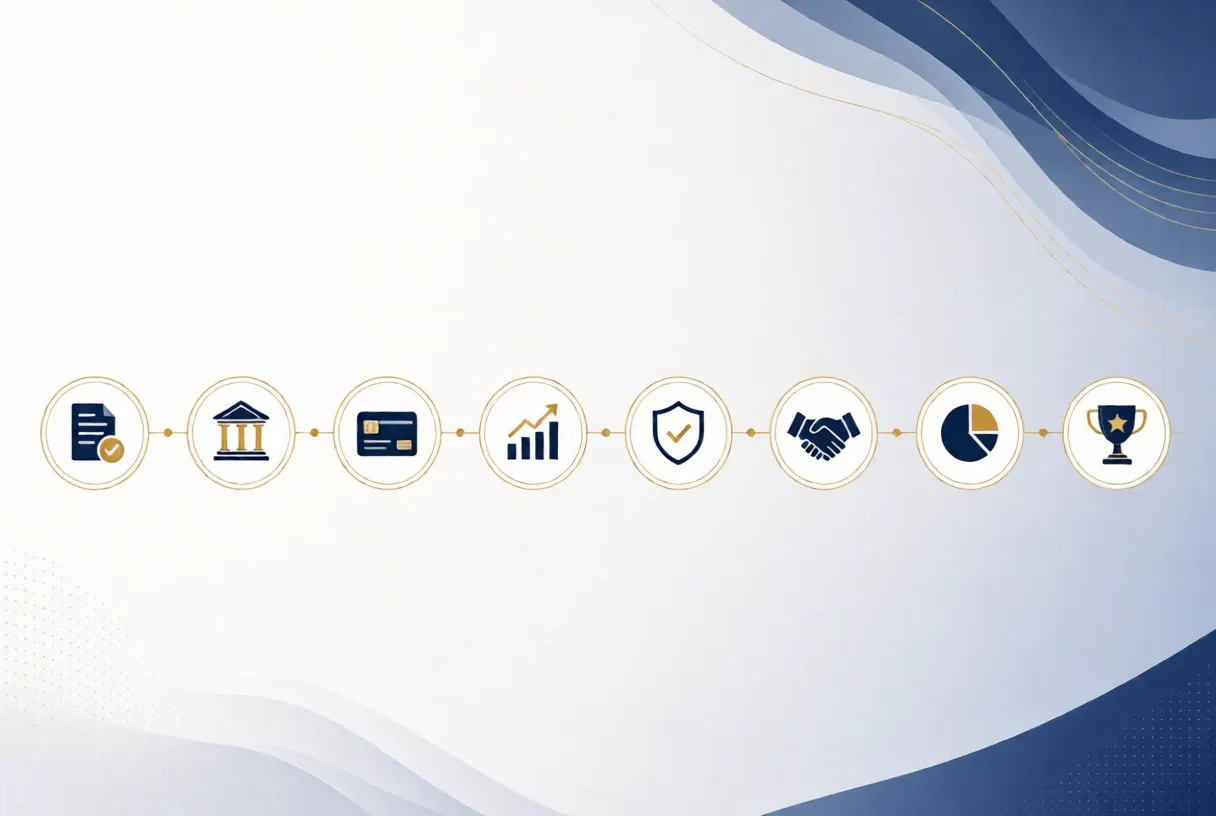
Quick Answer: Building business credit takes 8 deliberate steps: form a separate legal entity, get an EIN, claim your free D-U-N-S Number, open business bank accounts, keep business details identical everywhere, open reporting tradelines (vendors + a business credit card), pay on time or early, and monitor the file. Done in order, a new LLC can show real activity in 3–6 months and a usable profile in 6–12 months. The foundation is free.
Most owners start looking at business credit when a supplier asks for net-30 terms or a lender wants more than a personal guarantee. The process is straightforward, but the order matters. Skip a step or open the wrong accounts and months of activity never appear on any bureau file.
Useful starting resources:
How to Build Business Credit — 2027 Snapshot
8 steps. Free foundation. Realistic timeline.
| Step | Action | Cost |
|---|---|---|
| 1 | Form LLC or corporation | State fee |
| 2 | Get free EIN | Free |
| 3 | Claim free D-U-N-S Number | Free |
| 4 | Open business bank account | Low / free |
| 5 | Make details identical everywhere | Free |
| 6 | Open reporting tradelines + card | Varies |
| 7 | Pay on time or early | Free |
| 8 | Monitor and correct file | Free tier available |
Why Business Credit Is Worth Building
Business credit is your company’s own payment reputation, separate from your personal credit. When it exists and is healthy, it can support:
- Trade terms in the company’s name
- Lower reliance on personal guarantees over time
- Easier vendor and corporate buyer onboarding
It does not replace personal credit for young businesses. Lenders and many card issuers still review both. The earlier a clean business file exists, the sooner it can start working alongside (and eventually reduce dependence on) personal credit.
Related reading: Business Credit Score: What It Is, Ranges, How to Check Free & How to Build It
The 8 Steps (In Order)
Step 1 — Form a separate legal entity
An LLC or corporation creates the clearest separation. Sole proprietorships can build limited business credit in some cases, but the line between you and the business stays thin. Most suppliers, buyers, and lenders prefer a registered entity.
Useful links:
Step 2 — Get your EIN (free)
Your IRS Employer Identification Number is free and takes minutes at IRS.gov. Do not use a paid reseller. The EIN is the tax identifier most banks and bureaus expect.
Useful links:
- IRS: Get an Employer Identification Number (official free tool)
- SBA: Get federal and state tax ID numbers
- DUNS Number vs EIN vs UEI
Step 3 — Claim your free D-U-N-S Number
This is your company’s identifier in Dun & Bradstreet’s system. Most supplier and procurement checks start here. The free request is available at dnb.com. Standard processing is often up to 30 business days; D&B offers a paid expedited option if you have a hard deadline. Once you have the number, reporting vendors can attach trade experiences to your file.
Useful links:
- Dun & Bradstreet: Get a free D-U-N-S Number (official)
- How to Get a DUNS Number for Free
- How Long Does It Take to Get a DUNS Number?
- Is a DUNS Number Free?
- What Is a DUNS Number?
Step 4 — Open business bank accounts
A dedicated business checking account separates finances and creates the banking footprint lenders expect. Run business revenue and expenses through it. Commingling is one of the fastest ways to undermine both credit-building efforts and liability protection.
Useful links:
Step 5 — Make your business details identical everywhere
Use the exact same legal name, address, and phone number on formation documents, bank accounts, licenses, website, and any directory listings. Bureaus and buyers match records across databases. Small mismatches can split or hide your file.
Step 6 — Open reporting tradelines
This is the step that actually builds the file. Only accounts that report to business credit bureaus count.
- Net-30 (or similar) vendor accounts — Ask every vendor which bureaus they report to before you open the account. D&B typically needs at least three trade experiences from two or more vendors before it generates a PAYDEX score.
- A business credit card that reports to commercial bureaus — Many cards report to Experian, Equifax, or both. Some only report to personal bureaus. Confirm before you apply. Young companies often still need a personal guarantee. If personal credit is limited, a secured business card can be a starting point. Keep utilization low (commonly cited guidance is under ~30%).
Start with two or three solid reporting accounts rather than one. Then add more over time.
What to ask a vendor before opening a net-30 account
- Which business credit bureaus do you report to?
- How often do you report (monthly, quarterly)?
- Is there a minimum order or spend required before you report?
- Do you report positive payment history only, or also late payments?
- How long have you been reporting to that bureau?
Useful links:
- NerdWallet: How to Get and Build Business Credit
- NerdWallet: Business Credit Scores — What They Are
- PAYDEX Score: What a Good D&B Score Is — and How to Reach 80
- Business Credit Score: What It Is, Ranges, How to Check Free & How to Build It
Step 7 — Pay on time or early
Payment behavior is the largest factor. On PAYDEX, paying within terms generally supports a score around 80. Paying early is the most reliable way to push it higher. Set reminders or autopay so nothing slips. One large late invoice can move a dollar-weighted score more than several small on-time payments.
Useful links:
Step 8 — Monitor and correct the file
Check periodically. D&B Credit Insights Free shows PAYDEX risk ranges and change alerts. Aggregator free tiers (such as Nav) give multi-bureau summaries. Full detailed reports are usually paid. Dispute clear errors through each bureau’s process. Do this before a major supplier or financing application.
Useful links:
- SBA: Establish business credit
- Business Credit Score: What It Is, Ranges, How to Check Free & How to Build It
First 90 Days Action List
- Day 1–7: Form entity (if needed) + free EIN + request free D-U-N-S + open business bank account.
- Day 8–30: Confirm D-U-N-S is issued. Open 1–2 reporting vendor accounts and/or a reporting business credit card. Keep utilization low.
- Day 31–90: Make first payments on time or early. Run all business transactions through the business account. Confirm vendors will report.
- Ongoing: Payment reminders + quarterly file check.
Realistic Timeline
| Milestone | Typical Timing |
|---|---|
| Entity + EIN + D-U-N-S + bank account | Week 1 (+ D-U-N-S delivery) |
| First 2–3 reporting tradelines open | Month 1–2 |
| First trade experiences on file | Month 3–6 |
| Usable PAYDEX (~80 with early/on-time pay) | Month 6–12 |
| Stronger multi-vendor profile | Year 1–2 |
Anyone promising “80 PAYDEX in 90 days” is selling a shortcut that does not exist. The score is built from reported payment history, and history takes time.
Start With Your Free D-U-N-S Number
The practical first step for most new businesses.
Request Free D-U-N-S NumberCommon Mistakes That Waste Months
- Buying a shelf corporation or “aged company with credit” package (high fraud and rejection risk)
- Paying vendors who never report
- Commingling personal and business funds
- Treating a D-U-N-S Number as if it were already a credit score
- Paying for credit-building services before any reporting tradelines exist
- Assuming one bureau’s score represents all three
Frequently Asked Questions
How do I build business credit fast?
You cannot compress history, but you can remove delays. Get the D-U-N-S Number early, open reporting tradelines in the first one to two months, and pay early. Visible file activity usually starts in 3–6 months. A healthy PAYDEX range more often takes 6–12 months of consistent payment.
How do I build business credit with a new LLC?
Follow the same 8 steps. The LLC is the starting line, not a disadvantage. Newness is not a penalty; invisibility is.
Can I build business credit without a personal guarantee?
Vendor tradelines often start without one. Bank products and most business credit cards for young companies still commonly require a personal guarantee. Each year of strong business-only history improves the odds of no-guarantee terms later.
Do I need a D-U-N-S Number to build business credit?
For the Dun & Bradstreet side (where most supplier onboarding lives), yes. It is free and is the identifier your trade history attaches to. See Do You Still Need a DUNS Number in 2027?
How much does it cost to build business credit?
The foundation is free: EIN, D-U-N-S Number, and basic risk-range checks. Optional paid items (expedited D-U-N-S, full reports, monitoring subscriptions) are accelerators, not requirements. See Is a DUNS Number Free?
Does my LLC have its own credit score?
Yes. It is held in separate bureau files and is distinct from your personal credit. Lenders and buyers can review it independently, though many still also check personal credit on young businesses.
How long does it take to build business credit?
Visible activity: 3–6 months. A practical PAYDEX around 80: often 6–12 months of on-time or early payment. A stronger multi-vendor profile: 1–2 years. The clock starts once reporting accounts are open and active.
The Bottom Line
Business credit is built with consistent, ordinary actions: separate entity, free identifiers, real reporting tradelines, and on-time (or early) payment. Free tools cover the foundation. Paid accelerators only become useful after those reporting accounts exist. Start the sequence this month — the timeline above begins the day the file can receive trade experiences.
Verified 14 November 2026. Free-tier details, processing times, and reporting practices can change. Confirm on official IRS and bureau sites before acting. This is educational content, not financial, legal, or credit advice.