Business Credit Score: What It Is, Ranges, How to Check Free & How to Build It (2026)
Quick Answer: A business credit score shows how reliably your company pays its bills. In the United States the main files are held by Dun & Bradstreet (PAYDEX), Experian Business, and Equifax Business. There is no single combined score. You can check risk ranges free. A thin or blank file is normal until reporting tradelines exist.
Most business owners first encounter the idea of a business credit score when a supplier asks for net-30 terms or a lender wants to review the company file. What surprises many people is that the score is not one number. It lives in separate files at different bureaus, and each bureau weighs the data differently. Understanding this distinction early saves time later when you are preparing for financing or large supplier relationships.
Business Credit Score — 2026 Snapshot
US-focused models. Global D-U-N-S Number. Practical targets below.
| Score | Bureau | Range | Low-risk / good (US) |
|---|---|---|---|
| PAYDEX | Dun & Bradstreet | 1–100 | 80–100 |
| Intelliscore Plus | Experian | 1–100 (or 300–850 V3) | 76+ |
| Payment Index | Equifax | 0–100 | 90+ |
| Credit Risk Score | Equifax | 101–992 | Higher safer |
| FICO SBSS | FICO | 0–300 | Optional after Mar 2026 |
There Is No Single Business Credit Score
This is the foundation of the topic. In the United States, three primary bureaus maintain business credit files: Dun & Bradstreet, Experian Business, and Equifax Business. Each uses its own scoring models and data sources. A supplier checking Dun & Bradstreet sees a different picture than a bank pulling Experian or Equifax.
Which score matters depends on who is looking. Suppliers and buyers most often pull Dun & Bradstreet. Lenders frequently review Experian or Equifax (and sometimes all three). For a deeper look at the most widely discussed score, see our guide on the PAYDEX score. For a clear independent overview of how the three main bureaus work, NerdWallet’s guide to business credit scores is also useful.
The Main Scores, Explained Clearly
Dun & Bradstreet (D&B)
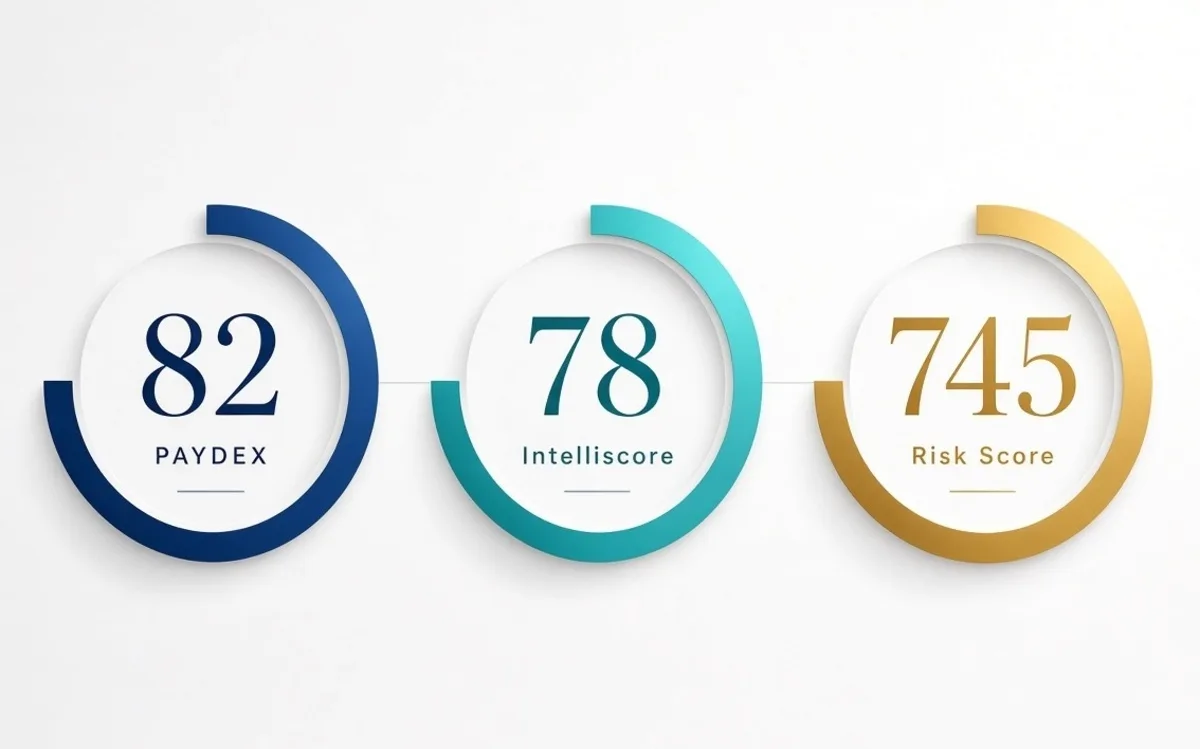
D&B is the bureau most suppliers and large buyers actually pull. Its flagship score is PAYDEX (1–100).
- 80 = generally pays within terms
- Above 80 = pays early
- Below 80 = pays late (the lower the number, the later)
PAYDEX is dollar-weighted, so one large late invoice moves it more than several small on-time payments.
D&B also publishes other ratings you may see on a full report:
- Delinquency Predictor (1–5 or percentile) — chance of severe late payment in the next 12 months
- Failure Score — likelihood of going out of business
- Supplier Evaluation Risk Rating (SER) (1–9) — risk a supplier will fail
- Maximum Credit Recommendation — suggested credit limit based on size, industry, and history
PAYDEX remains the score most people mean when they talk about a “D&B business credit score.”
Experian Business
Experian’s primary score is Intelliscore Plus.
- Classic version: 1–100 (higher is better; 76+ is generally considered low risk)
- Newer V3 versions: 300–850 (aligned with consumer-style scales)
It is a predictive model. It looks at payment history, public records, firmographics, and (in blended versions) owner information to estimate the chance of serious delinquency (90+ days past due or bankruptcy) in the next 12 months. Lenders, credit-card issuers, and many SBA lenders use it frequently. Experian also offers a Financial Stability Risk Rating (1–5) focused on longer-term default risk.
Equifax Business
Equifax does not rely on a single number. The scores you will most often encounter are:
- Payment Index (0–100) — focuses purely on payment behavior. 90+ generally means bills are paid on time.
- Credit Risk Score (101–992) — predicts the likelihood of serious delinquency. Higher is safer.
- Business Failure Score (typically 1000–1880 range) — estimates the chance the business will fail in the next 12 months.
- OneScore for Commercial — a newer AI-powered blended score that combines commercial and owner data for better coverage of smaller businesses.
Lenders and some larger vendors use these when evaluating commercial risk. Because Equifax uses multiple scores, always ask which specific score a lender or supplier is reviewing.
These three systems are the ones you will encounter most often. Other scores (including older blended models such as the former FICO SBSS) exist, but they are secondary for most small and mid-sized businesses.
What Is a Good Business Credit Score?
There is no universal “good” number. You compare each score only against its own scale. Higher is always better.
| Score | Bureau | Range | Low-risk / generally good |
|---|---|---|---|
| PAYDEX | Dun & Bradstreet | 1–100 | 80–100 (pays on time or early) |
| Intelliscore Plus | Experian | 1–100 (most common) | 76+ |
| Intelliscore Plus V3 | Experian | 300–850 | Higher is better |
| Payment Index | Equifax | 0–100 | 90+ |
| Credit Risk Score | Equifax | 101–992 | Higher is safer |
| FICO SBSS | FICO (blended) | 0–300 | Optional after March 2026 |
According to Dun & Bradstreet’s explanation of the PAYDEX score, a score of 80 means payments reported to D&B have generally been made within terms. Scores above 80 indicate earlier payments. Bankrate and Capital One both note that a PAYDEX of 80 or higher is generally viewed as low risk (Bankrate, Capital One). Experian and Equifax use different scales, so the same company can appear strong on one bureau and thin on another.
2026 SBA update: Effective 1 March 2026, the SBA discontinued use of the FICO SBSS score to screen 7(a) Small Loans ($350,000 or less). Lenders must now perform full commercial credit analysis. A debt service coverage ratio of at least 1.10x is a common requirement under the updated guidance. You can review the original notice on the SBA website. SBSS remains available for some lenders and other products, but it is no longer the automatic SBA gate.
Why Your Scores Differ Across Bureaus
Only a minority of vendors and creditors report to any given bureau. A supplier that reports to Dun & Bradstreet may never report to Experian or Equifax. Public records can also appear on one file and not another. Timing of updates varies.
PAYDEX is dollar-weighted. One large late invoice moves the score more than several small on-time payments. This is why the score can shift even when most of your payments look fine.
A blank or thin file is often treated as higher risk than a modest positive history. Checking all three files before a major financing or large supplier application is standard practice. If you are just starting, the first step is usually confirming you have a D-U-N-S Number.
| Source | What You Typically Get (Nov 2026) | Cost |
|---|---|---|
| Dun & Bradstreet Credit Insights | Risk range + basic PAYDEX band | Free |
| Nav (free tier) | D&B + Experian + Equifax ranges | Free |
| Experian Business | Limited score visibility | Paid for full |
| Equifax Business | Limited via resellers | Paid for full |
How to Check Your Business Credit Score for Free
Start free. Pay only when a real decision needs the exact number.
Always verify current pricing and exact free-tier limits on the provider’s site. Document submission and principal updates on Dun & Bradstreet can involve review delays. For a clear breakdown of what is free versus paid with D&B, see Is a DUNS Number free?. Nav’s free tier and D&B’s own free Credit Insights are two common starting points — Nav’s PAYDEX explainer offers additional practical detail on requirements and ranges.
Outside the United States?
The D-U-N-S Number is used in 30+ markets and is often required for government contracts, large corporate vendor lists, and some international banking relationships. Detailed scoring models such as PAYDEX, Intelliscore, and Equifax scores are strongest and most widely used inside the United States. Companies outside the US still benefit from a clean D-U-N-S file even when local credit systems are primary.
Global Relevance: Does This Apply Outside the United States?
The short, honest answer is: partially.
Dun & Bradstreet operates in more than 30 countries. The D-U-N-S Number is a globally recognized business identifier. Large corporations, governments, and some banks outside the United States regularly request a D-U-N-S Number when onboarding vendors or reviewing counterparties. In that sense, a clean D-U-N-S file can help companies in Europe, Asia, the Middle East, and elsewhere when they work with U.S. or multinational partners.
However, the detailed scoring models discussed here (PAYDEX, Intelliscore Plus, Equifax Credit Risk Score, etc.) are most widely used and most consistently updated inside the United States. Many countries rely on their own commercial credit systems or on local credit bureaus. Free-tier access and self-service monitoring tools are also strongest for U.S. businesses.
If your company is outside the United States:
- Obtaining a D-U-N-S Number is still useful if you sell to U.S. or global companies that use D&B.
- Do not assume a U.S.-style PAYDEX or Intelliscore will be the primary score local lenders or suppliers review.
- Confirm which bureau or local system your target customers and banks actually use.
Why Start With a D-U-N-S Number?
It is free, it is the unique identifier D&B uses, and most supplier and procurement checks begin with the D-U-N-S file. Getting it first gives you a place for trade experiences to land. You can still build Experian and Equifax files in parallel, but D-U-N-S is the practical starting point for the majority of small businesses.
Why Start With a D-U-N-S Number and then move to next two systems?
A D-U-N-S Number is free to obtain and is the unique nine-digit identifier Dun & Bradstreet uses for your business. Most supplier and procurement reviews begin with the D&B file. Once you have the number, reporting vendors can attach trade experiences to your file, which is what eventually produces a PAYDEX score.
You can (and should) also open accounts that report to Experian and Equifax. Starting with the D-U-N-S Number simply gives you the most widely requested business identifier first and creates a place for payment history to accumulate. See How long does it take to get a DUNS Number? and DUNS vs EIN for the practical differences.
How to Build and Improve Your Business Credit Score
- Obtain a free D-U-N-S Number and keep your business information accurate.
- Open accounts with vendors that report to at least one of the three bureaus (ask before you buy).
- Pay on time or early. Early payments are the fastest way to push PAYDEX above 80.
- Keep utilization reasonable on any business credit cards or lines that report.
- Monitor all three files periodically so you can correct errors before a major application.
- Separate personal and business finances where possible.
A thin file is normal in the first months. Consistent reporting tradelines matter more than the age of the company alone.
Common Mistakes
- Assuming one bureau’s score represents all three.
- Paying only personal cards and expecting business scores to rise.
- Waiting until you need financing to check the files.
- Blending ratings from different stores or bureaus.
- Ignoring small late invoices because “they are not material.”
Start free: Claim your D-U-N-S Number (global identifier, required for US PAYDEX).
Frequently Asked Questions
Is there one business credit score?
No. Dun & Bradstreet, Experian Business, and Equifax Business each maintain separate files and use different scoring models. There is no single combined number.
What is a good business credit score?
There is no universal number. On PAYDEX, 80+ is generally considered low risk. On Experian Intelliscore Plus (1–100 scale), 76+ is low risk. On Equifax scores, higher is better. Always compare a score only against its own scale.
What is a good PAYDEX score?
80 or higher is generally viewed as low risk by suppliers and many lenders. It means payments reported to Dun & Bradstreet have generally been made on time or early.
How do I check my business credit score for free?
Use D&B Credit Insights Free for PAYDEX risk ranges and alerts. Aggregator free tiers (such as Nav) show summarized multi-bureau views. Full numeric reports are usually paid. Availability can differ by country.
Can I check for free?
Yes. Risk ranges are available at no cost from D&B Credit Insights and Nav’s free tier. Exact numeric scores and full reports typically require a paid plan.
Does a business credit score affect my personal credit?
Not directly. Business and personal credit files are separate. However, many business cards and loans still require a personal guarantee, and late payments on those products can be reported to personal credit bureaus.
How long does it take to build a business credit score?
A score can appear after a few reporting tradelines exist. Meaningful strength usually takes several months of consistent on-time or early payments. Many owners see a usable PAYDEX within 60–90 days when they follow a deliberate reporting path.
Does an LLC have its own credit score?
Yes. It is separate from the owner’s personal score. A new entity starts with a thin or empty file and builds through reported trade activity.
Is this the same outside the United States?
The D-U-N-S Number is available and useful in most countries, especially for international trade and large buyers. The detailed scoring models, free tiers, and building tactics in this guide are primarily US-specific.
Who can see my business credit score?
Anyone who pays for the report — suppliers, buyers, lenders, and sometimes competitors. Business credit is less private than consumer credit.