Hostinger vs Bluehost 2026: Which Budget WordPress Host Is Better?
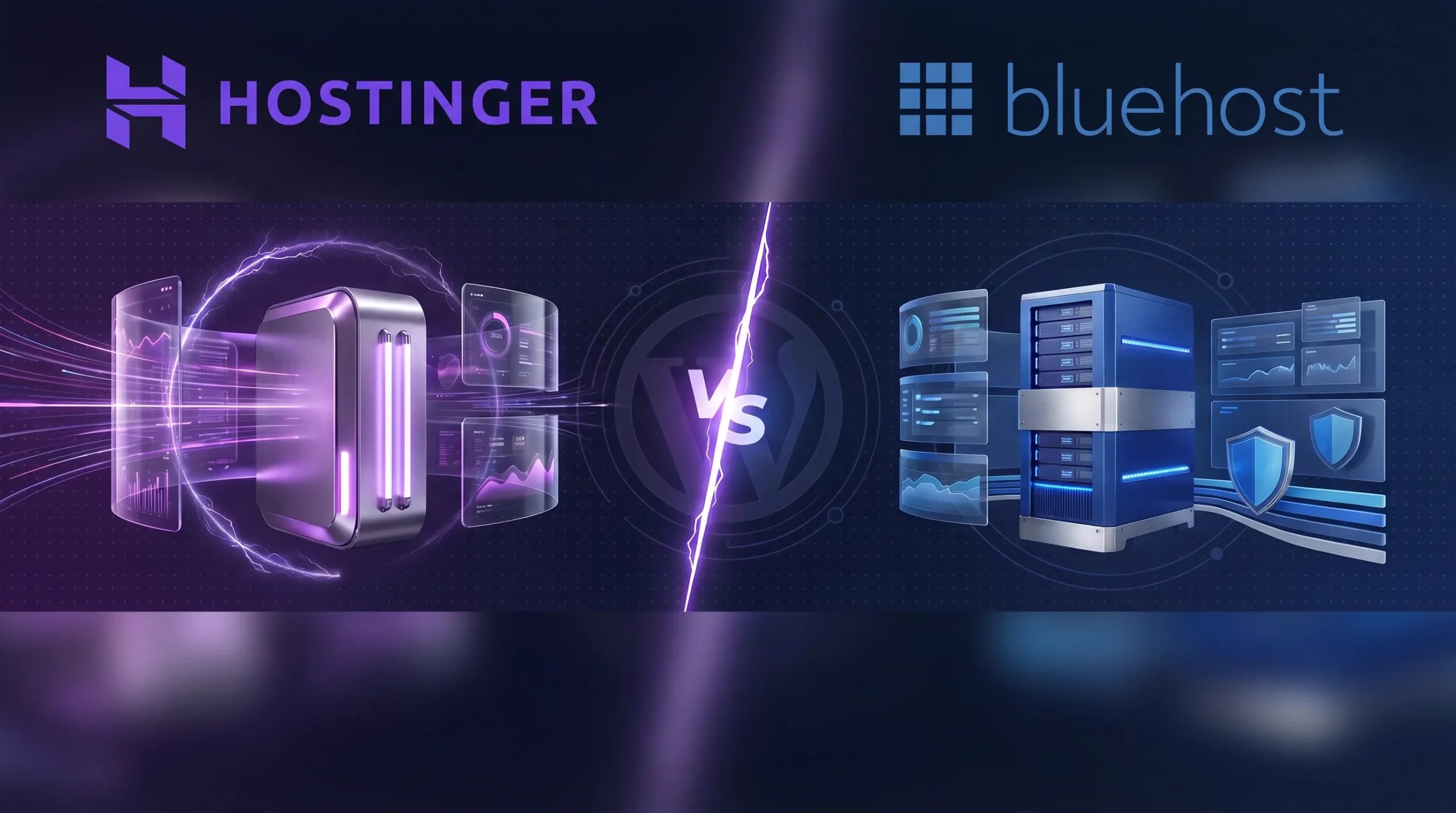
Choosing the right web host is one of the most critical decisions you will make for your online presence. If you are launching a new project, migrating an existing site, or simply looking to cut costs, you have almost certainly narrowed your choices down to two industry giants. The debate of Hostinger vs Bluehost is everywhere, dominating forums, YouTube reviews, and Facebook groups.
Both companies promise blazing-fast speeds, unshakeable reliability, and prices that seem almost too good to be true. However, the web hosting industry is notorious for aggressive marketing and affiliate-driven recommendations that often obscure the reality of long-term ownership. When you are searching for budget wordpress hosting, the initial price tag rarely tells the whole story.
In 2026, the landscape of cheap web hosting comparison has shifted. Server technologies have advanced, pricing models have become more complex, and the definition of “beginner-friendly” has evolved. You do not just need a host; you need a partner that aligns with your specific technical skills, budget constraints, and growth ambitions.
This comprehensive guide is designed to dismantle the marketing jargon and provide a radically honest look at both platforms. We will bypass the superficial feature lists and dive deep into the metrics that actually impact your day-to-day experience and your wallet. We will examine the stark reality of intro pricing vs renewal rates, dissect shared hosting performance under real-world stress, and explore the crucial differences between modern LiteSpeed hosting and traditional server stacks.
Whether you are an absolute beginner seeking a stress-free setup or a seasoned developer demanding maximum performance, this article will guide you through a clear, persona-based framework. By the end, you will know exactly which is better: Hostinger or Bluehost for your unique situation, ensuring you make a confident, data-backed decision without the regret of unexpected renewal shocks.
Hostinger vs Bluehost
Compare the full term, renewal math, shared hosting performance, support route, and plan limits before you click buy. The best host depends on the job—not just the teaser rate.
At-a-glance decision
Winner labels show fit, not a universal guarantee.
| Metric | Hostinger | Bluehost | Better fit |
|---|---|---|---|
| Starting price | $2.99/mo · 48 months | $3.99/mo · 36 months | Hostinger |
| Renewal shown | $10.99/mo on Premium | $9.99/mo on Starter | Bluehost on rate |
| Full entry checkout | $143.52 for 48 months | $143.64 for 36 months | Hostinger on term |
| Performance reality | LiteSpeed and cache-friendly stack | Conventional shared stack with caching | Hostinger edge |
| Control panel | hPanel · streamlined | Dashboard plus cPanel path | Context |
| First-year domain | Included on eligible term | Included on eligible term | Tie |
| Support channels | 24/7 chat-led support | 24/7 chat plus listed phone support | Bluehost |
| Entry backups | Weekly | Weekly | Tie · add your own |
| Overall fit | Best default for value-led WordPress | Best when phone/cPanel workflow matters | Persona dependent |
Pricing reality
A clearer view than the teaser-rate math.
- Years 1–4: $143.52 paid up front
- Year 5 at $10.99/mo: $131.88
- Intro checkout: $143.52
Assumes the listed renewal rate stays unchanged after the first term. Domain renewal, tax, and add-ons excluded.
- Years 1–3: $143.64 paid up front
- Years 4–5 at $9.99/mo: $239.76
- Intro checkout: $143.64
Assumes the listed renewal rate stays unchanged after the first term. Domain renewal, tax, and add-ons excluded.
Buyer profiles
Select a profile for the analytical recommendation.
Decision framework
Must-read insights
Start with the host that matches your workflow, not the headline that looks cheapest. Verify the live checkout, term length, taxes, and renewal rate before paying.
Affiliate disclosure: DiscoverVibe may earn a commission if you purchase through a link, at no extra cost to you. This dashboard is an editorial comparison, not a promise of uptime, support speed, or fixed future pricing. Public U.S. plan snapshot checked August 2026; tax, domain renewal, and optional add-ons are excluded unless stated.
Quick Overview of Both Hosts
Before diving into the granular details of performance and pricing, it is essential to understand the foundational philosophies of both Hostinger and Bluehost. While they both compete fiercely in the budget hosting space, their approaches to user experience, technology, and customer support are fundamentally different.
Hostinger: The Performance-Driven Disruptor
Hostinger, headquartered in Lithuania, has rapidly ascended the ranks by aggressively targeting the intersection of extreme affordability and modern server technology. They have positioned themselves as the go-to choice for users who prioritize speed and value above all else.
The cornerstone of Hostinger’s appeal in 2026 is their widespread adoption of LiteSpeed web servers across their shared hosting plans. This technology, combined with their proprietary hPanel control panel, offers a streamlined, highly optimized environment. hPanel was built from the ground up to replace the aging cPanel interface, providing a cleaner, more intuitive dashboard that feels remarkably modern. Hostinger appeals heavily to developers, budget-conscious bloggers, and small business owners who want maximum performance without the premium price tag.
Bluehost: The Established Industry Standard
Bluehost, owned by Newfold Digital and based in Utah, is one of the oldest and most recognized names in web hosting. Their reputation is built on stability, familiarity, and an incredibly strong partnership with WordPress. In fact, Bluehost is one of only three hosts officially recommended by WordPress.org, a status that carries immense weight for beginners.
Unlike Hostinger’s custom approach, Bluehost relies on the industry-standard cPanel, integrated into a customized, beginner-friendly onboarding dashboard. They utilize traditional Apache servers, focusing heavily on providing a reliable, standardized environment rather than chasing the absolute bleeding edge of server speed. Bluehost’s major advantage lies in its comprehensive support infrastructure, notably including telephone support—a rarity in the budget hosting tier. They are the safe, familiar choice for absolute beginners, traditionalists, and those who value the reassurance of a massive, established corporation.
Pricing Comparison 2026: The Intro vs Renewal Reality
When evaluating hostinger vs bluehost 2026, pricing is often the deciding factor. However, the budget hosting industry operates on a model of steep introductory discounts followed by significant renewal increases. Failing to account for these long-term costs is the most common mistake new website owners make.
To provide a truly honest comparison, we must look beyond the flashy “$2.99/month” banners and calculate the Total Cost of Ownership (TCO) over a three to five-year period. This long-term cost analysis reveals a surprising reality about which host is genuinely cheaper.
Hostinger Pricing Reality
Hostinger is famous for offering some of the lowest introductory prices on the market. Their entry-level shared hosting plan often starts around $2.99 per month. However, securing this rock-bottom rate requires a massive 48-month (four-year) upfront commitment.
The catch comes at renewal. Once that initial term expires, the price jumps significantly—often to $10.99 or $12.99 per month, depending on the specific plan and current promotions. This represents a nearly 400% increase.
Bluehost Pricing Reality
Bluehost’s introductory pricing is slightly higher, typically starting around $3.99 per month for their basic plan. They usually require a 36-month (three-year) commitment to lock in this rate.
While Bluehost also employs the intro/renewal pricing model, their renewal jump is generally less severe than Hostinger’s. A plan that starts at $3.99 might renew at $9.99 or $10.99 per month. This is roughly a 250% increase.
The TCO Breakdown (5-Year Projection)
Let us examine a hypothetical 5-year Total Cost of Ownership for their cheapest respective plans.
Hostinger (48-month intro at $2.99, renewing at $10.99):
- Years 1-4 (Paid upfront): $143.52
- Year 5 (Renewal rate): $131.88
- Total 5-Year Cost: ~$275.40
Bluehost (36-month intro at $3.99, renewing at $9.99):
- Years 1-3 (Paid upfront): $143.64
- Years 4-5 (Renewal rate): $239.76
- Total 5-Year Cost: ~$383.40
The Verdict on Pricing: If your primary goal is to minimize cash outlay for the first few years of a new project, Hostinger is the clear winner. However, if you are building a long-term business asset and want to avoid massive percentage increases upon renewal, Bluehost offers a slightly more stable, albeit initially more expensive, pricing trajectory.
Features Head-to-Head Comparison Table
Beyond pricing, the value of a hosting plan is determined by the features included. Both providers offer the essentials—free SSL certificates, one-click WordPress installations, and unmetered bandwidth. However, looking closely at the specific allocations reveals distinct advantages for different use cases.
| Feature | Hostinger (Premium Shared) | Bluehost (Choice Plus) | Winner & Why |
|---|---|---|---|
| Storage | 100 GB NVMe SSD | 40 GB SSD | Hostinger: Significantly more storage, utilizing faster NVMe technology. |
| Websites Allowed | 100 Websites | 3 Websites | Hostinger: Unbeatable for users managing multiple small projects or client sites. |
| Free Domain | Yes (1st Year) | Yes (1st Year) | Tie: Standard industry offering. |
| Control Panel | hPanel (Custom) | cPanel | Contextual: hPanel is faster and modern; cPanel is the familiar industry standard. |
| Backups | Weekly (Free) / Daily (Paid upgrade on lower tiers) | Daily (Included on Choice Plus) | Bluehost: Daily automated backups are crucial for peace of mind and are included in their mid-tier plans. |
| Server Tech | LiteSpeed | Apache | Hostinger: LiteSpeed offers superior caching and performance for WordPress out of the box. |
| CDN Integration | QUIC.cloud (Native) | Cloudflare (Basic) | Hostinger: QUIC.cloud integrates seamlessly with LiteSpeed for superior global delivery. |
Feature Summary: Hostinger generally provides more raw resources and superior server technology at lower price points. Bluehost focuses on stability, offering daily backups on their mid-tier plans and the familiarity of cPanel. For pure feature value, especially for hosting multiple sites, Hostinger holds a distinct edge in 2026.
Performance & Speed Reality
In the realm of SEO and user experience, speed is paramount. A slow website frustrates visitors, increases bounce rates, and negatively impacts Google rankings. When comparing hostinger or bluehost, performance is where the technological differences become glaringly obvious.
The Technology Stack: LiteSpeed vs Apache
The most significant differentiator in 2026 is the underlying server technology. Hostinger utilizes LiteSpeed Web Server, a modern, highly efficient alternative to the traditional Apache servers used by Bluehost.
LiteSpeed is specifically engineered to handle concurrent connections more efficiently, meaning your site is less likely to slow down during traffic spikes. Furthermore, Hostinger includes the LiteSpeed Cache plugin for WordPress for free. This server-level caching solution is widely considered one of the best in the industry, dramatically reducing Time to First Byte (TTFB) and overall page load times without requiring complex configuration.
Bluehost relies on the older, robust Apache architecture. While Apache is incredibly stable and powers a massive portion of the internet, it generally requires more aggressive third-party caching plugins (like WP Rocket) to achieve the same speeds that LiteSpeed delivers natively.
Real-World Benchmarks
Independent testing consistently highlights Hostinger’s speed advantage. In standard synthetic benchmarks, Hostinger page load times frequently average between 1.2s and 1.5s for a standard WordPress installation, often securing an A+ performance grade on tools like GTmetrix or Pingdom. Bluehost page load times generally average between 1.5s and 2.0s. While perfectly acceptable and often receiving a solid ‘A’ or ‘B’ grade, they consistently lag slightly behind Hostinger’s LiteSpeed-powered results.
Uptime Reliability
Both hosts guarantee 99.9% uptime, which is the industry standard. In rigorous monitoring, both generally deliver on this promise, keeping sites online the vast majority of the time. However, some independent stress tests have shown that Hostinger’s LiteSpeed servers handle sudden traffic surges with less degradation in response time compared to Bluehost’s shared Apache environment.
The Performance Verdict: Hostinger is the undisputed winner in raw performance. If page speed, core web vitals, and handling traffic spikes are your primary concerns, Hostinger’s LiteSpeed architecture provides a significant advantage over Bluehost’s traditional setup.
Who Should Choose Hostinger?
Hostinger is not just a cheap option; in 2026, it is a technologically advanced platform disguised as budget hosting. It is the ideal choice for users who prioritize speed, resource allocation, and modern interfaces over traditional legacy systems.
Best Use Cases for Hostinger
Hostinger excels for performance-focused bloggers seeking SEO advantages, freelancers managing multiple client sites (up to 100 websites on their Business plan), and developers who appreciate modern tech stacks and SSH access. The LiteSpeed servers and native caching provide measurable speed advantages that help pass Google’s Core Web Vitals assessments.
Choose Hostinger when: You want the absolute best performance for your dollar, you need to host multiple websites affordably, and you are comfortable using a modern, proprietary control panel rather than traditional cPanel.
Who Should Choose Bluehost?
Despite Hostinger’s technological edge, Bluehost remains a dominant force for very specific, valid reasons. They offer a safety net of familiarity, official endorsements, and support channels that many users find invaluable.
Best Use Cases for Bluehost
Bluehost excels for absolute beginners seeking hand-held onboarding and WordPress.org’s official endorsement. Users who demand 24/7 phone support will find Bluehost indispensable—Hostinger offers only chat and email. Traditionalists comfortable with cPanel will appreciate Bluehost’s industry-standard interface. For long-term budget planning, Bluehost’s renewal prices (roughly 2.5x intro) are more predictable than Hostinger’s steeper 3.7x jumps.
Choose Bluehost when: You are a complete novice seeking the safety of an official WordPress recommendation, you absolutely require telephone support, or you demand the familiarity of an industry-standard cPanel environment.
Pros & Cons Summary
To distill the comparison, here is a clear look at the strengths and weaknesses of each platform.
Hostinger
Pros:
- Blazing Fast: LiteSpeed servers and NVMe storage offer superior performance.
- Incredible Intro Value: Extremely low prices for the first term.
- Resource Heavy: Generous website and storage limits on mid-tier plans.
- Modern Interface: hPanel is clean, fast, and intuitive.
- Free Caching: The LiteSpeed Cache plugin is industry-leading.
Cons:
- Steep Renewals: Prices jump significantly after the initial term.
- Long Commitments: Requires a 48-month sign-up to get the lowest advertised price.
- No Phone Support: Customer service is limited to chat and tickets.
Bluehost
Pros:
- WordPress Official: One of only three hosts recommended by WordPress.org.
- Phone Support: 24/7 telephone assistance is available.
- Beginner Friendly: Excellent onboarding and guided setup.
- Familiarity: Uses the industry-standard cPanel.
- Predictable Renewals: Renewal price increases are generally less severe than competitors.
Cons:
- Slower Tech Stack: Traditional Apache servers cannot match LiteSpeed’s raw performance.
- Strict Limits: Lower storage and website limits on entry-level plans compared to Hostinger.
- Aggressive Upselling: The checkout process is cluttered with unnecessary add-ons.
Final Verdict + Recommendation Framework
The debate of hostinger vs bluehost 2026 does not result in a single, universal winner. The “best” host depends entirely on your specific priorities, technical comfort level, and long-term financial strategy.
If we must declare an overall winner based purely on technology, speed, and raw resource value, Hostinger takes the crown in 2026. Their adoption of LiteSpeed servers provides a tangible performance benefit that Bluehost’s traditional Apache setup struggles to match without expensive third-party optimization. For bloggers, developers, and small businesses looking to maximize their initial budget, Hostinger is the superior technical platform.
However, technology isn’t everything. Bluehost remains the premier choice for absolute beginners and traditionalists. If you value the reassurance of an official WordPress.org recommendation, demand the ability to call support on the phone, and prefer the familiarity of cPanel, Bluehost provides a safe, stable, and proven environment.
Your Decision Framework:
- Choose HOSTINGER if: You want the fastest possible load times, you plan to host multiple websites, you are comfortable with live-chat support, and you want to minimize your expenses for the next four years.
- Choose BLUEHOST if: This is your very first website, you want the safety net of 24/7 telephone support, you prefer predictable renewal pricing, and you want a platform officially endorsed by WordPress.
Both companies offer a standard 30-day money-back guarantee. If you are still on the fence, you can test either platform risk-free. Determine your primary priority—raw speed or supported simplicity—and make your choice with confidence.
FAQs
1. Is Hostinger actually faster than Bluehost?
Yes. Hostinger’s LiteSpeed servers and NVMe storage process requests more efficiently than Bluehost’s traditional Apache setup.
2. Why is Bluehost recommended by WordPress but Hostinger isn’t?
Bluehost maintains a long-standing partnership with WordPress.org. Hostinger is fully optimized for WordPress but lacks this official endorsement.
3. Can I migrate between hosts?
Yes. Both offer free migration tools. Hostinger’s is highly automated; Bluehost also assists, though complex sites may need paid services.
4. Do both offer a free domain?
Yes, for the first year. Hostinger includes it on mid-tier+ plans; Bluehost includes it on all plans.
5. What’s the difference between cPanel and hPanel?
cPanel (Bluehost) is the industry standard but feels cluttered. hPanel (Hostinger) is modern, faster, and more user-friendly.
6. Are there hidden fees with either host?
The most significant “hidden” cost with both hosts is the renewal pricing, which is substantially higher than the introductory rates. Additionally, Bluehost is known for aggressively pushing paid add-ons (like advanced security or SEO tools) during the checkout process, which you must manually uncheck if you do not want them.
7. Which host is better for WooCommerce?
Bluehost’s WooCommerce-specific plans include daily backups and premium extensions, making them ideal for eCommerce startups. Hostinger’s superior speed benefits conversions, but ensure you select their Business plan for daily backups.
8. How do I cancel?
Both offer 30-day money-back guarantees. Cancel via billing dashboards or contact support for refunds (domain registrations are non-refundable).