
Business Credit Score in India: CMR Rank, Company Credit Reports, and How to Check Yours (2026)
Most business owners searching for their business credit score in India discover there isn’t one such credit score. Must be remembered that there are four RBI-licensed bureaus — TransUnion CIBIL, CRIF High Mark, Experian, and Equifax — each issue a separate Company Credit Report. Dun & Bradstreet India adds its own D&B Rating, while most MSME lenders also review the promoter’s personal CIBIL score.
This creates common mix-ups: treating the personal score as the business score, confusing the CMR’s 1–10 rank with the 300–900 consumer scale, or checking only after a loan rejection. Company Credit Reports are paid; the free annual report rule applies only to individuals. The practical starting point is the free D-U-N-S Number plus a clear view of what the CMR and D&B Rating actually measure.
This guide covers the exact ranks and reports used in India, what “good” looks like, how to check them, and the habits that improve a CIBIL MSME Rank.
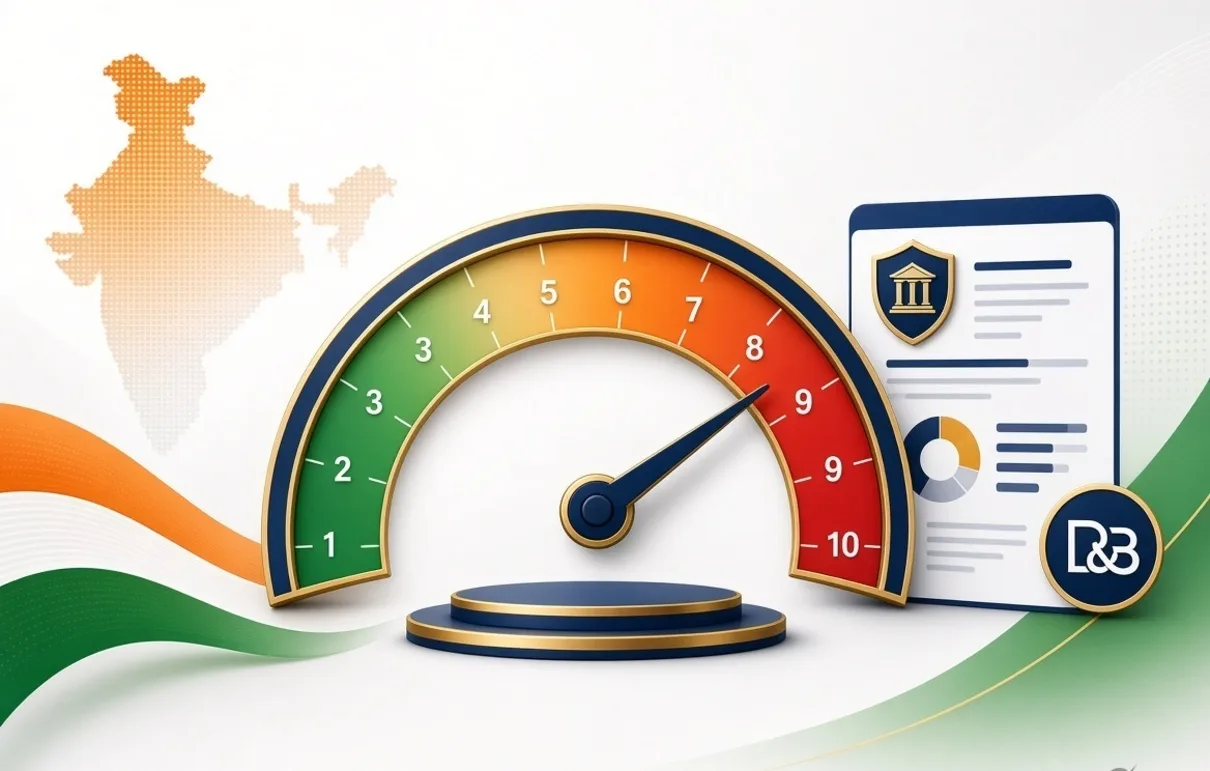
India has no single business credit score. The four RBI-licensed bureaus each issue a Company Credit Report. TransUnion CIBIL’s report includes the CIBIL MSME Rank (CMR) — a 1–10 scale where CMR-1 is lowest risk. Dun & Bradstreet India assigns a separate D&B Rating (1–4). Company reports are paid; the free annual report applies only to individuals. Most owners start with the free D-U-N-S Number and their personal CIBIL report.
There Is No Single Business Credit Score in India
Four licensed bureaus hold four different commercial files, each with its own model. Your MSME lender, your multinational buyer, and your export counterparty may each look at a different one.
| Bureau | Business product | What it shows | Where it matters most |
|---|---|---|---|
| TransUnion CIBIL | Company Credit Report + CIBIL MSME Rank (CMR, 1–10) | Loan repayment behavior, utilization, defaults; CMR-1 = lowest risk | MSME and business-loan decisions |
| CRIF High Mark | Commercial credit report | Full-service bureau — MSME, microfinance, and commercial borrower data | MSME and micro-lending |
| Experian India | Commercial credit report | Business borrowing and repayment history | Lending decisions |
| Equifax India | Commercial credit report | Business credit information | Lending decisions |
| Dun & Bradstreet India | D&B Rating (Composite Credit Appraisal 1–4) | Overall creditworthiness: payment history, financials, public records, years in operation | Global buyers, supplier onboarding, exports |
For a clear independent overview of how the four Indian bureaus compare, Paisabazaar’s bureau guide is useful.
On the D&B file you will also see the same global scores used worldwide: PAYDEX (0–100, payment behavior), the Delinquency Predictor, the Failure Score, and the Supplier Evaluation Risk (SER) Rating. See How PAYDEX works.
Two India-specific points:
- Lenders routinely read the promoter’s personal CIBIL score alongside the company’s CMR. In practice, personal and business credit are judged together far more often than the clean “separate files” framing used in the US.
- The DUNS number is the entry ticket to the global file. Without it, global buyers checking D&B data find nothing. See How to get a DUNS number and What is a DUNS number.
India Business Credit — 2026 Snapshot
CMR 1–4 = good · D&B Composite Appraisal 1 = best · Personal CIBIL 750+ helps
| Rank / Rating | Bureau | Scale | Good (India) |
|---|---|---|---|
| CIBIL MSME Rank (CMR) | TransUnion CIBIL | 1–10 | CMR 1–4 |
| D&B Rating | Dun & Bradstreet India | 1–4 | 1–2 |
| Company Credit Report | CRIF / Experian / Equifax | Bureau-specific | Clean history |
| Personal CIBIL | TransUnion CIBIL | 300–900 | 750+ |
What the CIBIL MSME Rank (CMR) Actually Is
TransUnion CIBIL introduced the CMR in April 2020 for entities with aggregate commercial exposure up to ₹50 crore. It estimates the probability of the business becoming an NPA within 12 months.
- Scale: CMR-1 (lowest risk) to CMR-10 (highest risk). It is a rank, not a 300–900 score.
- What “good” means: CMR 1–4 is generally considered good. Most lenders prefer this range, though exact cut-offs vary.
- Where it appears: on your Company Credit Report, refreshed when lenders report new data (typically monthly).
- If it shows “NA”: the business is outside the eligible exposure range or has too little history. This is not a negative mark.
How to Check Your Business Credit in India
- Your DUNS file (D&B India) — the number is free. Request it on dnb.co.in. Full scores and ratings on your own file are paid. See Is a DUNS number free?.
- Your personal CIBIL report — free once a year. Under RBI rules each of the four bureaus must give individuals one free full credit report per calendar year. Check at cibil.com.
- Your Company Credit Report — paid. Order the CCR from TransUnion CIBIL (and CRIF/Experian/Equifax for their files). Current commercial report plans from CIBIL typically start in the ₹3,000 range for a short-term view. Confirm exact pricing on each bureau’s site before ordering.
- Through your lender. Banks pull the CCR and CMR when you apply. Ask for the details if an application is rejected.
Beware of agents. D&B India is the sole authorized entity for DUNS registration in India. Anyone charging you to “register” your DUNS or guarantee a CIBIL rank is selling paperwork you can do yourself.
What a Good Business Credit Score Is (India)
- CIBIL MSME Rank: CMR 1–4 = good; CMR 7–10 = high risk.
- D&B Rating: Composite Credit Appraisal of 1 is most creditworthy; 4 is the bottom of the standard scale. A “2” is often the highest possible if you have not supplied current financial statements.
- Personal CIBIL score (read alongside): 300–900 scale; 750+ is the conventional good bar for promoters.
What Affects Your CMR
Does: repayment behavior on business loans, credit utilization on working-capital limits (keep well under the limit; many cite under ~75%), fresh loan enquiries, defaults/overdues, and the promoter’s personal repayment record.
Doesn’t (directly): GST filings, income-tax returns, or turnover on their own. Bureaus score what lenders report. Thin bureau history (never borrowed formally) usually means no CMR at all.
How to Improve Your CMR
- Pay every business EMI on or before the due date.
- Keep utilization low on working-capital limits (OD/CC).
- Avoid clustered loan enquiries.
- Fix errors on your CCR — file a dispute with the bureau.
- Build the global D&B file in parallel (DUNS number + consistent details + trade references). See How to build business credit.
Common Mistakes (India Edition)
- Treating the personal CIBIL score as the business score.
- Confusing CMR (1–10, lower better) with the 300–900 personal score scale.
- Maxing out working-capital limits right before applying for a loan.
- Paying a “DUNS registration agent.”
- Assuming US score ranges (PAYDEX 80, etc.) are what an Indian lender sees.
- Ignoring the Company Credit Report until a loan is rejected.
FAQ
What is a business credit score in India?
There is no single business credit score in India. Businesses receive a Company Credit Report from each of the four RBI-licensed credit information companies (TransUnion CIBIL, CRIF High Mark, Experian, and Equifax). TransUnion CIBIL’s report includes the CIBIL MSME Rank (CMR) on a 1–10 scale. Dun & Bradstreet India assigns a separate D&B Rating (Composite Credit Appraisal 1–4).
How do I check my company’s CIBIL rank (CMR)?
Order the Company Credit Report from TransUnion CIBIL on cibil.com. The CIBIL MSME Rank appears on the report. Company reports are paid; the free annual credit report applies only to individuals.
What is a good CIBIL MSME Rank?
CMR 1–4 is generally considered good, with CMR-1 being the lowest risk. Most lenders prefer this range, although each lender sets its own cut-off.
Is the CIBIL MSME Rank the same as the personal CIBIL score?
No. The personal CIBIL score runs from 300 to 900 for individuals (higher is better). The CIBIL MSME Rank is a 1–10 rank for businesses (lower number is better). Lenders frequently review both when assessing MSME loans.
Can I check my business credit report for free in India?
The RBI free-annual-report rule covers individuals, not companies. Free options for businesses are limited to obtaining your free D-U-N-S Number (which creates the D&B file) and any summary views a bureau shows before payment. Full Company Credit Reports are paid.
Do I need a DUNS number in India?
Not legally. However, global buyers, supplier onboarding portals, and Apple/Google organization developer accounts use the D-U-N-S Number to find and verify your business. It is free from Dun & Bradstreet India (dnb.co.in).
Who can see my company’s credit report?
Lenders you apply to can pull it, and anyone else who purchases the Company Credit Report (buyers, suppliers, partners) can also see it. Business credit information is less private than consumer credit.
How often does the CIBIL MSME Rank update?
Whenever lenders report fresh data to TransUnion CIBIL — typically monthly.
Do GST filings or turnover affect my business credit score?
Not directly. Credit bureaus score what lenders report (repayment history, utilization, defaults), not your tax filings or turnover. A thin bureau file (no formal borrowing history) usually means no CMR at all.
How long does it take to build a CIBIL MSME Rank?
Once your business has reported borrowing history — typically a few months of consistent lender reporting — a rank can appear. There is no instant path; well-serviced, reported credit is what builds it.
What is the D&B Rating in India?
Dun & Bradstreet India’s D&B Rating includes a Composite Credit Appraisal on a 1–4 scale (1 is most creditworthy). It is used mainly by global buyers, suppliers, and export counterparties rather than by most Indian MSME lenders.
Does my personal CIBIL score affect my business loan?
Yes, in practice. Indian MSME lenders routinely review the promoters’ personal CIBIL scores alongside the company’s CIBIL MSME Rank. A strong personal score (commonly 750+) helps, especially for younger businesses.
The Bottom Line
India’s business-credit picture is a rank (CMR) plus a global D&B file that export buyers read. Check the free pieces first — your DUNS number and your annual personal CIBIL report — then buy the Company Credit Report when a real loan decision is coming, and fix what it shows before the lender sees it.
Verified November 2026. Bureau products, eligibility thresholds, and pricing can change. Confirm current details on official bureau and dnb.co.in sites before acting. This is educational content, not financial or legal advice.


