
Scala Hosting vs Hostinger (2026): Which Is Better?
If you are searching for the best web host, the debate of Scala Hosting vs Hostinger is likely one of the most common crossroads you will encounter. Hostinger is globally recognized for its incredibly low introductory prices and sleek custom interface, making it a favorite among beginners. On the other hand, Scala Hosting has built a strong reputation for offering powerful, managed cloud VPS solutions that promise enterprise-level performance without the enterprise price tag.
The short answer is this: if you are launching your very first site on a tight budget and want the simplest possible onboarding experience, Hostinger is the better choice. However, if you are running a business, anticipate high traffic, or want guaranteed server resources without having to manage the backend yourself, Scala Hosting is the superior alternative.
In this comprehensive 2026 comparison, we will dive deep into the true cost of ownership, the SPanel vs hPanel user experience, resource limits, and the stark differences in support quality to help you make the right decision for your specific needs.

The ultimate battle for your website’s infrastructure: Managed VPS power versus budget-friendly simplicity.
Side-by-Side Comparison Table
Before we break down the nuances, here is a quick look at how these two providers stack up against each other across the most critical metrics.
| Feature | Scala Hosting | Hostinger |
|---|---|---|
| Best For | SMBs, Developers, Growing Businesses | Beginners, Students, Low-Budget Startups |
| Starting Price (Promo) | $2.95/mo (Shared) / $14.98/mo (VPS) | $2.69/mo (Shared) / $4.99/mo (VPS) |
| Renewal Price | ~$14.95/mo (Shared) / ~$24.95/mo (VPS) | ~$10.99/mo (Shared) / ~$19.49/mo (VPS) |
| Core Technology | True Managed Cloud VPS & Shared | Shared, Cloud, & Unmanaged VPS |
| Control Panel | SPanel (cPanel alternative) | hPanel (Custom UI) |
| Databases / Inodes | Unlimited | Capped (e.g., 150 DBs, 600k Inodes) |
| Customer Support | 24/7 Direct Human Experts | 24/7 AI Chatbot + Ticketing |
| Free Migration | Manual, Expert-Handled | Automated Self-Service Tool |
Pricing & True Cost of Ownership
When evaluating web hosting, looking only at the promotional price is a common trap. To understand the true value, we must look at the renewal rates and what you actually get for your money.
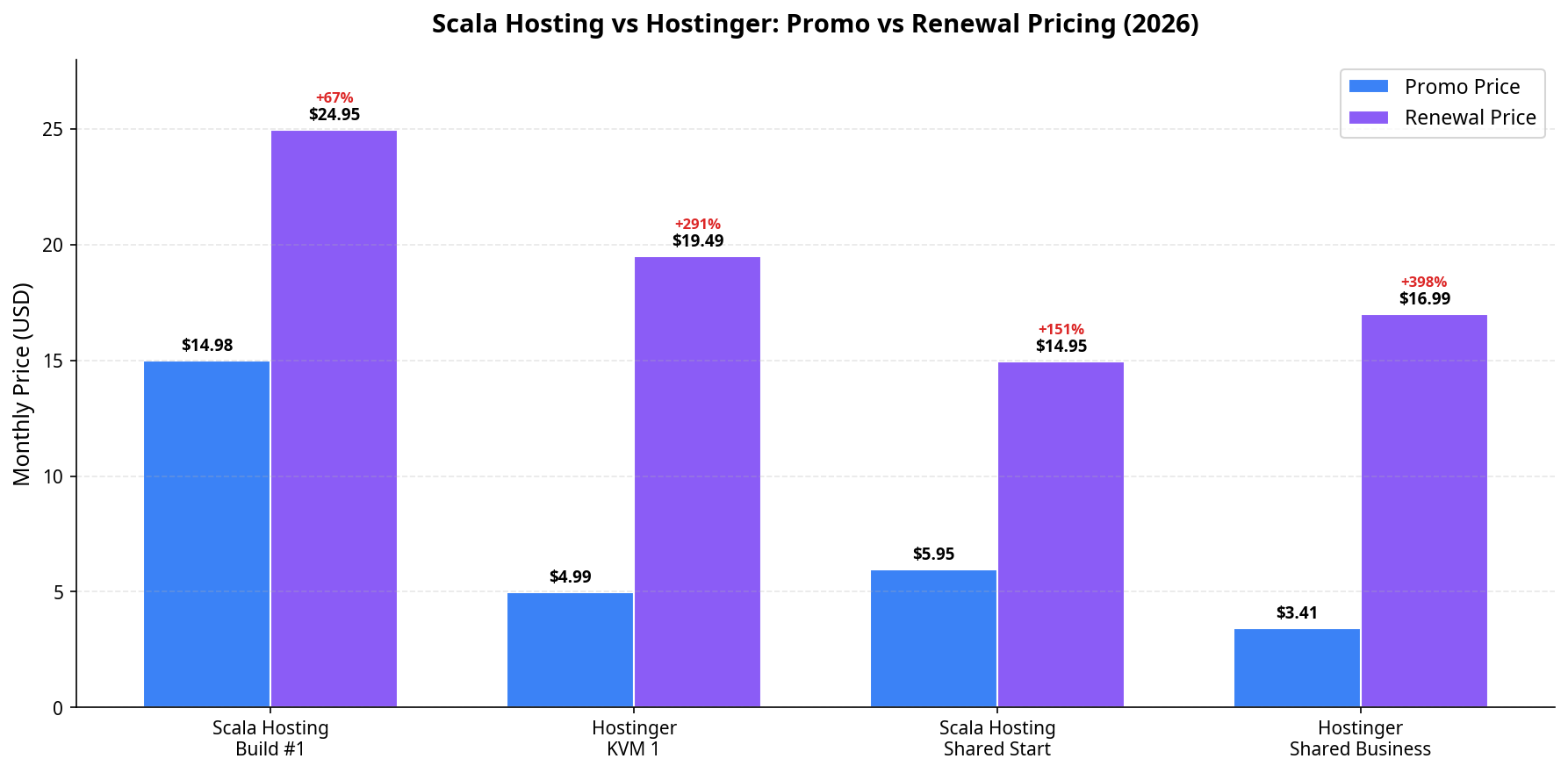
The hidden cost of hosting: Notice the significant markup between introductory promo rates and standard renewal prices.
Hostinger is notoriously aggressive with its initial pricing. You can get their entry-level Premium shared hosting for as low as $2.69 per month if you lock in a 48-month term. However, this plan caps you at 100 websites and 20GB of SSD storage. When the promotion ends, the price jumps nearly 300% to $10.99 per month.
Scala Hosting’s entry-level Mini shared plan starts at $2.95 per month. While slightly more expensive out of the gate, it includes their proprietary SPanel and SShield security. Upon renewal, it jumps to around $9.95 per month—a less drastic markup than Hostinger, but still significant.
The VPS Comparison
The real difference emerges when you look at their Virtual Private Server offerings. Hostinger’s KVM 1 VPS starts at $4.99 per month (renewing at $19.49). The catch? Hostinger’s VPS is entirely unmanaged. You get root access, but you are responsible for all server administration, security patching, and troubleshooting.
Scala Hosting’s Build #1 VPS starts at $14.98 per month (renewing at $24.95). This plan provides a Managed Cloud VPS. Their team handles all backend management, daily offsite backups, and server optimization. Furthermore, Scala’s infrastructure guarantees your resources, meaning you will never suffer from the “noisy neighbor” effect common in oversold shared environments.
Performance & Resource Quality Deep Dive
Performance is where the architectural differences between the two companies become obvious.
Hostinger utilizes LiteSpeed Enterprise servers and NVMe storage, which results in excellent time-to-first-byte (TTFB) metrics for their price point. Their infrastructure is highly optimized for standard shared hosting environments, making their entry-level plans surprisingly fast for small blogs or brochure sites.
However, as your site grows, Hostinger’s resource limits become a major bottleneck. Even on their higher-tier shared plans, you are subject to strict inode caps (limiting the number of files and folders) and database size limits (often capped at 3GB per database). If you exceed these limits, your site will slow down or be temporarily suspended.

Control panel interfaces: SPanel offers a traditional, robust server management experience, while hPanel focuses on streamlined, beginner-friendly website tools.
Scala Hosting, conversely, operates primarily as a managed cloud VPS provider. This means you are renting a dedicated slice of a server with guaranteed CPU cores, RAM, and NVMe storage. In benchmark tests, Scala’s managed VPS consistently outperforms shared hosting environments, providing the raw power needed for complex WooCommerce stores, high-traffic blogs, or multiple client sites. Because it is a true VPS, there are no arbitrary inode limits, and you can create unlimited databases.
Control Panel & Ease of Use (SPanel vs hPanel)
The user interface is a critical factor, especially for beginners or developers migrating from previous hosts.
Hostinger (hPanel)
Hostinger completely abandoned the traditional cPanel interface years ago in favor of its custom hPanel. The result is a clean, modern, and highly intuitive dashboard. It simplifies complex tasks into easy-to-click buttons, making it incredibly approachable for non-technical users. It also integrates seamlessly with their AI website builder and domain management tools. However, because it is custom-built, it lacks some of the advanced server-level configurations that veteran developers might expect.
Scala Hosting (SPanel)
Scala developed SPanel to solve a specific industry problem: cPanel’s licensing costs are too high and the software is often bloated. SPanel provides a robust, traditional hosting interface that feels very familiar to anyone who has used cPanel or DirectAdmin. It offers deep server management capabilities, including advanced file managers, detailed resource monitoring, and a comprehensive WordPress Manager for staging and cloning. While slightly less “flashy” than hPanel, it is significantly more powerful and transparent about what is happening under the hood.
Support Quality Comparison
This is perhaps the most polarizing category in the Scala Hosting vs Hostinger debate.
Hostinger’s support operates on a 24/7 basis, but the primary point of contact is an AI chatbot. While the AI can handle basic password resets and billing questions, trying to resolve complex technical issues or server errors often requires a frustrating loop of interactions before you reach a human agent. Furthermore, because their VPS is unmanaged, their support team will generally only help with their control panel, not your server configuration.
Scala Hosting has earned a stellar reputation (often rated 4.9/5 on Trustpilot) specifically for its support. They offer 24/7 live chat that connects you directly to in-house, senior-level server engineers. There are no chatbot barriers. Whether you are migrating a complex database or debugging a server error, their team handles it directly. For a managed VPS provider, this level of white-glove support is a massive competitive advantage.
Pros & Cons of Each
Scala Hosting
Pros:
- True managed cloud VPS with guaranteed resources.
- Exceptional, human-centric 24/7 customer support.
- Unlimited inodes and databases.
- Excellent daily offsite backup system included.
- Anytime money-back guarantee.
Cons:
- Higher starting price for VPS plans.
- No AI website builder.
- SPanel, while powerful, has a steeper learning curve than hPanel.
Hostinger
Pros:
- Incredibly low introductory pricing.
- Sleek, beginner-friendly hPanel interface.
- Wide array of AI website building and SEO tools.
- Massive global network of data centers.
- Excellent performance for lightweight shared hosting.
Cons:
- Steep price increases upon renewal.
- Strict resource limits (inodes, database size).
- Support relies heavily on AI chatbots before reaching a human.
- VPS plans are unmanaged (requires technical knowledge).
Who Should Choose Scala Hosting?
You should strongly consider Scala Hosting if you fall into one of these categories:
- Small to Medium Business Owners: Your website is a critical revenue driver, and you cannot afford downtime or slow load times. You need guaranteed resources that scale with your traffic.
- Web Developers and Agencies: You need to host multiple client sites, require staging environments, and want a powerful control panel that gives you deep server access without the headache of managing the hardware yourself.
- Users Frustrated with Hostinger: If you have hit the wall on Hostinger’s shared hosting—running into inode limits, database caps, or performance throttling—Scala’s managed VPS is the perfect upgrade path.
Who Should Choose Hostinger?
You should choose Hostinger if:
- Absolute Beginners: You are launching your first blog, portfolio, or small business site. You need the lowest possible entry cost and an interface that holds your hand through the setup process.
- Budget-Conscious Hobbyists: You are running a personal project, a low-traffic forum, or a test environment where guaranteed VPS resources are unnecessary.
- AI Enthusiasts: You want to take advantage of Hostinger’s integrated AI tools for website generation, image creation, and basic SEO optimization right out of the box.

The right choice depends entirely on your technical comfort level and your site’s performance requirements.
Final Verdict + Recommendation
In the Scala Hosting vs Hostinger comparison for 2026, the “winner” depends entirely on what you value most in your web infrastructure.
Hostinger wins the battle of accessibility and initial cost. It is the undisputed champion for beginners who need a fast, cheap, and easy way to get a website online. Their tools are modern, and their shared hosting performance is highly optimized for the price.
However, Scala Hosting wins the battle of performance, reliability, and long-term value. As your website grows, the resource limits on Hostinger will eventually hold you back. Scala’s managed VPS eliminates those bottlenecks, providing a secure, fast, and highly supported environment that allows you to focus on your business rather than your server.
The Decision Framework:
- Choose Hostinger to start your first site cheaply and quickly.
- Choose Scala Hosting to grow your business, manage client sites, or host high-traffic applications with peace of mind.
FAQs
1. Is Hostinger or Scala Hosting better for beginners?
Hostinger is generally better for absolute beginners due to its incredibly low starting price ($2.69/mo) and the highly intuitive, simplified hPanel interface.
2. Can I migrate my site from Hostinger to Scala Hosting?
Yes. Scala Hosting offers free, manual migration services performed by their expert support team. Hostinger provides an automated self-service migration tool, which is less reliable for complex sites.
3. What is the main difference between SPanel and hPanel?
SPanel (Scala) is designed to be a lightweight, powerful alternative to cPanel, offering deep server management tools. hPanel (Hostinger) is a custom-built, simplified interface focused on ease of use for shared hosting users.
4. Does Scala Hosting have a money-back guarantee?
Yes, Scala Hosting offers an anytime, unconditional pro-rated money-back guarantee, which is more flexible than Hostinger’s standard 30-day guarantee.
5. Is Hostinger’s cloud hosting actually a VPS?
No. Hostinger’s “Cloud” plans are essentially high-resource shared hosting running on CloudLinux for isolation. Scala Hosting provides true Cloud VPS with dedicated, guaranteed CPU and RAM allocation.
6. Which host has better support?
Scala Hosting is widely regarded as having superior support. They provide direct 24/7 access to senior human engineers, whereas Hostinger’s support is fronted by an AI chatbot and can be slow to resolve complex technical issues.