
Hemingway Editor vs ProWritingAid vs Wordtune 2026: Which Writing Tool Wins?
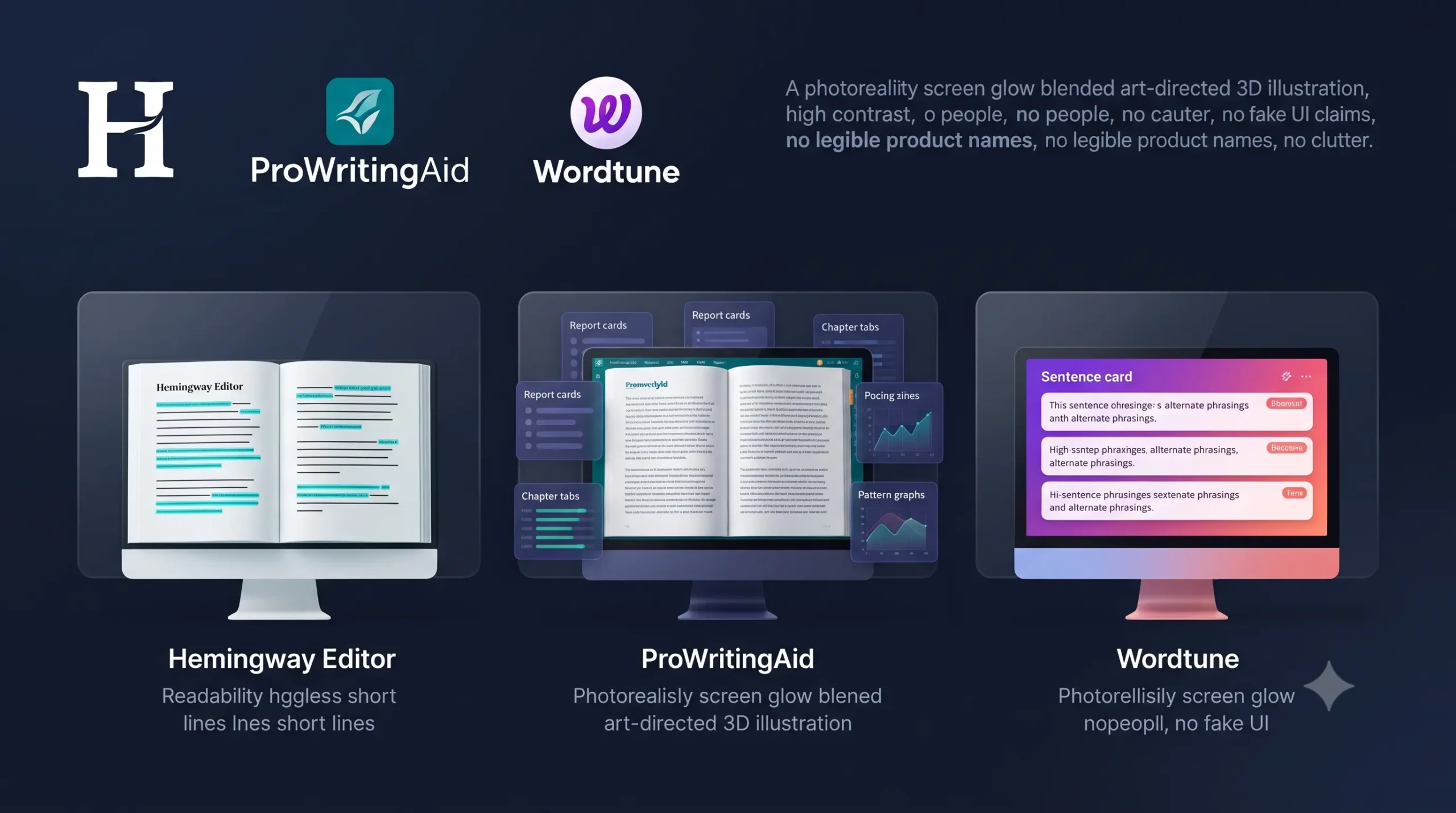
Here is the clean answer. Choose ProWritingAid for serious long-form editing. Choose Hemingway Editor for the best free readability check. Choose Wordtune when a sentence needs a more natural, concise, or formal shape. They are not three versions of the same product. They represent three different editing philosophies.
Hemingway Editor diagnoses. It shows where prose is long, passive, vague, or hard to read. ProWritingAid studies patterns across a document and offers a much deeper set of reports for authors, academics, and content teams. Wordtune acts as a sentence rewriter, giving you alternate ways to express an idea. In my view, the winner depends less on the number of features than on the kind of editing you actually do.
DiscoverVibe.blog · 2026 buyer’s dashboard
Choose the editor that fits your writing problem.
Hemingway diagnoses readability, ProWritingAid studies the whole manuscript, and Wordtune helps you reshape a sentence quickly. This dashboard turns those differences into a practical buying decision.
Decision matrix
What each tool is built to do
Editorial decision scores, not laboratory accuracy claims. Read the article’s test notes before treating a number as a benchmark.
| Criterion | Hemingway Editor | ProWritingAid | Wordtune |
|---|---|---|---|
| Readability | 9.5/10Best full-draft clarity scan | 8.4/10Deep reports plus scoring | 7.8/10Sentence-level fluency |
| Grammar depth | 6.5/10Plus improves the gap | 8.8/10Broad grammar and style reports | 7.4/10Not its main job |
| AI rewriting | 8.0/10Useful, credit-metered | 8.7/10Rephrase and Sparks | 9.1/10Best sentence alternatives |
| Long-form analysis | 4.8/10Short-form first | 9.6/10Reports, critique, manuscript tools | 5.3/10Not manuscript-centric |
| Ease of use | 9.5/10Paste, scan, edit | 7.3/10Power brings a learning curve | 9.0/10Fast inline rewrites |
| Pricing reality | 9.0/10Strong free core | 7.8/10Add-on story credits | 8.4/10Daily or unlimited rewrite tiers |
| Credit efficiency | 7.8/10One AI sentence = one credit | 6.8/10Advanced tools use add-ons | 7.1/10Free and Advanced caps |
| Integrations | 6.0/10Dedicated editor; WordPress/Medium routes | 9.0/10Word, Docs, Scrivener and more | 8.3/10Browser, Docs, Word workflows |
| Overall decision score | 8.1/10 | 8.5/10 | 8.0/10 |
Pricing reality
The cheapest useful path depends on your workflow.
Hemingway’s core editor is free. Wordtune caps free activity. ProWritingAid’s free Web Editor is limited to 500 words at a time, with separate credits for some advanced analyses.
See the true 1/2/3-year cost →Output-quality reality
A cleaner sentence can still be the wrong sentence.
Hemingway can over-reward shortness. Wordtune can smooth away intent. ProWritingAid can surface more suggestions than a busy draft deserves.
Read the same-text test →Quick persona picks
Start with the job you need done.
These are workflow recommendations, not affiliate rankings.
Quick decision framework
Answer these four questions before you buy.
Its reports, manuscript tools, and integrations justify the learning curve for serious writers.
See ProWritingAid plans →Its free core gives you a fast visual audit without a subscription.
Try Hemingway free →It is the quickest way to test a new tone or more natural phrasing.
Try Wordtune free →Key insight: the best workflow may use two tools.
Run Hemingway first to see where a draft is difficult to read. Use ProWritingAid for pattern-level analysis. Use Wordtune only on sentences that still need a different shape. This preserves more of your voice than asking one AI tool to rewrite everything.
Affiliate disclosure: DiscoverVibe.blog may earn a commission from qualifying purchases. That does not change the scoring or the limitations described in this comparison.
Quick answer: which writing tool should you choose?
- Best overall for novelists, long-form writers, and serious editors: ProWritingAid, because its reports, integrations, and manuscript tools go far beyond surface grammar.
- Best free writing editor and readability tool: Hemingway Editor, because its core web editor gives a fast visual diagnosis without a subscription.
- Best for non-native English writers and tone changes: Wordtune, because it supplies quick fluency, clarity, and formal-versus-casual alternatives.
- Best two-tool workflow: Hemingway Editor first, then ProWritingAid or Wordtune only where the draft still needs work.
What I compared and how I tested it
This comparison uses the same-text editorial protocol across a fiction paragraph, a business email, and an academic-style paragraph. I reviewed official product and help pages, recent independent articles, accessible user discussions, and comparison pages. The point was to observe what each tool notices first, what it changes, and how much human cleanup its suggestions still require.
The dashboard uses an editorial decision score, not a laboratory accuracy benchmark. I weighted readability, grammar depth, rewriting, long-form usefulness, ease, pricing transparency, credit efficiency, and integrations. Vendor claims are labeled as such, and inaccessible or third-party pricing is marked directional.
| Test area | What I looked for | Why it matters |
|---|---|---|
| Fiction | Voice preservation, pacing, dialogue, sensory detail | A clean sentence can still flatten a character’s voice |
| Business | Clarity, tone, length, directness | Most workplace writing needs speed without sounding robotic |
| Academic | Grammar, formal register, structure, cautious claims | A style checker should not invent evidence or alter meaning |
| Workflow | Paste friction, reports, integrations, export, review time | A powerful tool is not useful if you avoid opening it |
| Pricing | Free limits, annual cost, credits, renewal exposure | The monthly headline price is rarely the whole cost |
The short version of the three editing philosophies
Hemingway Editor is an opinionated readability tool. Its color system exposes long sentences, passive voice, adverbs, complex words, and difficult passages. That directness helps, but it can overcorrect literary rhythm or technical precision.
ProWritingAid is a writing coach and diagnostic suite. Its official pages list 25+ reports. They cover readability, repetition, pacing, passive voice, style, sensory detail, author comparison, and custom rules. The suite also includes Rephrase, Sparks, Chapter Critique, Manuscript Analysis, and Virtual Beta Reader. This depth suits books and long projects. It also asks you to learn which reports matter.
Wordtune is a sentence-level rewriting assistant. It helps when a draft is correct but unnatural, or when one idea needs several tones. It suits second-language writers, busy professionals, and copywriters, but it is not a full-manuscript style checker.
Same-text test: what changed in the output?
Fiction sample
The fiction sample used close third person, a long sentence, two adverbs, passive voice, and an intentional fragment. Hemingway exposed the sentence length quickly, but its pressure to simplify was less helpful when the rhythm mirrored rising panic. ProWritingAid surfaced repeated words, sentence variation, passive voice, readability, and sensory detail across the paragraph. Wordtune produced the fastest alternatives, but some sounded too polished or generic.
Fiction verdict: ProWritingAid wins for chapter-level diagnosis. Hemingway is a selective clarity pass, and Wordtune is a repair tool for a stuck line. None should overrule voice.
Business email sample
The business sample was a client email that buried its request under polite openings and a dense middle sentence. Hemingway made the problem obvious and pushed the draft toward shorter, more direct verbs. Wordtune was better when the goal changed to “make this warmer” or “make this more formal,” because it offered alternatives without a full rewrite. ProWritingAid handled the email well, but its report depth felt excessive for 150 words.
Business verdict: Hemingway wins the clarity scan, Wordtune wins tone variations, and ProWritingAid wins when email editing belongs to a larger system.
Academic-style sample
The academic sample contained cautious claims, a long sentence, and technical terms that should not be simplified blindly. Hemingway showed the difficulty clearly, but a lower grade level was not automatically better. ProWritingAid gave the best view of repeated terms, sentence variety, transitions, and style patterns, yet it could not verify the research. Wordtune helped with fluency but carried the greatest risk of changing certainty or technical meaning.
Academic verdict: ProWritingAid is the strongest editing companion, Hemingway is a useful readability check, and Wordtune is a careful sentence helper. None is a citation or fact checker.
Pricing reality: free plans, credits, and three-year cost
The official Hemingway page lists Individual 5K at $100 annually, Individual 10K at $150, and Team 10K at $150 per user. Its support page says AI rewrites use sentence credits: a four-sentence paragraph uses four credits, while grammar fixes are unlimited. The free editor keeps core readability analysis.
Wordtune lists Basic at $0 with 10 rewrites or suggestions per day and three summaries per month. Advanced is $4.89 monthly when billed annually; Unlimited is $6.99. Paid plans show higher monthly prices, a three-day trial requiring payment details, and no refunds. Active writers can outgrow Advanced’s daily cap.
ProWritingAid’s pricing page was region-blocked here. Official help pages confirm a 500-word free Web Editor limit, unlimited words on paid plans, and separate Story Credits and Plagiarism Checks. One Story Credit runs a manuscript, marketability, plot, or virtual beta analysis once; one plagiarism check covers up to 2,000 words. Third-party 2026 references commonly report about $120 yearly and $399 lifetime, but verify those figures on live checkout.
| Tool and plan | Current annual-billing reference | 1-year cost | 2-year cost | 3-year cost | Hidden or easy-to-miss reality |
|---|---|---|---|---|---|
| Hemingway Plus Individual 5K | $100/year | $100 | $200 | $300 | 5,000 AI sentence rewrites per month; subscription renews unless canceled |
| Hemingway Plus Individual 10K | $150/year | $150 | $300 | $450 | 10,000 AI sentence rewrites per month; grammar fixes are unlimited |
| ProWritingAid Premium | About $120/year, directional | About $120 | About $240 | About $360 | Official pricing was region-blocked here; confirm renewal price and add-ons |
| ProWritingAid lifetime | About $399 once, directional | About $399 | About $399 | About $399 | Story and plagiarism credits are separate and non-refundable |
| Wordtune Advanced | $4.89/month annually | $58.68 | $117.36 | $176.04 | 30 rewrites per day and 15 summaries per month |
| Wordtune Unlimited | $6.99/month annually | $83.88 | $167.76 | $251.64 | Unlimited rewrites and summaries; monthly plan costs more |
The practical value order is clear. Start with Hemingway if you need readability and have a limited budget. Choose Wordtune Advanced if your bottleneck is daily sentence rewriting and you can live with caps. Choose ProWritingAid when you will actually use its reports, integrations, and long-form analysis. A lifetime license is only good value if you will keep editing for years and accept the separate credit economy.
Hemingway Editor review: best for clear, direct prose
Hemingway Editor remains the easiest tool here to understand. Paste in a draft and the visual system tells you where to look. Yellow and red highlights identify long or difficult sentences. Blue highlights flag adverbs or weak language. Green highlights passive voice. Purple highlights suggest simpler alternatives. The right panel shows readability and basic document statistics.
That design supports a clean editing habit: write first, scan second, decide third. The free web editor is enough for many blogs, emails, landing pages, and short business documents. The Plus tier adds an advanced grammar checker, AI rewriting, tone and style adjustments, and monthly AI sentence allowances. The desktop Classic app is a one-time offline purchase. Check the current product page before buying. Classic and Plus are different products.
The limitation is not that Hemingway is “bad.” It is that its philosophy is narrow. It treats shorter and simpler as strong defaults. That works beautifully for plain-language nonfiction. It can overcorrect voice, technical precision, dramatic rhythm, and fiction that uses long sentences on purpose. Reedsy’s March 2026 review rated Hemingway 2/5 for book writing.1 It praised the clean interface. It criticized the lack of chapter structure, footnotes, manuscript tools, and long-form organization.
Choose Hemingway when: you write web copy, emails, newsletters, consumer content, or direct nonfiction. It also fits writers who want a visual audit, a simple interface, and a generous free tier.
Avoid Hemingway as your only tool when: you write novels or research-heavy work. It is also a poor fit when you need deep grammar analysis, collaboration, or literary judgment.
ProWritingAid review: best for long-form depth
ProWritingAid is the strongest overall choice for a writer who will use more than a basic grammar checker. Its official feature page lists 25+ reports and tools. They cover readability, repeated words, pacing, passive voice, sensory detail, author comparison, and custom rules. Other tools include Rephrase, Sparks, Chapter Critique, Manuscript Analysis, and Virtual Beta Reader. Its integrations include Word, Google Docs, Scrivener, browser extensions, Apple Notes, Notion, Pages, Atticus, Gmail, and more.2
That breadth changes the work. You inspect patterns: sentence variety, repeated phrases, sensory detail, transitions, and passive construction. The cost is attention. ProWritingAid says writers do not need to accept every suggestion and can ignore or disable rules. A long list of flags is not a long list of errors.
The free plan is useful for trying the interface, but the 500-word editing limit makes it awkward for a book or a large article. Premium removes the word limit and adds advanced features. Premium Pro adds more rewriting and style options, with 50 Sparks and three Critiques per day according to the current help page. The expensive surprise is the credit layer.3 Story Credits and Plagiarism Checks are not unlimited parts of the subscription.
Choose ProWritingAid when: you write novels, memoir, essays, academic papers, whitepapers, or long SEO content. It also fits writers who want pattern reports, use Scrivener, Word, or Google Docs, and plan to build a serious editing practice.
Avoid ProWritingAid when: you only need a quick email check. Skip it if you dislike dashboards or will not use the reports that justify the subscription.
Wordtune review: best for sentence-level rewriting
Wordtune solves a different problem: “I know what I mean, but I cannot find the right sentence.” Its paid plans offer rewrites and AI suggestions. They also include summaries, grammar checks, clarity improvements, vocabulary help, and fluency support. The official plans page shows a free tier, a capped Advanced tier, and an Unlimited tier. The same page lists a 30% discount for eligible students, educators, and nonprofits.4
In the same-text test, Wordtune was the fastest way to compare formal, casual, concise, and fluent versions. That makes it practical for customer emails, sales copy, internal communication, and second-language writing. The tool can reduce the time spent circling one awkward phrase.
The risk is semantic drift. A smooth rewrite can sound more confident than the original. It can add meaning you did not intend. It can also remove an unusual word that was doing useful work. The more important the sentence, the more carefully you should compare the original and the alternative. Wordtune is a writing improvement tool, not a final editor.
The free plan is good for occasional use, but ten rewrites a day is not much for a full-time copywriter. Advanced is affordable if 30 daily rewrites and 15 monthly summaries cover your work. Unlimited is easier to budget for heavy users, although the monthly price is higher than the annual equivalent. Wordtune’s interface is more approachable than ProWritingAid’s, but it does not offer the same manuscript-level view.
Choose Wordtune when: you write in a second language, adapt content for different audiences, need tone variants, write many emails, or regularly get stuck on phrasing.
Avoid Wordtune as your only tool when: you edit a novel or need a full-document report. Do not rely on it to validate research or preserve every shade of the source sentence.
Free versus paid: what gives the best value?
Hemingway has the best free core. You can test the readability model without an account, a daily quota, or a subscription. That makes it ideal for a budget-conscious writer in India or anywhere else where a recurring dollar cost deserves scrutiny. Pay for Plus only when AI rewriting and advanced grammar save enough time to justify the renewal.
Wordtune has the most understandable free AI allowance for light users. Ten rewrites per day and three summaries per month will cover a student who uses it occasionally. A daily user will hit the wall quickly. The paid tiers are reasonable when you know your rewrite volume, but the three-day trial is short and requires payment details.
ProWritingAid gives free users a taste of its reports, but the 500-word limit makes serious use difficult. Its paid value is high for an author who will use reports for months, especially if a lifetime option remains available at checkout. The value falls when you need frequent manuscript analyses, plagiarism checks, or other credit-based features. Budget for those separately.
Best pick by persona
Solo blogger or content creator: Start with Hemingway. It catches the kind of long, dense writing that hurts web reading, and the free version lets you build a reliable editing habit before paying.
Freelance writer or copywriter: Use Hemingway for structural clarity and Wordtune for alternate tones. Add ProWritingAid if you handle long guides, whitepapers, or repeat client work that benefits from custom rules.
Small or midsize agency: Wordtune is convenient for fast variations, while ProWritingAid is stronger for standards and deeper review. Ask vendors about team billing, admin, privacy, and shared style controls before buying for multiple seats.
Fiction or long-form novelist: Choose ProWritingAid. Hemingway can be a useful selective pass, but it should not decide what your voice is allowed to sound like. Use Wordtune only for a stuck line.
Screenwriter: None of these replaces dedicated screenplay software. ProWritingAid may help with prose in treatments or pitch documents; Hemingway can tighten a synopsis; Wordtune can test logline phrasing.
Student or academic writer: ProWritingAid offers the broadest editing support, while Wordtune can help with fluency. Keep your own sources, citation rules, and original argument in control. No writing editor proves that a claim is true.
Marketing team: Pick Wordtune for quick channel variations or ProWritingAid for deeper style consistency. Hemingway is excellent as a final plain-language pass on landing pages and emails.
Budget-conscious or global writer: Start with Hemingway free. If English fluency is the main problem, try Wordtune’s free allowance. Move to a paid plan only after you know where the free limit interrupts your work.
Enterprise or Fortune 500 team: Investigate ProWritingAid first because its integrations and custom rules are better suited to a governed workflow. Verify security, data-processing, SSO, retention, billing, and admin terms directly with the vendor. Do not infer enterprise readiness from a consumer plan page.
The workflow I would actually use
For a normal blog post, draft without any checker. Run Hemingway once the argument is complete. Fix only the highlights that make the piece harder to follow. Then run ProWritingAid’s readability, repeated-words, and style reports if the article is long or commercially important. Use Wordtune on the two or three sentences that remain awkward. Finish by reading the draft aloud.
For fiction, reverse the emphasis. Start with your own editorial pass. Use ProWritingAid to inspect patterns across scenes, not to erase every unusual construction. Use Hemingway only on exposition that feels muddy. Use Wordtune as a small repair tool, never as a blanket rewrite engine.
For academic work, treat all three as language assistants. Preserve the original claim beside every rewrite. Check citations separately. If a tool changes a technical term, degree of certainty, or causal connection, reject the suggestion even if the new sentence sounds better.
FAQ: Hemingway Editor vs ProWritingAid vs Wordtune
Is Hemingway Editor better than ProWritingAid?
Hemingway Editor is better for a quick, visual readability check, especially on short web content. ProWritingAid is better for grammar depth, long-form analysis, custom rules, and manuscript workflows. The right choice depends on whether your main problem is sentence clarity or document-level editing.
Which is better for fiction, Hemingway Editor or ProWritingAid?
ProWritingAid is the better fit for fiction because it offers reports for repetition, pacing, structure, sensory detail, and manuscript-level analysis. Hemingway can still help with clarity, but its strong preference for shorter, simpler prose can work against a deliberate literary voice.
Is Wordtune better than Hemingway Editor for rewriting?
Yes, Wordtune is the stronger sentence rewriter because it generates multiple alternatives and supports tone and fluency changes. Hemingway is better at showing where a sentence is hard to read, but its core experience is diagnosis rather than creative rephrasing.
Which writing tool has the best free plan?
Hemingway Editor has the best free plan for unlimited core readability analysis. Wordtune’s free plan is useful for occasional rewrites but limits daily suggestions and monthly summaries. ProWritingAid’s free plan provides access to reports but limits editing to 500 words at a time.
Can I use Hemingway Editor, ProWritingAid, and Wordtune together?
Yes. A sensible sequence is Hemingway for a full-draft clarity scan, ProWritingAid for deeper patterns, and Wordtune for a few sentences that still need a new shape. Using all three on every line would create too many suggestions and slow the work down.
Bottom line
For one paid tool, I would choose ProWritingAid if you write long-form work and will spend time learning its reports. It offers the widest editorial range of the three, with the clearest path from a sentence check to a chapter or manuscript review. The trade-offs are complexity, internet dependence for integrations, and separate credit economics for advanced analysis and plagiarism checks.
For the lowest-risk purchase, choose Hemingway Editor. Its free core is unusually useful, and its purpose is easy to understand. It is the best starting point for bloggers, marketers, students who need plainer prose, and anyone who wants to see readability problems without opening a crowded dashboard.
For the fastest improvement to one awkward sentence, choose Wordtune. It is the most useful option when tone, fluency, and phrasing are the bottleneck. Just remember that a fluent rewrite is not automatically accurate, original, or appropriate for your audience.
The honest winner is therefore conditional: ProWritingAid for depth, Hemingway Editor for clarity, and Wordtune for expression. If your budget allows only one first step, start with the free tool that matches your biggest problem. Then pay only when the workflow, not the feature list, proves its value.


