
Best Free Web Hosting Without Ads in 2026: 5 Picks
Summary: For an ongoing free host that keeps provider ads off your site, InfinityFree is a strong starting point; ByetHost and GoogieHost are also viable. FreeHosting and AwardSpace suit other small projects. These plans are not trials, but their storage, bandwidth, domain, and feature limits still matter when matching a host to your site.
What does a $0 plan actually leave you to manage? A clean site is only the start: PHP, databases, storage, and domain rules can matter just as much. For a WordPress project, compare our best free WordPress hosting options. Here, the best free web hosting without ads in 2026 means an ongoing free plan that does not insert its own ads on hosted websites, rather than a trial or credit offer.
Before you sign up, check whether the plan fits your site and includes HTTPS. Google’s page experience guidance recommends secure pages and avoiding ads that distract from or interfere with content. Those checks matter even when a host promises an ad-free site: your visitors still need a secure connection and a page that works well.
Which free hosts keep provider ads off your site?
These five providers describe ongoing free plans without forced ads on hosted sites. Their own plan descriptions are the basis for the listed features, not a guarantee of speed or uptime for every website. Compare the limits and technical requirements before choosing.
| Rank | Provider | Ad policy | Plan resources | Domain and security |
|---|---|---|---|---|
| 1 | InfinityFree | No ads on hosted sites | 5 GB storage, unlimited bandwidth, PHP and MySQL | Free subdomains, custom domains, free SSL |
| 2 | ByetHost | No forced ads | 5 GB NVMe storage, unlimited bandwidth, PHP and MySQL | Custom domains, free SSL |
| 3 | GoogieHost | No forced ads | Up to 1 GB NVMe storage, PHP and MySQL | Free subdomain, custom-domain connection, free SSL |
| 4 | FreeHosting | No forced ads | 10 GB storage, unlimited bandwidth, one email account and one database | Own domain; confirm SSL availability before launch |
| 5 | AwardSpace | Ad-free hosting | 1 GB storage, 5 GB monthly bandwidth, PHP and MySQL | Free subdomain; check SSL and domain terms |
1. InfinityFree
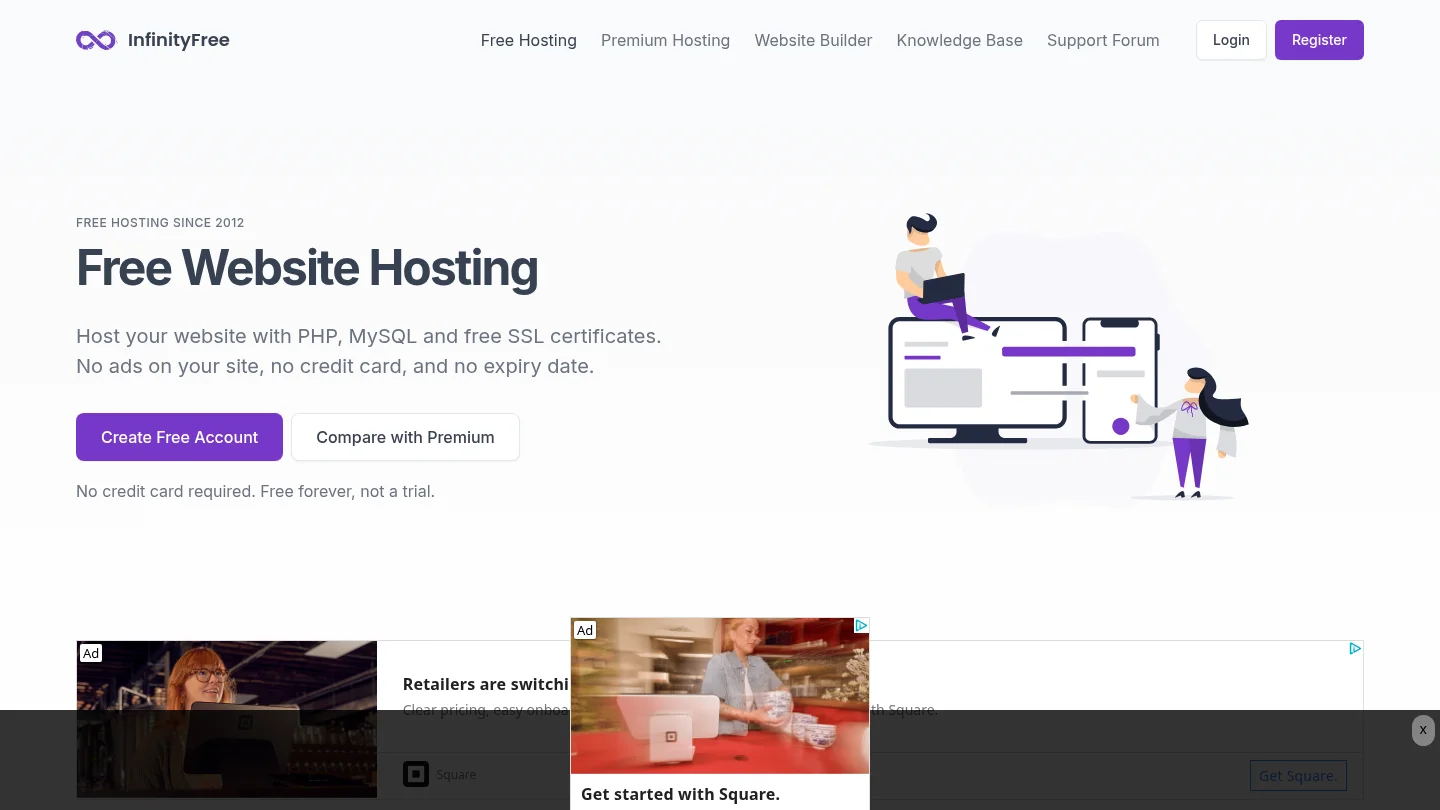
Best for: Small dynamic sites, WordPress experiments, and learning projects that need PHP and MySQL.
InfinityFree describes its plan as permanently free, with no trial expiry or credit card requirement. Its listed features include 5 GB of storage, unlimited bandwidth, PHP, MySQL, free SSL, and free subdomains. You can also connect a domain you already own. The provider states that ads appear on its own website and control panel, not on your hosted site.
Its Softaculous installer supports WordPress and other applications, so you do not need to upload every file manually. The plan is a practical option for testing a database-backed site without paying for a server. Review the provider’s activity terms as well as its resource limits before using it for a site that needs continuous availability.
Pros
- Ongoing free plan with no expiry stated.
- PHP, MySQL, free SSL, and WordPress installation are listed.
- Use a free subdomain or connect a domain you own.
Cons
- Storage is capped at 5 GB, and the plan is not designed to provide paid-hosting resources.
- The account terms require some site activity, so check the current rules for inactive sites.
2. ByetHost
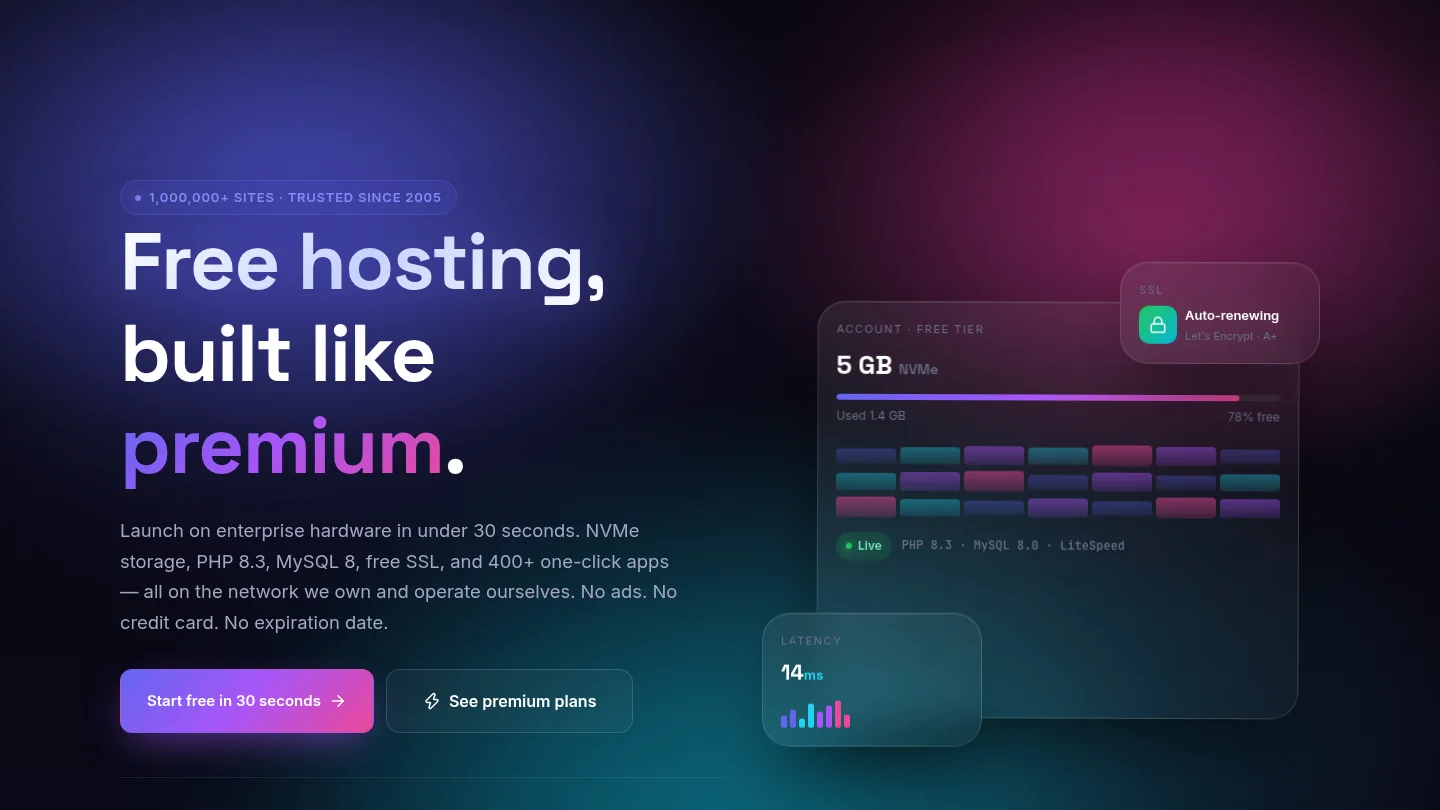
Best for: Users who want PHP applications, MySQL, and an application installer on a free plan.
ByetHost lists 5 GB of NVMe storage, unlimited bandwidth, PHP 8.3, MySQL 8, free SSL, and more than 400 one-click applications. It also states that its free hosting has no forced ads or expiry date. The published plan allows custom domains, making it a possibility for users who already own a domain.
The listed storage and tools make it worth comparing with InfinityFree for a small database-backed site. However, unlimited bandwidth does not mean unlimited processing capacity or guaranteed performance under every workload. Check the current terms and resource policies before moving a business-critical website.
Pros
- Includes PHP, MySQL, SSL, and a broad application installer.
- Lists 5 GB of NVMe storage and unlimited bandwidth.
- Provider states that the plan has no expiry and no forced ads.
Cons
- The stated storage allowance is 5 GB, so media-heavy sites need to track their usage.
- Review the plan terms to confirm the limits relevant to your particular application.
3. GoogieHost
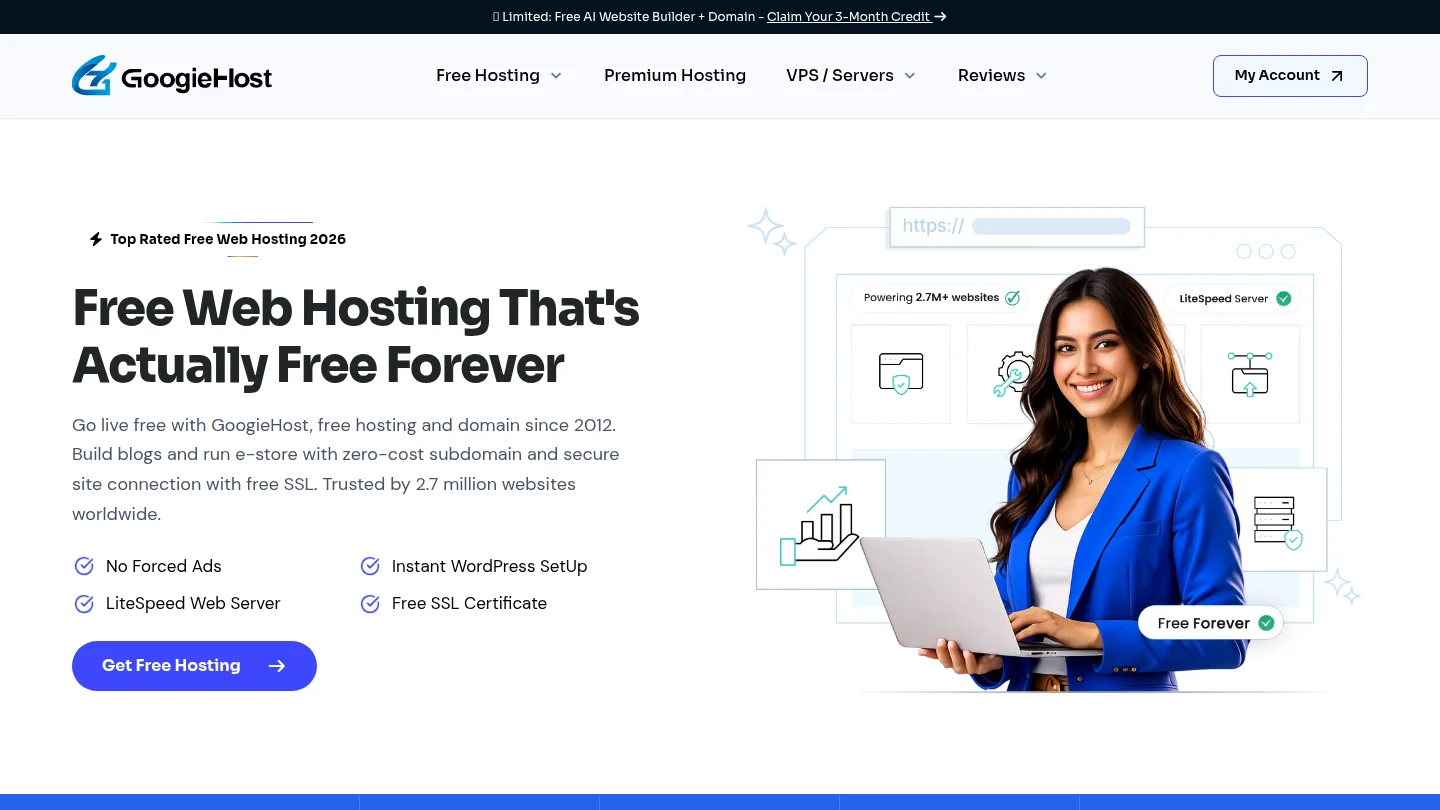
Best for: Beginners who want a control panel and one-click setup for a small website.
GoogieHost describes its free plan as ongoing, with no forced ads, PHP, MySQL, free SSL, and up to 1 GB of NVMe storage. Its plan includes a free subdomain, and it states that you can connect a custom domain. The provider also lists a multi-channel support service, which may be useful if you are new to hosting.
The installer and dashboard make this option easier to approach than a bare server setup. Still, 1 GB of storage is a modest allowance, and the plan is better matched to a small project than a large media library. Read the account and activity terms before relying on it for a public-facing site.
Pros
- Free SSL and PHP and MySQL support are listed.
- Offers a free subdomain and custom-domain connection.
- Includes a control panel and one-click applications.
Cons
- Storage is limited to up to 1 GB on the free plan.
- Confirm the current account requirements and support terms before signup.
4. FreeHosting
Best for: A lightweight personal site that needs more listed storage than the other options here.
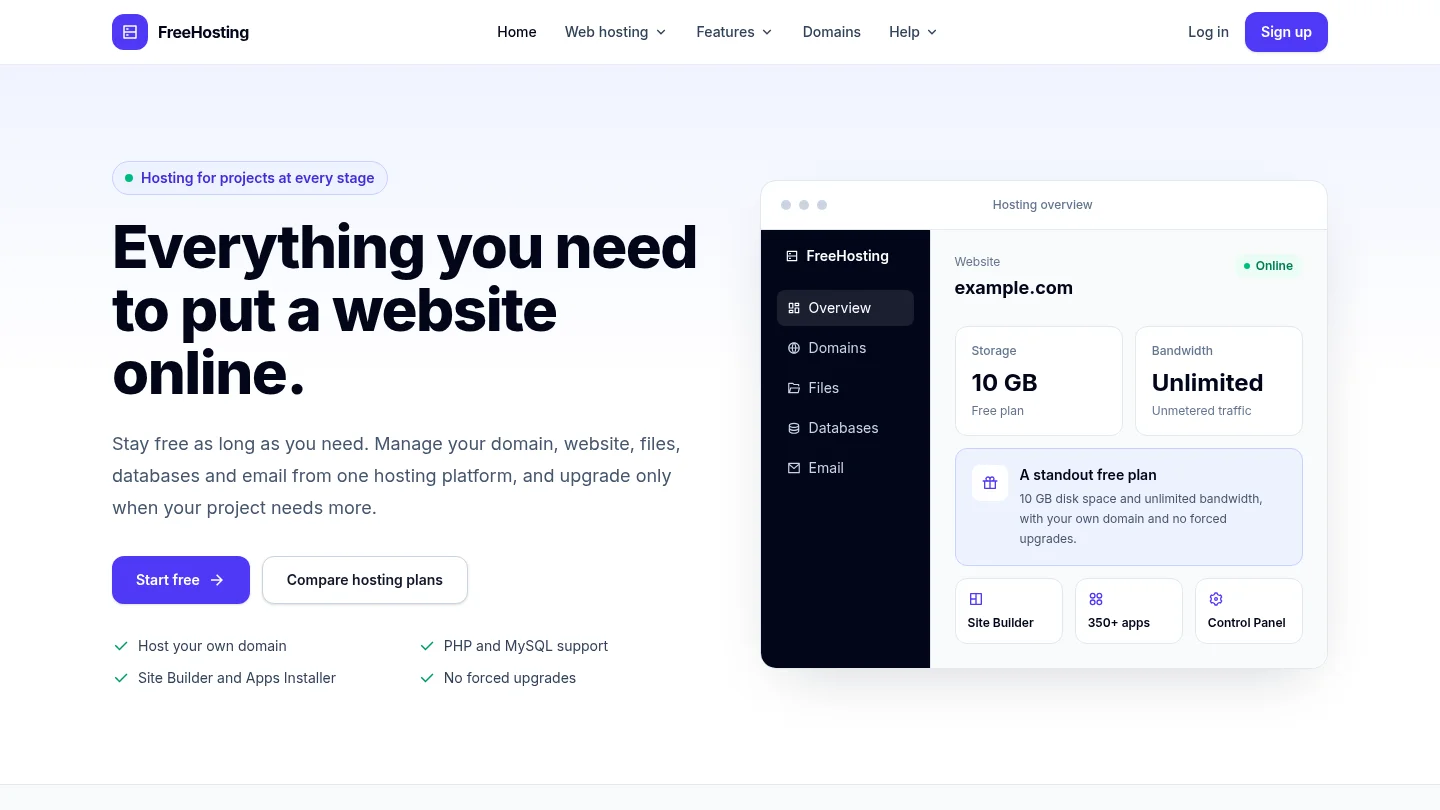
FreeHosting lists 10 GB of storage, unlimited bandwidth, PHP, MySQL, one email account, and one database. Its free plan uses your own domain rather than providing a free subdomain. The provider says you can keep the plan as long as you need it and that it does not force upgrades.
The storage allowance is generous compared with the other plans in this selection, but the single database and email account may constrain a project with several applications or inboxes. Confirm SSL availability, the number of sites allowed, and any current usage terms before publishing. A free plan’s listed storage and bandwidth do not establish how it will perform under your particular workload.
Pros
- Lists 10 GB of storage and unlimited bandwidth.
- Supports PHP and MySQL, with a site builder and application installer.
- Provider states there are no forced upgrades.
Cons
- The plan lists one email account and one database.
- You need to supply your own domain; the plan description does not establish a free subdomain.
5. AwardSpace
Best for: A small blog or basic website where a free builder and direct support are useful.
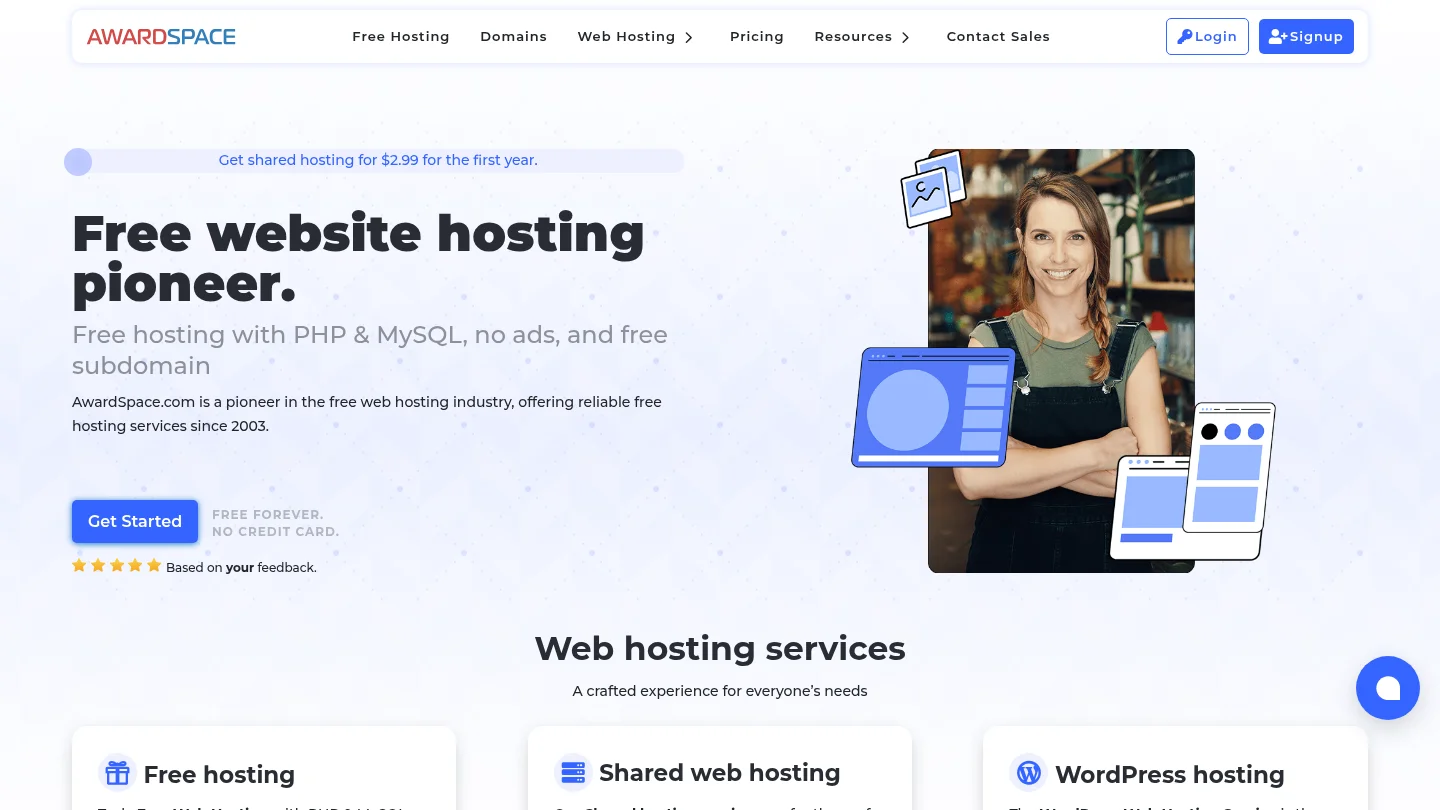
AwardSpace describes its free hosting as ad-free and lists 1 GB of storage, 5 GB of monthly bandwidth, PHP, MySQL, a website builder, and a free subdomain. It also states that the free plan includes 24/7 support and a 99.9% uptime guarantee. These features make it a straightforward option for a small site with limited traffic needs.
The monthly bandwidth cap is the main practical constraint: image-heavy pages and rising traffic can use it more quickly. The plan description does not establish SSL availability or custom-domain terms, so verify both before you publish. If you need more storage or traffic capacity, compare a paid plan before your site grows into the free plan’s limits.
Pros
- Provider states the free plan is ad-free and includes 24/7 support.
- Includes a website builder, PHP, MySQL, and a free subdomain.
- Lists a 99.9% uptime guarantee.
Cons
- Storage is limited to 1 GB and monthly bandwidth to 5 GB.
- Confirm SSL and domain terms directly before relying on the plan.
How should you choose a free host without ads?
Start with the type of website you are building. A static portfolio made from HTML, CSS, and JavaScript does not need the same server features as WordPress or another application with a database. MDN explains the difference between static and dynamic sites; use that distinction to decide whether you need PHP and MySQL.
Next, confirm what “ad-free” means in the plan terms. Look for a clear statement that the host will not insert ads on your published pages, and check separately for mandatory provider branding. Then compare storage, monthly bandwidth, SSL, support, and whether you can connect a domain you already own.
A custom domain is separate from the hosting account. ICANN’s domain registrant guidance explains that registrants manage domain settings through their registrar. Keeping access to that account gives you more control if you later change hosts.
If you are considering a managed WordPress platform, distinguish it from self-hosted WordPress on an ad-free host. Our review of the limitations of WordPress.com’s free plan explains the trade-offs of that separate setup. If you prioritize a managed experience over a $0 plan, compare our hassle-free WordPress hosting coverage as well.
When is it time to move beyond free hosting?
Consider changing plans when your site regularly approaches its storage or bandwidth cap, needs more than one database, or depends on dependable support. A free plan can suit a class project, a portfolio, or a small experiment. A growing business site has more to lose from limited resources or unclear support terms.
Before you publish, test the site on a phone, confirm that HTTPS works, and keep a separate copy of your files and database where possible. Check whether the provider supports the application you use and whether the domain is controlled through an account you can access. These simple checks help you avoid choosing a plan based only on its headline allowance.
Conclusion
For a small dynamic project, free hosting without ads can provide a useful start. Compare InfinityFree and ByetHost for PHP and database tools, GoogieHost for a smaller beginner setup, FreeHosting for its listed storage, and AwardSpace for a builder and support. Before signup, verify the current ad policy, SSL, domain terms, and resource limits against your site’s needs.
Frequently Asked Questions
Are these free hosting plans trials?
The providers listed describe ongoing free plans rather than time-limited trials. Review each provider’s current terms for account, usage, and activity requirements.
Does free no-ad hosting always include SSL?
No. Some providers list free SSL, while others do not establish SSL availability in their free-plan details. Confirm that HTTPS is included and working before publishing.
Can I install WordPress on free hosting without ads?
Some traditional hosts in this selection list PHP, MySQL, and one-click application installers that support WordPress setup. Check the provider’s current requirements and resource limits before installing it.
Can I use my own domain with a free hosting plan?
Some providers listed here state that you can connect a domain you already own, while others advertise a free subdomain. Check the exact plan terms and make sure you can access the domain registrar account.
When should I upgrade from free hosting?
Consider an upgrade when you approach the storage or bandwidth cap, need more databases or support, or depend on consistent availability. Compare the paid plan’s renewal terms and features before moving your site.