
Stock Photos of People: Model Releases in 2026
The file is cheap. The face is the risk. You can license a photo of a person for a few dollars. That receipt does not answer the question that matters. Can this face go on an ad, a package, a political post, or a healthcare landing page?
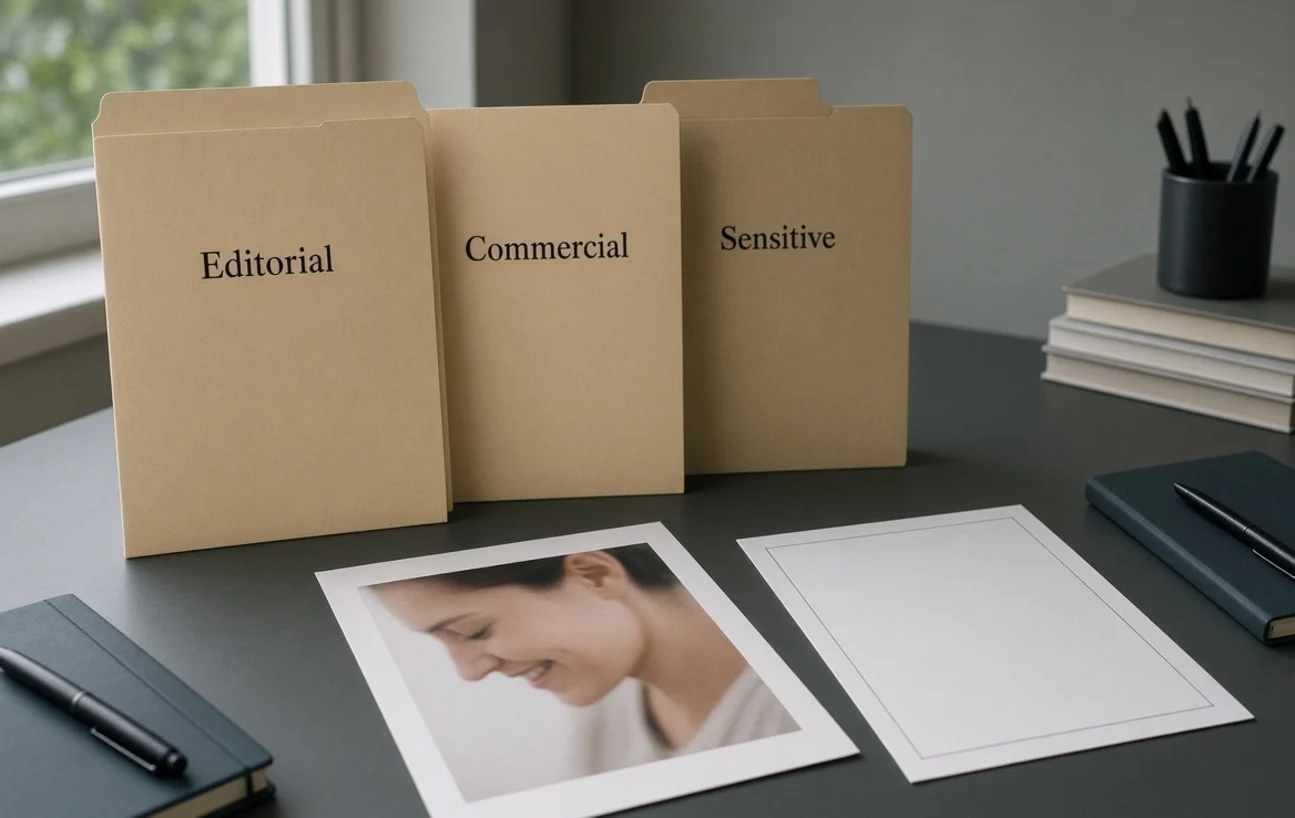
Buyers search stock photos of people and get a grid of smiles. The grid hides three products. Editorial is a news frame. Standard commercial is a released portrait for ordinary promotion. Sensitive use is a separate permission, and on a normal plan it is usually a no.
A model release is necessary, not sufficient. It is a hall pass for ordinary ads, not a blank check.
Three uses: editorial, standard commercial, sensitive
Shutterstock’s contributor help puts the split in one line. Commercial content “is used for advertising and promotional purposes.” Editorial “cannot be used to sell, promote, or monetize a business, product or service.” It can show logos and recognizable people without a model release, because the job is news or education, not a pitch. That page was updated 12 December 2025.
Adobe Stock says the same thing to buyers. An “Editorial Use Only” asset “may only be used in relation to events or topics which are newsworthy or of public interest.” It “may not be used for commercial purposes such as advertisements, promotions, endorsements, advertorials, commercial blogs, merchandise, etc.” An Extended license does not lift that ban.
Kitchen English: selling needs a commercial file. Reporting can use editorial. Illness, politics, or adult context sits outside both.
Editorial. A news-style crowd, no releases, logos in frame. A blog editor can use it beside the story, with the credit the license asks for. A toothpaste brand cannot put that face on a pack.
Standard commercial. A studio portrait with a model release on file. A performance-ad buyer can use it in a product ad, a homepage, or packaging, inside the copy limits they bought. Adobe’s Standard license stops at 500,000 copies or views. Enhanced or Extended is the print-run and merchandise question, not the face question. The release does not turn the smile into a political attack ad.
Sensitive. A released gym photo used as an “addiction recovery before/after.” The release cleared ordinary commercial use. It did not clear a health story the model never agreed to tell. The file can be legal to download and still be the wrong file.
Three uses, one grid
A model release is necessary, not sufficient.
Editorial
News or education. Recognizable people can appear without a release. Not for ads, packs, or sponsored selling.
Standard commercial
Released portrait for an ordinary ad, site, or pack. Copy caps and merchandise are a separate license seat.
Sensitive
Pharma, politics, dating, adult, tobacco, before/after. A normal plan usually says no. A release does not lift it.
Three checks before checkout
- Badge: editorial or commercial.
- Release on file if a person is recognizable and the use sells.
- Claim matches the license — not politics, pharma, or a fake before/after.
Contributor shooting notes are in the checklist below. Policies checked: September 2026.
A news editor lives in the first bucket. A founder with a released homepage smile lives in the second. A healthcare page lives in the third, even with a perfect release.
Which library to subscribe to is a different job. The Shutterstock vs Adobe Stock comparison covers the purchase.
What a model release actually covers
Shutterstock defines a model release as an agreement that protects the creator, the model, and the customer. Commercial uploads need one for a recognizable person, a tattooed body part even if the face is out, nude or suggestive poses, and illustrations in the likeness of a real person. Editorial uploads of recognizable people do not. That page was updated 22 July 2026. A self-portrait counts. You sign as both model and photographer.
Adobe Stock’s contributor guide, updated 11 June 2026, matches that shape. A signed release is required when someone can be recognized, including close-ups and people in the background. A crowd where no one can be picked out is the exemption.
A release lets the library license the likeness inside its rules. You do not get the signed form. The library keeps it.
Crowd photos are the hoped-for loophole. A blur with no readable face can be commercial. A sharp face in front still needs a release. That is why a real event crowd is often editorial only.
Property releases: the other piece of paper
A model release covers the person. A property release covers recognizable property or artwork the owner must clear for commercial use. Shutterstock’s list includes murals, tattoos, sculptures, private interiors, and private land. Editorial files generally skip both papers, which is why they stay editorial.
Adobe’s property-release guide, updated 18 August 2026, treats a prominent tattoo as artwork. If the tattoo is the focal point, or the artist can be identified from the design, you may need a property release and a model release from the wearer and the artist. A small tattoo that is not the subject is a softer case.
Why a buyer should care: a released smile in front of an unreleased mural is still a risky file. The model signed. The artwork behind her did not. Scan the wall, the shirt logo, and the loft, not just the face.
Sensitive use: pharma, dating, politics, before/after, adult, derogatory context
A normal commercial license is not “any use.”
Shutterstock’s customer-use help says Standard and Enhanced do not allow sensitive use, “such as pornography, or for tobacco ads, political endorsements, or any use that could be defamatory if a model is depicted in the image.” The public license is tighter. You may not portray a person in a way a reasonable person would find offensive. Named cases include adult venues, escort or dating services, tobacco ads, a political context (party, candidate, elected official, or a political viewpoint), and showing the person as ill, medicated, or engaged in crime.
Adobe’s terms use the same fence: tobacco ads, adult entertainment, implied political endorsements, and implying mental or physical impairment. You can edit a commercial file. You cannot put the model in a bad light.
Shutterstock sells a separate sensitive-use license to enterprise buyers, mostly agencies with pharma work. Contributor help, updated 15 July 2025, describes use that might make a reasonable person think the subject is ill, endorses a cause, or is tied to something controversial. That is not a self-serve button. Pornographic or defamatory use stays off even then.
Three generic cases, no private names:
- Editorial crowd. News story: fine. Toothpaste pack: no. No release, so no ad.
- Released studio portrait. Product ad: fine. Political attack ad: no. The release cleared the person, not the message.
- Released gym photo. Fitness campaign: fine. “Addiction recovery, before and after”: no. The layout invents a condition the model did not agree to play.
A dating-app ad is in Shutterstock’s named ban. A split screen that implies the person was sick before they bought is sensitive use, even when both frames are released.
How buyers search, without the bait headings
Buyers still type demographic strings into the box. “White person stock photo” and “Asian woman stock photo” are real queries. They are a bad page title, and a weak shoot brief. The release rules do not change with the face.
The old generic family — same sofa, same three smiles — gets skipped because it does not match the product or the city. That is casting, not a release waiver. A more specific face still needs editorial or commercial, a release on file, and a use that is not sensitive.
Search the job, then read the badge. “Parent packing a school lunch” beats a demographic string. A wider grid does not relax the political or pharma rules.
AI faces vs released humans
An AI face is not a released human.
Adobe’s generative-AI rules say a file that depicts, is based on, or is meant to portray an identifiable person needs a model release. If the face is fictional but looks like a person, the contributor must tick “People and Property are fictional.” That box is a statement to Adobe. It is not a signature from the face. A buyer of a generated portrait does not hold a model release.
Shutterstock does not accept AI-generated submissions from contributors. Its own generator is a different product. A commercial photo with a release was signed by a person. A generated face was not.
Using either one in a political attack, a medical before/after, or a dating ad still hits the sensitive-use fence.
Which generator is safer — Shutterstock’s AI tools, Adobe Firefly, or Midjourney — is a different article. It covers training claims and indemnity. It does not replace the release check here.
Do not strip a watermark to dodge this. A file without a license is not a file with a release.
Buyer checklist before checkout
Read the badge. “Editorial use only” means no ad, no pack, and no sponsored post that sells. Credit the file. Do not recrop an editorial frame until the story changes.
Confirm a release if the use is commercial and a person is recognizable. On Shutterstock, look for the model-released mark. A soft crowd is the exception, not a sharp face in front.
Match the claim to the license. Product ad and packaging: standard commercial, then check copy caps and whether merchandise needs Enhanced or Extended. Politics, pharma, dating, tobacco, adult, or a before/after health story: stop. Ask the vendor for a sensitive-use or custom license, or shoot your own with a release that names that use.
Scan the background. A mural, a private loft, or a logo on a shirt can sink a file the model already signed. Save the asset ID. Homepage, email, and packaging can be three uses.
Contributor checklist before upload
If you shoot people, the release is the product.
Shutterstock requires a valid model release for every recognizable person in commercial content, including you. A partial face can still count. A witness cannot be you, the model, or the model’s parent. Minors need a guardian’s release. A typed name is not a signature.
Adobe wants a release for each identifiable person, including background passersby. Group releases are not accepted. An unidentifiable crowd is the exemption.
Add a property release for a mural, a focal tattoo design, or a private interior. The person wearing a tattoo is not always the owner of the artwork.
Do not upload a recognizable person as editorial and expect an ad buyer. Keyword the event. Illustrative editorial still cannot sell a product.
For generated files, do not invent a release. Shutterstock will not take contributor AI uploads. Adobe wants the generative-AI box ticked, and a real release if a real person was the prompt.
FAQ
Do I need a model release for a photo of a person?
For commercial licensing, yes, if the person is recognizable. Editorial files can show people without a release, and those files stay editorial.
Can I use an editorial stock photo in an ad?
No. Both vendors bar ads, promotion, and merchandise for editorial files. A bigger license does not clear the badge.
Does a model release allow political or medical use?
Not on a standard commercial license. Politics and depicting illness need a separate sensitive-use deal, where one exists. Defamatory use stays off the table.
Are AI-generated faces safe without a release?
No. A generated face has no model signature unless a real person was the source and signed. Adobe wants a release for an identifiable person, or a fictional checkbox if the face only looks human. Sensitive uses still apply. Shutterstock does not accept contributor-uploaded AI files.
What is a property release?
Permission from the owner to license a recognizable place or artwork for commercial use. It does not replace a model release.
Can I use a crowd photo commercially?
Often, if no one is identifiable and the file is commercial. A sharp face in front still needs a release.
Do I need a release to upload a photo of myself?
Yes, if you want it sold as commercial. You sign as both model and photographer.
Does an enhanced license cover sensitive use?
No. Enhanced and Extended raise print runs or allow merchandise. They do not unlock politics, health claims, dating, adult, or tobacco.
Pick the use, then the file
Editorial for a reported story. Standard commercial for an ordinary ad or pack, with a release on the person and a clean background. Stop for politics, pharma, dating, adult, tobacco, and before/after health claims unless the vendor has given that use in writing.
This is not legal advice. The license on your download outranks this page.
Browse the official people collections, then read the badge before checkout.
The contributor checks are above. Library choice sits on the Shutterstock vs Adobe Stock comparison. Generator safety is a separate page.