
AI Email Marketing Tools & Automation Guide 2026 (Best Tools + How to Use Them)
The landscape of email marketing has undergone a seismic shift in 2026. The era of basic, rule-based automation is officially behind us, replaced by a new paradigm driven by generative AI and predictive machine learning. For marketers, solopreneurs, and agencies, the challenge is no longer simply getting an email into an inbox; it is about delivering hyper-personalized, highly relevant content at the exact moment a subscriber is most likely to convert. The difference between a basic automation tool and a true AI-powered email marketing platform lies in the latter’s ability to analyze vast amounts of behavioral data, generate dynamic content, and continuously optimize campaigns in real-time without manual intervention.
This comprehensive guide cuts through the noise of 2026’s saturated AI tool market. We are not here to list every platform with a chatbot attached to it. Instead, this guide provides a practical, radically honest assessment of the best AI email marketing tools available today. We will explore what AI can actually do right now, examine the current limitations that vendors try to hide, and provide actionable workflows and example prompts. Whether you are scaling an ecommerce brand, managing B2B SaaS lead generation, or building a creator newsletter, this guide will help you leverage AI to work smarter, faster, and more profitably.
What AI Can Actually Do in Email Marketing in 2026
To make informed decisions, it is crucial to separate AI marketing hype from reality. In 2026, artificial intelligence has moved beyond simple subject line generation into deeply integrated, autonomous marketing functions. Here is what leading AI email marketing tools can actually do today.
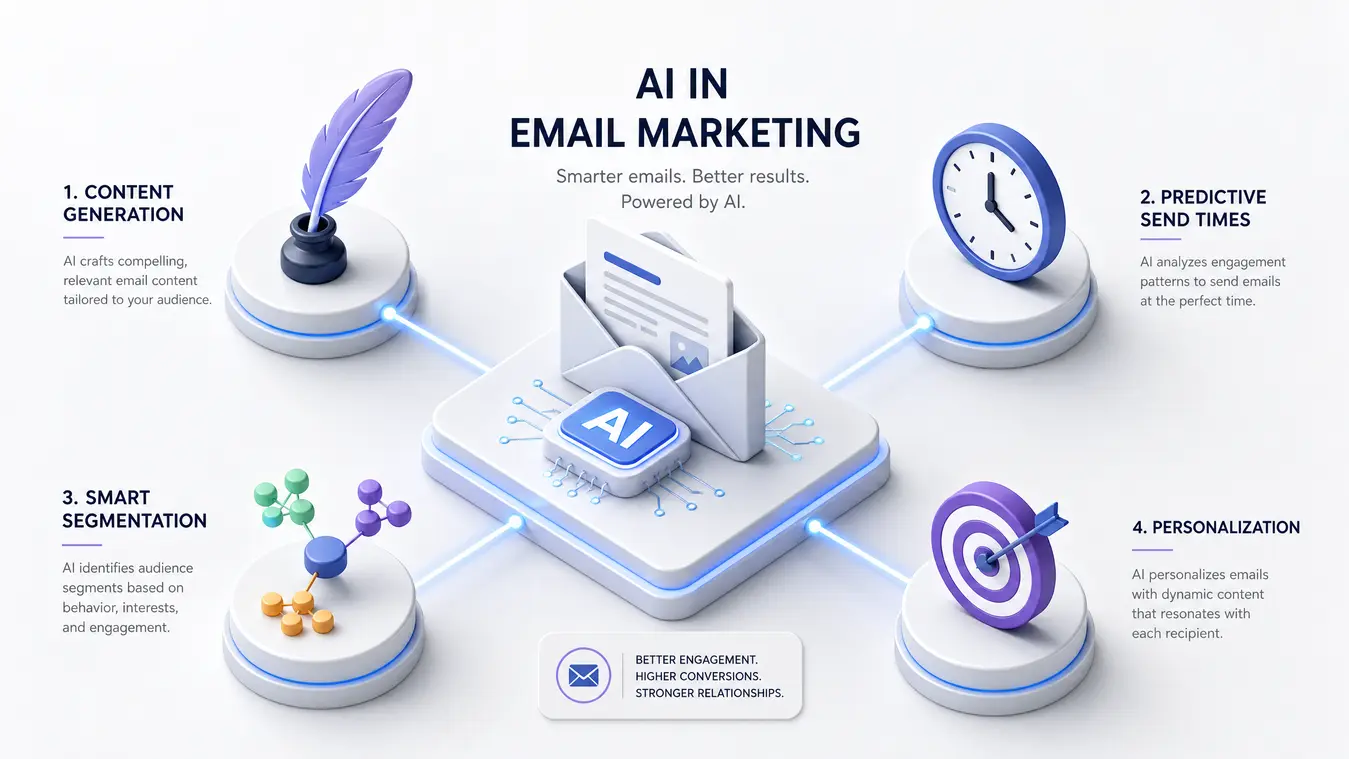
Content Generation and RewritingThe most visible application of AI in email marketing is content generation. Modern platforms use large language models (LLMs) to draft entire email sequences, generate multiple subject line variations, and rewrite existing copy to match different tones or demographics. Unlike the robotic outputs of 2024, 2026 models can ingest brand guidelines and previous campaign performance to generate copy that sounds remarkably human. Tools like Jasper AI and Brevo’s Aura assistant have become indispensable for overcoming writer’s block and rapidly producing first drafts that require only light editing.
Predictive Send Times and Deliverability
AI has revolutionized send-time optimization. Instead of blasting an entire list at a single scheduled time, AI-powered platforms analyze individual subscriber engagement patterns—factoring in time zones, historical open rates, and device usage—to predict the exact minute each subscriber is most likely to open an email. Furthermore, AI deliverability tools now monitor sender reputation in real-time, automatically pausing campaigns or adjusting sending volumes if they detect a spike in spam complaints or bounces. This predictive capability ensures that your emails land in the primary inbox rather than the spam folder.
Smart Segmentation and Behavioral Targeting
Traditional segmentation relied on static tags and explicit form fields. Today, AI segmentation analyzes implicit behavioral data—such as time spent on specific web pages, purchase history, and email interaction patterns—to create dynamic, micro-segments. This allows marketers to send highly targeted messages based on predicted future behavior rather than past actions alone. By dynamically grouping users, AI ensures that every subscriber receives the most relevant message possible, drastically improving click-through rates.
Automated Campaign Building and Performance Prediction
The latest generation of email marketing software features autonomous agents capable of building entire campaigns from scratch. By analyzing historical performance data, these AI agents can predict which layout, imagery, and call-to-action combinations will yield the highest return on investment before the campaign is even launched. They can then automatically adjust the campaign parameters in real-time based on initial engagement metrics, essentially acting as a tireless, data-driven marketing manager.
Best AI Email Marketing Tools 2026
The market in 2026 is divided into two distinct categories: all-in-one email marketing platforms with deeply integrated AI, and specialized AI writing tools designed to integrate with existing platforms. Here are the best options across both categories.
1. HubSpot
HubSpot remains the undisputed heavyweight champion for B2B and SaaS email marketing. Their Breeze AI agents represent a massive leap forward, offering autonomous agents that manage strategy, content creation, and execution.
Key features:
- Breeze AI Agents: Autonomous agents that can manage marketing tasks, from drafting emails to analyzing campaign performance.
- Predictive Lead Scoring: AI that analyzes historical data to predict which leads are most likely to convert.
- CRM-Integrated AI: Seamless integration of AI tools directly within the CRM, ensuring data-driven personalization.
Pros:
- Unmatched CRM integration
- Powerful autonomous AI agents
- Excellent for complex B2B funnels
Cons:
- Expensive as you scale
- Steep learning curve
- AI features require higher-tier plans
Pricing: HubSpot Marketing Hub starts at $20/month, but advanced AI features require the Professional tier ($890/month).
2. ActiveCampaign
ActiveCampaign has aggressively integrated AI into their platform through their “Active Intelligence” system. It is arguably the most sophisticated automation platform on the market, blending AI with deep workflow customization.
Key features:
- Active Intelligence: A system of 12+ AI agents that assist in campaign creation, automation building, and data analysis.
- Content Gen AI: Generates email copy, subject lines, and preheaders based on user prompts.
- Predictive Sending: AI-driven send time optimization and predictive analytics.
Pros:
- Best-in-class automation builder
- Strong AI-driven analytics
- Highly customizable workflows
Cons:
- Interface can be overwhelming for beginners
- Complex pricing structure
- AI features are not available on the lowest tier
Pricing: ActiveCampaign starts at $15/month, with advanced AI features included in the Plus plan ($29/month).
3. Klaviyo
For ecommerce brands, especially those on Shopify, Klaviyo is the gold standard. Their K:AI platform focuses heavily on revenue generation, using predictive analytics to identify the most valuable customers and automate revenue-driving flows.
Key features:
- K:AI Predictive Analytics: Forecasts customer lifetime value (CLV) and churn risk.
- AI-Powered Copy: Generates product recommendations and tailored messaging based on purchase history.
- Smart Segmentation: Automatically creates segments based on predictive scores.
Pros:
- Best-in-class ecommerce integration
- Deep predictive analytics
- High ROI for retail brands
Cons:
- Can become very expensive as the contact list grows
- Less focused on B2B or content marketing
- Strict adherence to their best practices is required
Pricing: Klaviyo offers a free plan, with paid plans starting at $45/month.
4. Mailchimp
Mailchimp has transformed from a simple newsletter tool into a comprehensive marketing platform powered by its AI Content Studio. It is particularly well-suited for small businesses that need a balance of power and ease of use.
Key features:
- AI Content Studio: Generates full email layouts, copy, and images based on simple prompts.
- Smart Recommendations: AI suggests optimal send times, subject lines, and content.
- Predictive Analytics: Forecasts open rates and click-through rates before sending.
Pros:
- Very user-friendly interface
- Strong AI content generation tools
- Generous free plan for beginners
Cons:
- Expensive for large lists
- Limited advanced automation compared to ActiveCampaign
- AI features can sometimes feel generic
Pricing: Mailchimp offers a free plan, with Standard pricing starting at $13/month.
5. Brevo (formerly Sendinblue)
Brevo stands out in 2026 for offering powerful AI features, including their Aura AI writing assistant, at a highly competitive price point. It is an excellent choice for businesses looking for multi-channel marketing without the premium cost of enterprise platforms.
Key features:
- Aura AI Assistant: Generates email subject lines, body copy, and WhatsApp messages.
- Transactional Email: Strong transactional email capabilities alongside marketing campaigns.
- Multi-Channel Automation: Combines email, SMS, and WhatsApp in a single workflow.
Pros:
- Extremely affordable
- Good AI writing tools
- Multi-channel capabilities
Cons:
- Template designs can be basic
- Deliverability varies depending on configuration
- Less advanced predictive analytics than Klaviyo
Pricing: Brevo offers a free plan, with paid plans starting at $8.08/month.
6. Jasper AI
While not an email marketing platform itself, Jasper is the premier specialized AI writing tool. Many teams use Jasper to draft campaigns and then upload the content to their ESP (Email Service Provider).
Key features:
- Brand Voice Training: Learns your company’s tone and style guidelines.
- Marketing Templates: Specific templates for email sequences, ad copy, and landing pages.
- Campaign Workflow: Allows for collaborative editing and approval processes.
Pros:
- High-quality, brand-consistent copy
- Excellent for agencies managing multiple brands
- Deep customization options
Cons:
- Subscription is expensive ($49-$125+/month)
- Requires integration with an ESP
- Steep learning curve for advanced features
Pricing: Jasper starts at $49/month.
How to Use AI Effectively in Email Marketing
Owning an AI tool is only half the battle; using it effectively requires a strategic approach. The goal is to use AI to handle the heavy lifting of data processing and initial drafting, while retaining human oversight for strategy and brand alignment.

Practical Playbook: Writing Better Emails with AI
The most common mistake marketers make with AI is asking it to “write an email about our summer sale.” This results in generic, robotic copy that readers immediately recognize as AI-generated. The secret to great AI copy is providing highly specific, context-rich prompts.

**Example Prompt for Subject Lines:**Instead of: “Write a subject line for a sale.”Try: “Generate 5 subject lines for a summer sale targeting ecommerce customers who have abandoned their carts in the last 7 days. The tone should be urgent but playful. Include one option that uses FOMO (Fear Of Missing Out) and one that focuses on the discount amount. Keep them under 45 characters.”
**Example Prompt for Body Copy:**Instead of: “Write an email about our new software feature.”Try: “Draft a 200-word email announcement for our new predictive analytics feature. Target B2B SaaS marketing managers. Highlight that it saves 5 hours a week. Use a professional, authoritative tone, and include a clear call-to-action to book a demo. Avoid using jargon like ‘synergy’ or ‘leverage’.”
Building Smart Automation Sequences
AI excels at building complex automation workflows. Instead of manually setting up if/then logic, you can use AI agents (like those in ActiveCampaign or HubSpot) to generate the entire sequence.
- Define the Trigger: Clearly state the action that will start the automation (e.g., “User downloads whitepaper”).
- Set the Goal: Define the desired outcome (e.g., “User books a sales call”).
- Prompt the AI: Ask the AI to build a 5-step email sequence that moves the user from the trigger to the goal, specifying the time delays between each email and the specific educational value each email should provide.
- Review and Refine: Always review the AI-generated logic. Ensure the branching paths make sense and that the content aligns with your brand voice.
Personalization That Doesn’t Feel Robotic
True personalization goes beyond inserting a first name into the subject line. It involves tailoring the entire content of the email based on the recipient’s behavior.
Use AI to dynamically generate content blocks. For example, if a user frequently clicks on articles about SEO, the AI can generate a personalized product recommendation for an SEO tool within the newsletter. The key is to use the AI to analyze the data and suggest the personalization, but human reviewers should ensure the recommendations are accurate and not creepy.
Combining AI with Human Oversight
AI is a powerful assistant, but it is not a replacement for human judgment. Always implement a “human-in-the-loop” workflow.
- Draft: Let the AI generate the initial copy and structure.
- Review: Have a human editor check for brand voice consistency, accuracy, and tone.
- Edit: Adjust the copy to add nuance, humor, or specific cultural references that AI cannot grasp.
- Deploy: Send the campaign.
- Analyze: Use AI to analyze the results and suggest improvements for the next campaign.
AI Email Marketing Best Practices 2026
As AI becomes ubiquitous, the baseline quality of email copy is rising, which means standing out requires more effort. Here are the critical best practices for 2026.
Do’s:
- Train the AI on your brand: Always upload past successful campaigns, brand guidelines, and tone-of-voice documents to your AI tool before generating new content.
- A/B test AI-generated copy: Never assume the AI’s first draft is the best. Use A/B testing to see which AI variations perform best with your specific audience.
- Focus on high-value AI tasks: Let AI handle segmentation, send-time optimization, and initial drafting. Focus your human effort on strategy, creative direction, and complex customer interactions.
Don’ts:
- Don’t rely entirely on AI: Sending 100% AI-generated copy without human review will eventually alienate your audience. They will recognize the generic tone.
- Don’t ignore compliance: AI tools are not always up-to-date on GDPR, CCPA, or CAN-SPAM regulations. Ensure your automated workflows and unsubscribe processes are compliant.
- Don’t over-personalize to the point of being creepy: There is a fine line between helpful personalization and invasive surveillance. Use predictive analytics responsibly.
AI Email Marketing by Use Case
Different business models require different AI applications. Here is how to apply AI effectively based on your specific use case.

Ecommerce
For ecommerce brands, the primary goal of AI is to increase revenue per recipient. Tools like Klaviyo excel here by using predictive analytics to identify VIP customers and those at risk of churning. AI-driven product recommendations, triggered by browsing behavior, should be the cornerstone of your automation strategy.
B2B / SaaS
In B2B, the sales cycle is longer and requires more education. AI tools like HubSpot are ideal for managing complex lead nurturing sequences. Use AI to score leads based on engagement, automatically routing highly engaged prospects to the sales team while keeping others in automated educational flows.
Creators & Newsletters
Creators rely heavily on subscriber engagement and monetization. AI writing assistants (like those in ConvertKit or Jasper) are invaluable for drafting newsletters quickly. Use AI to summarize long-form content into digestible email updates, and use predictive segmentation to send targeted sponsorship offers to the most active readers.
Small Businesses & Solopreneurs
For solo operators, time is the most valuable asset. Platforms like Brevo or Mailchimp offer AI features that automate the entire campaign creation process. Use AI to generate the entire email—from subject line to body copy—based on a simple prompt, allowing you to maintain a consistent sending schedule without spending hours writing.
Common Mistakes When Using AI for Email
While AI is powerful, it is easy to misuse it. Avoid these common pitfalls to ensure your email marketing remains effective.
The “Generic AI Voice” TrapThe most frequent mistake is publishing AI-generated copy without editing it. AI models tend to use similar phrasing, predictable structures, and overly enthusiastic tones (e.g., “Unlock your potential today!”). Always edit the output to match your authentic brand voice.
Ignoring the ContextAI tools operate in a vacuum unless you provide them with context. If you do not upload your brand guidelines or past performance data, the AI will generate content based on general internet trends, which is rarely specific to your audience.
Over-Automating to the Point of SpammingAI allows you to send more emails than ever before, but just because you can, doesn’t mean you should. Over-automating can lead to subscriber fatigue and increased unsubscribe rates. Use AI to send the right message at the right time, not just to send more messages.
Future Trends in AI Email Marketing
The evolution of AI in email marketing is accelerating. Looking ahead, we can expect several key trends to define the next phase of the industry.

Autonomous Marketing AgentsThe future is not just about AI assisting marketers; it is about AI acting autonomously. We will see a rise in fully autonomous AI agents that can plan, execute, and optimize entire email marketing strategies with minimal human intervention, handling everything from content creation to A/B testing and list management.
Hyper-Personalized Dynamic ContentDynamic content will become the standard. Instead of sending slightly different versions of an email to different segments, AI will generate entirely unique emails for every single subscriber, tailored to their specific interests, browsing history, and current context, in real-time.
Integration of Multimodal AIAI will increasingly handle not just text, but also visual and interactive elements. We will see AI tools that automatically generate custom images, GIFs, and interactive AMP components within emails, based on the text copy and the recipient’s preferences.
Final Recommendations
Choosing the right AI email marketing tool depends heavily on your specific business model, budget, and technical expertise.
Best Overall: ActiveCampaign offers the most robust blend of powerful automation and advanced AI capabilities, making it the top choice for growing businesses and agencies.
Best for Ecommerce: Klaviyo is unmatched for revenue-focused, data-driven email marketing, leveraging its K:AI platform to maximize lifetime value.
Best for B2B/SaaS: HubSpot provides the best CRM-integrated AI experience, essential for managing complex, long-term B2B sales cycles.
Best Starter Stack (Budget-Friendly): For solopreneurs or small businesses just starting out, Brevo offers excellent AI writing tools and a highly generous free plan, allowing you to scale your AI-driven campaigns without breaking the bank.
FAQs
**Can AI do email marketing for me entirely?**While AI can automate many tasks, including drafting copy and building workflows, it is not recommended to hand over complete control. Human oversight is still essential for brand alignment, strategic direction, and ensuring the AI does not generate inaccurate or inappropriate content.
**What is the best AI tool for email subject lines?**The best tool depends on your ESP. However, tools like Brevo’s Aura, Mailchimp’s AI Content Studio, and specialized tools like Jasper AI are highly effective at generating and A/B testing subject line variations based on engagement data.
**Is AI-generated email copy compliant with spam laws?**AI tools generate the text, but they do not manage your sending practices. Compliance with laws like CAN-SPAM, GDPR, and CCPA depends on your mailing practices, such as including a physical address and a clear unsubscribe link, which you must ensure are present regardless of who (or what) wrote the email.
**How do I train an AI tool to match my brand voice?**Most advanced AI tools (like Jasper or HubSpot’s Breeze) allow you to upload brand guidelines, past successful emails, and tone-of-voice documents. The AI analyzes these inputs to generate future copy that aligns with your established brand identity.
**Will AI replace email marketers?**AI is a powerful tool that will automate many repetitive tasks, but it will not replace strategic email marketers. Marketers who learn to effectively prompt, manage, and edit AI outputs will become significantly more productive and valuable.
Conclusion
The integration of AI into email marketing is no longer a futuristic concept; it is the current reality. The tools available in 2026 offer unprecedented capabilities for content generation, predictive analytics, and workflow automation. However, the technology is only as effective as the strategy behind it. By understanding both the power and the limitations of AI, you can build email marketing campaigns that are not only highly efficient but also deeply personalized and engaging. The key to success in 2026 is not to let AI take over completely, but to use it as a force multiplier for your own strategic insights and brand vision.
Ready to elevate your email marketing? Start by auditing your current workflow, identifying the most time-consuming tasks, and exploring how the AI tools recommended in this guide can automate them for you.


