
Toptal vs Arc.dev (2026): Honest TCO Comparison
If you are reading this in 2026, the landscape of remote engineering talent has fundamentally shifted. The days of blindly paying a 50% markup for “premium” freelance talent are over. Engineering leaders are under immense pressure to balance velocity with runway, and the choice of talent platform can literally make or break a Q3 roadmap.
As a collaborative panel comprising a Fortune 500 CTO, a Scaling Startup CEO, and a Talent Platform Analyst, we have analyzed the real-world performance of the two heavyweights in the vetted talent space: Toptal and Arc.dev.
Toptal vs Arc.dev
A data-driven capability matrix for engineering leaders making high-stakes hiring decisions.
Marketing, PM, Sales
Marketing, PM
This is a brutally honest, data-backed look at Total Cost of Ownership (TCO), vetting reality, and platform mechanics in 2026. We will clearly show where Toptal remains the undisputed king of premium short-term hires, and why Arc.dev is quietly eating their lunch when it comes to long-term value and team integration.

The 30-Second Executive Glimpse
Here is what you need to know before diving deeper:
- Toptal remains the gold standard for immediate, low-risk, high-budget hires. If you need a hyper-specialized engineer tomorrow and budget is irrelevant, Toptal is your answer.
- Arc.dev offers nearly identical vetting rigor but strips away the massive opaque markup. For startups and scale-ups hiring for 6+ months, Arc.dev is the mathematically superior choice.
- The TCO Gap: Hiring a senior developer on Toptal for 6 months will cost you roughly $62,400 more than hiring an equally vetted developer on Arc.dev. At 4 engineers, that gap becomes $249,600.
- The Verdict: Toptal is a luxury tool for specific use cases. Arc.dev is the default smart choice for 80% of engineering hiring decisions in 2026.
1. The Vetting Reality: “Top 3%” vs “Top 1%”
Both platforms sell you peace of mind through rigorous vetting. In 2026, the traditional “spray and pray” model of open marketplaces is a non-starter for serious engineering teams. But how do the elite platforms actually compare under the hood?
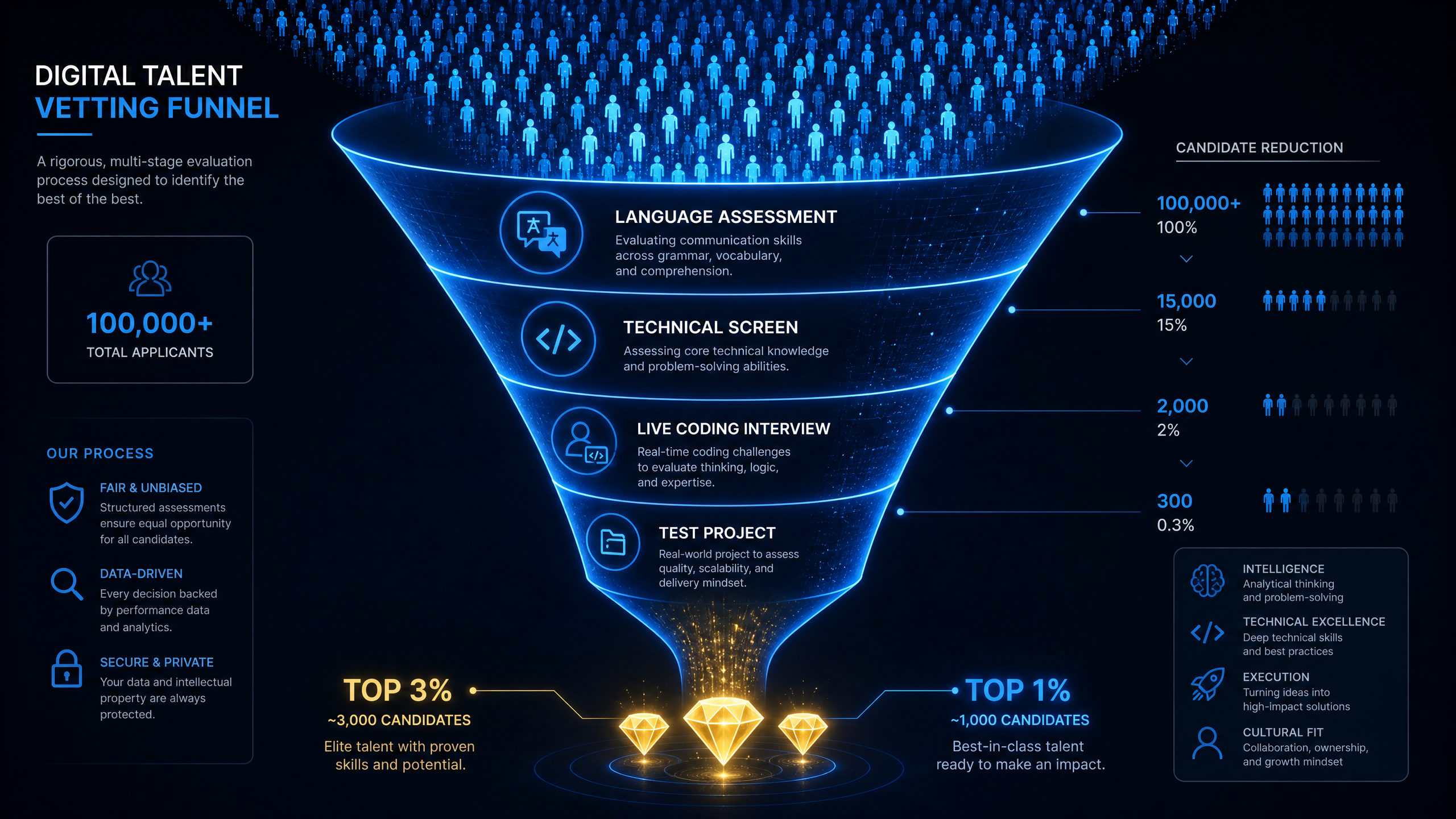
Toptal’s Vetting Machine (Top 3%)
Toptal famously accepts less than 3% of applicants through a five-stage process: language and personality assessment, in-depth skill review, live screening with domain experts, a test project lasting one to three weeks, and ongoing performance monitoring. The result is a network of developers who are not only technically excellent but also exceptional communicators who can operate with minimal oversight.
In 2026, Toptal was ranked #11 on Newsweek’s Most Reliable Companies in America list — the highest-ranked professional services firm, above Accenture (#33), Deloitte (#39), and McKinsey (#80). This is not marketing fluff; it is a verified signal of enterprise-grade reliability that matters when you are defending a vendor choice to a Fortune 500 procurement committee.
Arc.dev’s Tech-First Approach (Top 1–2%)
Arc (formerly CodementorX) boasts an even stricter acceptance rate for technical roles. Because their DNA is rooted in developer mentorship, their technical screeners are often deeper subject matter experts than Toptal’s generalist reviewers. Arc also conducts English fluency assessments and evaluates distributed work experience, ensuring developers are not just technically excellent but also prepared for the specific challenges of asynchronous remote collaboration.
The Verdict: It is effectively a tie on vetting quality. Both platforms will deliver a developer who will not embarrass you in a sprint review. The difference is not who passes — it is how much you pay for the privilege.
| Vetting Dimension | Toptal | Arc.dev |
|---|---|---|
| Acceptance Rate | Top 3% | Top 1–2% |
| Vetting Stages | 5 stages | 6 stages |
| Technical Depth | Strong (generalist) | Very strong (tech-specialist) |
| Communication Assessment | Yes | Yes |
| Remote Work Evaluation | Partial | Comprehensive |
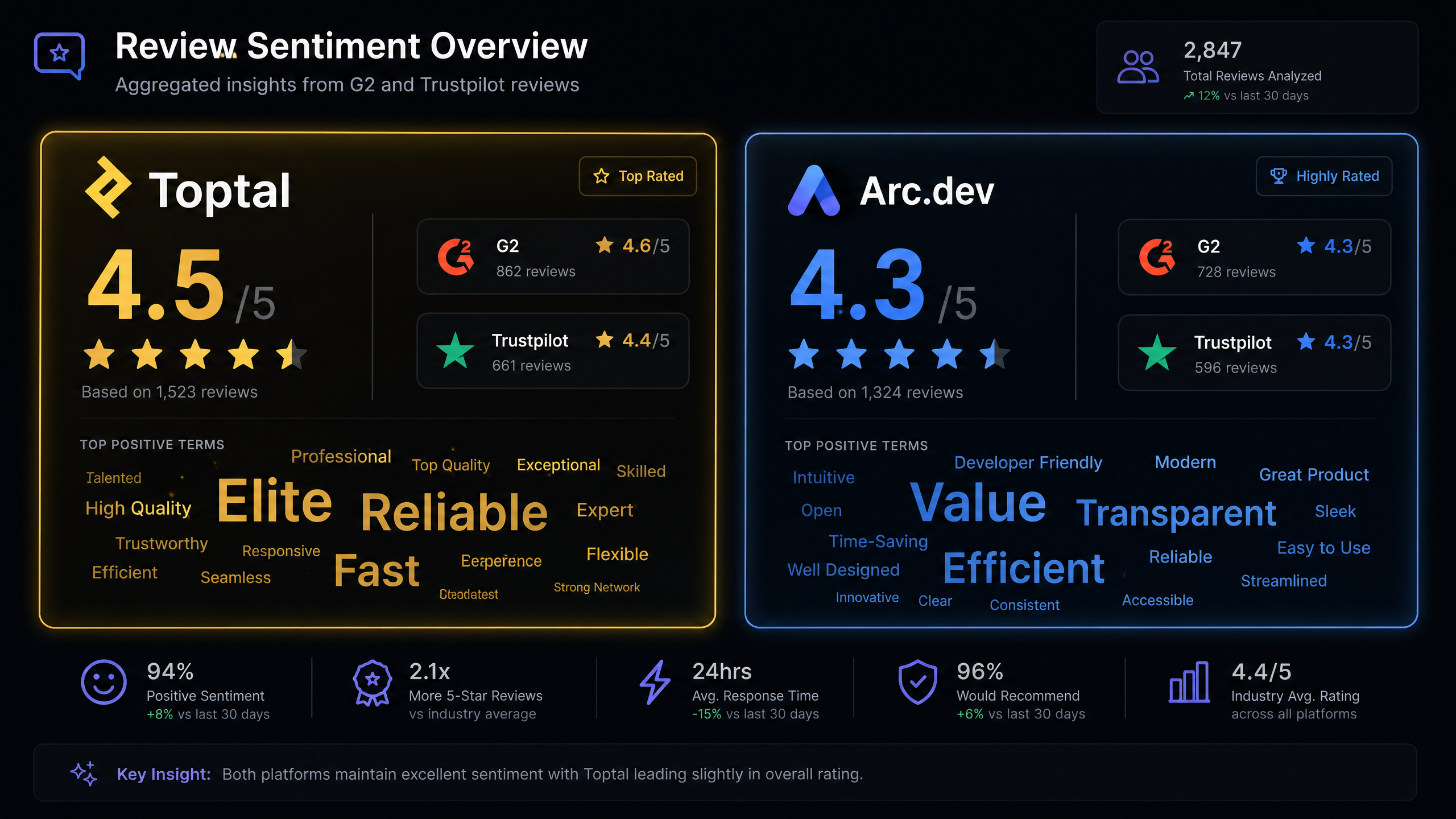
| G2 Rating (2026) | 4.5 / 5 | 4.3 / 5 |
2. Total Cost of Ownership: The Hidden Iceberg
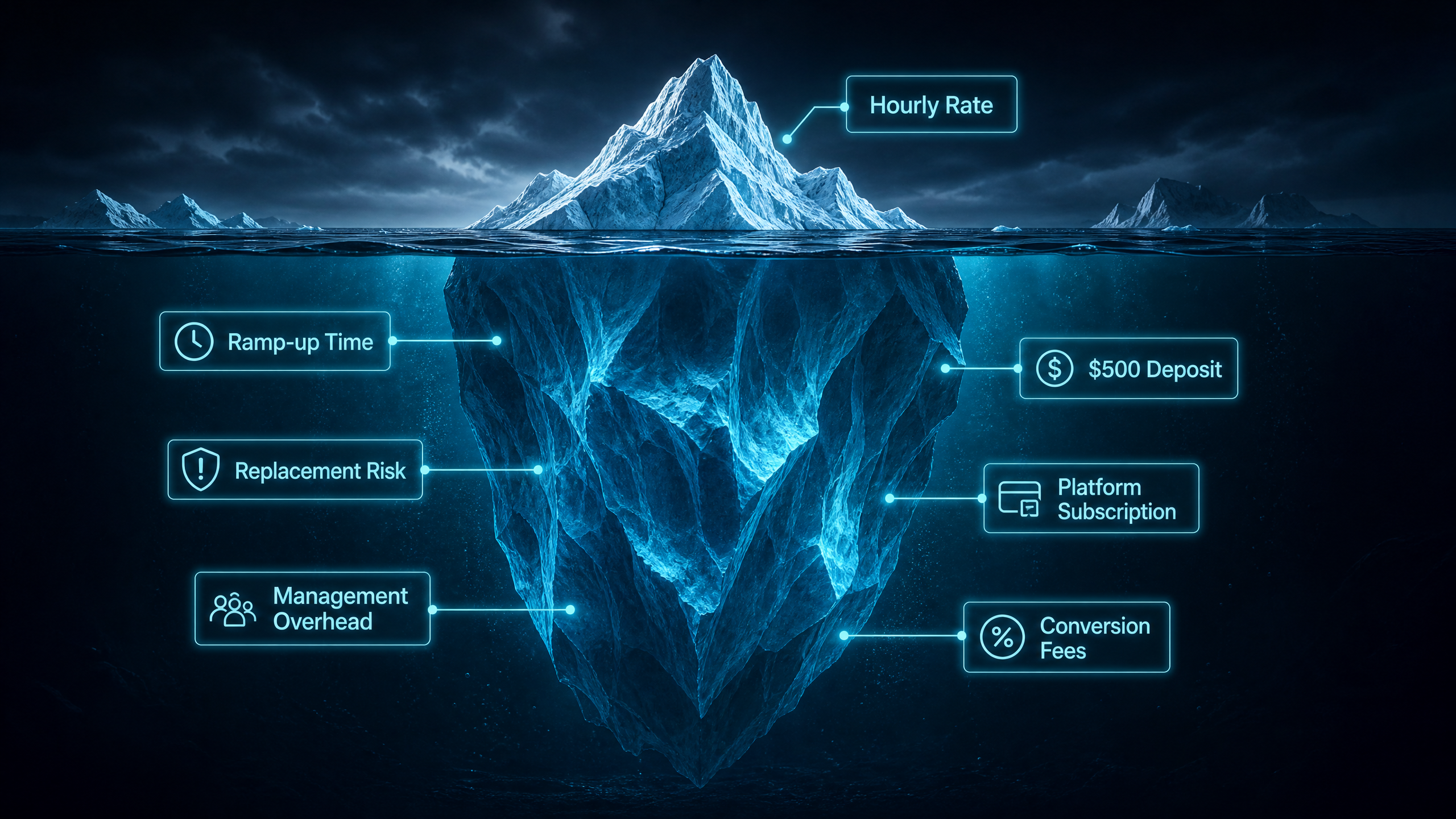
This is the section most comparison articles skip, and it is the most important one for any leader who is accountable for a budget. The hourly rate is just the tip of the iceberg.
Toptal’s Pricing Model (The Premium Markup)
Toptal requires a $500 initial deposit before the talent search even begins. This deposit is refundable but is frequently cited in G2 and Trustpilot reviews as slow to recover when a match is not made. On top of that, clients pay a $79/month platform subscription fee once they proceed with a talent search.
Senior developers on Toptal typically range from $100 to $200+ per hour. The critical issue is that Toptal does not disclose its markup. Industry analysts and client reviews consistently estimate the platform margin at 30% to 50%, meaning the developer you are paying $150/hr for may be earning $80–$100/hr. You have no way to benchmark whether you are paying fairly.
Arc.dev’s Pricing Model (The Value Play)
Arc has no upfront deposit and no platform subscription. Senior developers typically range from $60 to $110+ per hour, and Arc’s pricing is significantly more transparent. The platform operates on a leaner margin, passing the savings directly to the client. For full-time hires, Arc charges a one-time 20% fee based on the first year’s salary — a clean, benchmarkable structure.
The 3-Month and 6-Month TCO Calculation (1 Senior Full-Stack Developer, 160 hrs/month)
| Cost Component | Toptal | Arc.dev |
|---|---|---|
| Avg. Senior Hourly Rate | $150/hr | $85/hr |
| Monthly Cost (160 hrs) | $24,000 | $13,600 |
| Platform Subscription | $79/mo | $0 |
| Initial Deposit | $500 (locked) | $0 |
| Ramp-up Cost (2 weeks) | ~$6,000 | ~$3,400 |
| 3-Month TCO | ~$78,237 | ~$44,200 |
| 6-Month TCO | ~$144,474 | ~$81,600 |
| 6-Month Savings | — | ~$62,874 |
Scaling the Math: If you are hiring a team of 4 senior engineers for a 6-month product build, choosing Arc.dev over Toptal saves you approximately $251,496 — enough to fund two additional junior developers for an entire year, or extend your startup’s runway by two to three months.

The Hidden Costs That Never Appear in Rate Cards
Beyond the headline numbers, there are five hidden costs that engineering leaders consistently underestimate:
Ramp-up Time is the cost of the first one to two weeks when a developer is learning your codebase, your team’s conventions, and your product context. At Toptal’s $150/hr, this dead-weight cost is $6,000. At Arc’s $85/hr, it is $3,400. If a developer churns after three months and you need to replace them, you pay this cost again.
Replacement Risk is significantly higher on Toptal’s freelance model. Toptal developers often maintain multiple concurrent client relationships. If a critical project milestone coincides with another client’s urgent need, your developer’s attention is split. Arc.dev’s staff augmentation orientation means developers are more likely to treat your engagement as their primary commitment.
Management Overhead on Toptal is lower for short-term engagements because the developer is expected to operate autonomously. For long-term product development, however, this autonomy can become a liability. Developers who operate as freelancers rather than embedded team members require more explicit scope definition, more formal communication protocols, and more deliberate knowledge transfer.
Conversion Fees are a hidden trap that many clients discover only when they want to hire a Toptal developer full-time. Toptal’s contracts include provisions that charge a significant buyout fee for direct employment — a cost that can run into tens of thousands of dollars and effectively locks you into the platform for the duration of the engagement.
The $500 Deposit Friction is a real operational issue. Multiple G2 and Trustpilot reviews from 2025 and 2026 document cases where clients needed to follow up repeatedly to recover their deposit when a match was not made. For a startup with tight cash flow, having $500 locked in a platform deposit for weeks is a genuine inconvenience.
3. Speed, Support, and Platform Mechanics
Hiring Velocity: Toptal’s Unmatched Speed
Toptal’s average time-to-match is under 24 hours. This is genuinely impressive and represents a meaningful competitive advantage for time-sensitive engagements. If your lead developer resigns on a Friday and you have a critical sprint starting Monday, Toptal’s matching engine is the only platform that can realistically close that gap.
Arc.dev typically delivers candidates within 24 to 72 hours. For most non-emergency hiring scenarios, this difference is negligible. However, for the specific use case of emergency specialist replacement, Toptal’s speed advantage is real and worth the premium.

Platform Integration and Management Overhead
Toptal’s platform is highly polished. Time tracking, invoicing, project management tools, and support are enterprise-grade. The platform supports communication, progress tracking, and payments in one centralized interface. For a Fortune 500 procurement team that needs clean audit trails and consolidated billing, Toptal’s infrastructure is genuinely superior.
Arc.dev’s platform is designed for startups and growing teams. Their HireAI tool uses AI to match candidates based on role, hiring needs, and budget. The platform provides a talent dashboard for reviewing shortlisted candidates and tracking hiring stages. It is functional and efficient, though it lacks the enterprise polish of Toptal’s interface.
The Freelance vs. Staff Augmentation Distinction
This is perhaps the most important and least-discussed distinction between the two platforms. Toptal is, at its core, a freelance marketplace. Developers on Toptal operate as independent contractors who may have multiple concurrent clients, work in a freelance style, and do not integrate into your team as full-time members.
Arc.dev, by contrast, leans strongly toward staff augmentation. Their developers are accustomed to integrating into your Slack, Jira, GitHub, and company culture. They attend your standups, participate in your sprint planning, and behave like embedded team members rather than external consultants. For any engagement longer than three months, this cultural distinction has a significant impact on team cohesion, knowledge retention, and product quality.

4. When Should You Still Choose Toptal in 2026?
We promised to be brutally honest. Toptal is not obsolete. It is a precision instrument designed for specific, high-stakes use cases. The mistake most companies make is using a precision instrument for every job.
Scenario 1: The Emergency Specialist
Your Series B fintech startup has a critical PCI-DSS compliance audit in three weeks. Your lead security engineer just resigned. You need a certified payment security specialist with Stripe and AWS experience, and you need them by Monday. This is Toptal’s use case. Pay the premium, get the specialist, pass the audit. The cost is irrelevant compared to the risk.
Scenario 2: The Enterprise Procurement Requirement
Your Fortune 500 client has specified that all third-party contractors must come from vendors on their approved vendor list. Toptal is on that list. Arc.dev is not. This is not a quality decision — it is a procurement decision. Toptal wins by default.
Scenario 3: The Non-Tech Hire
You need a fractional CFO to prepare your Series C deck, a brand strategist to reposition your product, and a React developer simultaneously. Toptal’s multi-discipline network covers all three. Arc.dev’s tech-first focus means you will need a different platform for the non-technical roles.
Scenario 4: The Minimal-Oversight Engagement
You are a solo founder with no internal engineering team. You need a senior developer who can operate completely autonomously, make architectural decisions independently, and deliver a working MVP with zero hand-holding. Toptal’s culture of high-autonomy freelancers is perfectly suited to this use case.

5. When is Arc.dev the Smarter Choice?
For the vast majority of startups, scale-ups, and modern tech companies in 2026, Arc.dev represents the superior ROI. The platform has matured significantly since its CodementorX days and now offers a compelling combination of vetting quality, hiring speed, and pricing transparency that Toptal simply cannot match on a TCO basis.
Scenario 1: The Long-Term Product TeamYou are a Series A startup building a core product. You need three senior engineers for 12 months. At Toptal’s rates, that engagement costs approximately $864,000. At Arc.dev’s rates, it costs approximately $490,000. The $374,000 difference is not a rounding error — it is the difference between profitability and another funding round.
Scenario 2: The Scaling Engineering OrganizationYou are a VP of Engineering at a Series C company scaling from 20 to 50 engineers over the next 18 months. You need developers who will integrate into your existing team, adopt your engineering culture, and stay for the long term. Arc.dev’s staff augmentation orientation is purpose-built for this use case.
Scenario 3: The Transparent Procurement MandateYour CFO has mandated that all vendor contracts must have benchmarkable, transparent pricing. Toptal’s opaque markup structure fails this requirement. Arc.dev’s transparent hourly rates and clean fee structure pass it.
Scenario 4: The Budget-Constrained StartupYou have 18 months of runway. Every dollar matters. You need senior engineering talent but cannot afford to burn $62,400 per developer per 6 months on platform markup. Arc.dev delivers equivalent talent quality at a TCO that preserves your runway.
Final Verdict: The 2026 Decision Crossroads

In 2026, the “Toptal Premium” is a luxury tax that is justified in approximately 20% of hiring scenarios. For the remaining 80%, it is an expensive habit that engineering leaders are increasingly unwilling to defend to their boards.
Toptal remains the undisputed champion for short-term, high-urgency, budget-unconstrained engagements. Its 24-hour matching, enterprise-grade support, and multi-discipline network are genuinely differentiated. If you need a specialist tomorrow and cost is secondary, there is no better platform.
Arc.dev is the default smart choice for 2026. It delivers equivalent vetting quality, comparable hiring speed, and dramatically better TCO for any engagement longer than three months. Its staff augmentation orientation makes it the superior choice for building long-term product teams. And its transparent pricing means you can actually benchmark whether you are paying fairly — a basic expectation that Toptal still fails to meet.
The question is not which platform is better. The question is which platform is right for your specific situation. Use the decision framework below to find your answer.
Platform Quick-Reference Summary
| Dimension | Toptal | Arc.dev |
|---|---|---|
| Best For | Short-term, urgent, enterprise | Long-term, scalable, startup/scale-up |
| Vetting | Top 3% (5 stages) | Top 1–2% (6 stages, tech-focused) |
| Matching Speed | Under 24 hours | 24–72 hours |
| Senior Rate | $100–$200+/hr | $60–$110+/hr |
| Upfront Deposit | $500 | $0 |
| Platform Fee | $79/month | $0 |
| 6-Month TCO | ~$144,000 | ~$81,600 |
| Markup Transparency | Opaque (30–50%) | Transparent |
| Trial Period | 2 weeks, no risk | 2 weeks, no risk |
| Talent Scope | Multi-discipline | Tech-focused |
| G2 Rating | 4.5 / 5 | 4.3 / 5 |
| Best Engagement Model | Freelance / short-term | Staff augmentation / long-term |


