
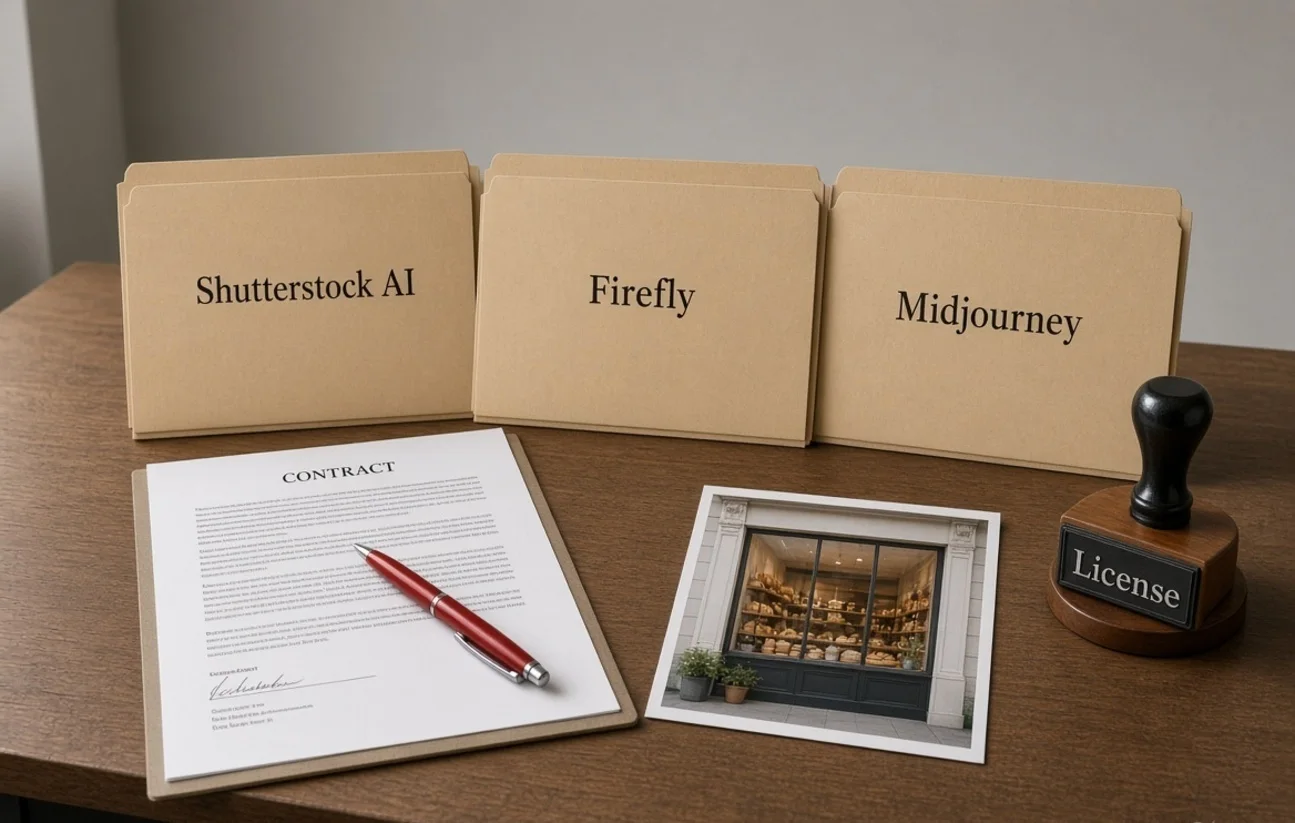
Shutterstock AI vs Firefly vs Midjourney: License & Risk
A client ad still has to hold up in twelve months. That is the job. Shutterstock AI, Adobe Firefly, and Midjourney can all make a stock-style picture. They do not hand you the same license, the same defense, or the same right to put the file back on a stock site.
Pretty is a different page. This one asks a narrower question. Can a brand, a lawyer, or an agency reviewer live with the file?
License and risk, not a beauty contest
Which file survives a client ad
Pretty is not the job. A paid ad, a package, or a stock upload is. These three tools do not hand you the same defense.
Policies checked: October 2026. Prices change. A vendor license is not a copyright registration.
We earn commissions when you shop through the links below.
Verdict by use
Social filler, decks
Any paid tool
Midjourney is fine if the company is under the $1 million gate. Speed beats indemnity here.
Paid ad, small client
Firefly paid, or Shutterstock after review
You want a vendor that will name a commercial license. Review the file if a face or logo appears.
Packaging, national brand
Firefly enterprise, or a released photo
“You own it” is not “we will defend the suit.” If the contract omits indemnity, buy a released stock photo.
Stock contributor
Usually skip generators
Shutterstock does not accept contributor AI uploads. Adobe Stock and Dreamstime are conditional, not a free pass.
Indemnity snapshot
| Tool | Commercial use | Who defends a claim | Cap | Main exclusion |
|---|---|---|---|---|
| Shutterstock AI | During a paid subscription, after the file is licensed | Shutterstock, only after an “approval for commercial use” when the picture shows a trademark, a copyrighted work, or a public personality | License page lists $10,000 Standard and $250,000 Enhanced image licenses | No automatic cover for trademarks, famous faces, or famous characters |
| Adobe Firefly | Paid plans, non-beta features | Adobe, only if the contract includes the Firefly IP indemnity | Not published on the public sheet | Beta, non-Adobe models, and a seat without the entitlement |
| Midjourney | Paid plans. Company or employee over $1 million needs Pro or Mega to own the file | Silent. Midjourney does not offer to defend you | None published | Upscaling someone else’s image. No copyright guidance |
Shutterstock caps are from the license page indexed 30 September 2026. Confirm on the live sheet before you rely on a number.
Official tool pages only. This block compared license shape, not picture quality.
Verdict by use
There is no single winner. The use picks the tool.
Social filler, thumbnails, and internal decks can come from any paid tool. Midjourney is fine if the company is under the revenue gate. Risk is low. Speed matters more than a defense clause.
A paid ad for a small client should come from Firefly on a paid plan, or from Shutterstock’s generator if the file is reviewed and licensed on their sheet. You want a vendor that will name a commercial license.
Product packaging, a national brand, or anything a lawyer will see needs Firefly enterprise indemnity if the contract includes it. If the contract does not, buy a released stock photo. “You own it” is not the same as “we will defend the suit.”
Stock contributors should usually skip generators. Shutterstock does not accept AI uploads from contributors. Other sites have to be checked one by one.
Policies checked: October 2026.
How each tool is legally packaged in 2026
These are three different purchases. A prompt box is not a license.
Shutterstock AI sits inside a stock license. The pricing page sells generation credits. On some plans it also sells partner models from Runway, Google, and OpenAI. A partner-model file is not the same object as a file from a model trained on Shutterstock’s own library.
The license page indexed on 30 September 2026 grants access during the subscription. You may use the tools for your own business, including client work. Output still has to be licensed as content before you treat it as a cleared download. Posts from 2023 talked about broad enterprise indemnity. The live license is narrower. If the picture shows a trademark, a copyrighted work, or a public personality or famous character, Shutterstock does not indemnify you automatically. Some plans can request a content review. An “approval for commercial use” is what turns indemnity on. Even then, it runs under the ordinary terms.
Contributor rules point the other way. Shutterstock’s contributor help still says it will not accept AI submissions. Ownership cannot be assigned to one person, and they cannot verify which model made the file. That page was still the live policy in October 2026. Customers can generate. Contributors cannot upload the result.
Adobe Firefly lives inside Creative Cloud, Express, and its own plans. Adobe says current Firefly models were trained on licensed content, including Adobe Stock, and on public-domain work. It says customer files are not used to train those models. The credits FAQ, updated 30 September 2026, says you can use non-beta Firefly outputs in commercial projects. Beta outputs are not indemnified for eligible team and enterprise customers.
Indemnity is a contract, not a box on the $9.99 plan. The product page, published 27 August 2026, applies only if your agreement links to that URL. It lists the features, the apps, and the export click that trigger cover. It leaves out beta or trial features, and features powered by non-Adobe models. It does not publish a dollar cap. Adobe’s business FAQ says the company must buy the entitlement, and that buy needs a new contract. The routes named are an Adobe Express and Firefly site license, or certain Creative Cloud for enterprise plans. An old Creative Cloud seat does not carry it by itself.
Midjourney is a membership with an ownership clause, not a stock license. The terms, effective 27 May 2026, say you own the assets you create to the fullest extent the law allows. That grant still follows the agreement and third-party rights. Two exceptions sit in the same section. If you upscale someone else’s image, that image stays with the original creator. If you are a company, or any employee of a company, with more than $1,000,000 USD a year in revenue, you must be on Pro or Mega to own your assets. The commercial-use page says the same line in plainer words.
Ownership survives a later downgrade or cancel. Midjourney also says it cannot advise you on copyright. The copyright section does not offer to defend you. Stealth mode, which keeps new work out of the public gallery, is a Pro and Mega feature. A shared Discord room is still visible to the people in that room.
One asterisk sits on all three. The U.S. Copyright Office said in January 2025 that a generative output is protected only where a human set enough of the expressive choices. Prompts alone do not do that. A vendor license is not a copyright registration.
Indemnity table
This is the snippet. Who pays if a brand sues.
| Tool | Commercial use on which plan | Who defends a claim | Cap if published | What is excluded |
|---|---|---|---|---|
| Shutterstock AI | Paid subscription. File must be licensed. Review if it shows a mark, a copyrighted work, or a famous face | Shutterstock, after “approval for commercial use,” under the terms | $10,000 Standard Image License. $250,000 Enhanced. Indexed license page, 30 September 2026 | Automatic cover for trademarks, public personalities, and famous characters |
| Adobe Firefly | Paid plans for non-beta commercial use. Indemnity only on a qualifying enterprise entitlement | Adobe, if the contract includes the Firefly IP indemnity | Not published on the public sheet | Beta, non-Adobe models, and uses that break the agreement |
| Midjourney | Any paid plan under the revenue gate. Pro or Mega if you are the company, or an employee of a company, over $1 million | Silent. No customer indemnity in the copyright section | None published | Someone else’s upscale. No copyright advice |
Read the Shutterstock caps as license limits, not as a promise that every generated file is covered for $10,000. Screenshot the live license before you quote the number in a client email. Commercial use on a Firefly paid plan is not the same sentence as indemnity. The public sheet does not name a dollar cap. Do not paste a blog’s figure into a contract.
Can I sell this on Dreamstime, Shutterstock, or Adobe?
A buyer license is not a contributor seat. Check each desk.
Shutterstock. No. The contributor policy refuses AI submissions, including files from other tools. The model leans on many artists’ work, so the output cannot be assigned to one person. Their generator can still place a customer’s output into the catalog under Shutterstock’s rules. That is the platform’s pipe, not your upload button.
Adobe Stock. Yes, with labels, as of the contributor guide updated 11 June 2026. You must hold the rights the Contributor Agreement asks for. Tick “Created using generative AI tools.” If the face or place is fictional, tick “People and Property are fictional.” Do not put artist names, real people, or fictional characters in the prompt, title, or keywords. Adobe names Firefly and Midjourney as examples. It will not advise you on another tool’s license. A Midjourney file is allowed only if that paid-plan grant covers a stock submission. The fictional-people box is a statement to Adobe. It is not a model release.
Dreamstime. Conditional. The contributor FAQ welcomes AI uploads if you hold full rights, tag the file as AI, and file it in the generative category. Some tools grant those rights only on a paid plan. Realistic generated faces are refused, because a model release is not possible. Cartoon characters, figures from behind with no face, and body parts without a recognizable feature are the listed exceptions. A side view of a realistic face is not. Editorial-style AI is refused. Payout shape is on the Dreamstime review.
If the rent depends on Shutterstock uploads, generators are the wrong workshop. If it depends on Adobe Stock, the label and the tool license are the workshop.
Likeness is not a model release
“It looks like a real person” is not a signature. A commercial license does not invent a model.
A generated face has no release unless a real person was the source and signed. A celebrity likeness, a team jersey, or a logo in the frame can fail even when the tool says commercial use is allowed. Shutterstock puts a public personality or famous character outside automatic indemnity. Midjourney is silent and tells you to ask a lawyer. Adobe’s indemnity, where the contract includes it, still leaves out claims that come from how you used the file.
Sensitive use is a separate article. Politics, pharma, dating, and a fake before-and-after stay off a generated face. Editorial versus commercial, and why an AI face is not a released human, is in stock photos of people.
Paid photo libraries are a different purchase. If the job is a real person with a release on file, start with Shutterstock vs Adobe Stock and stop. This page does not rank those catalogs.
One brief, three outputs
Same brief, as a concept, not a live screenshot. “A small bakery owner at a wooden counter, morning light, no logo, no readable text, not a real person.”
On Shutterstock you would still fix hands, an invented apron logo, and any face that drifts toward a known person. Then license the file. If the face reads as a public figure, ask for the content review before the ad runs.
On Firefly, keep the Adobe model selected if indemnity is why you are here, and export from a seat that is on the contract. A paid plan covers ordinary commercial use. The enterprise clause covers a lawsuit only if legal already bought it.
On Midjourney, do not upscale a stranger’s grid. Under $1 million in company revenue, Standard is enough for ownership. Over that line, or if you are an employee of a company over that line, use Pro or Mega. Do not expect Midjourney to take the call if a brand objects. Pro is also the privacy gate. Basic and Standard land in the public gallery.
None of the three is a released portrait. None is ready for a package without a human pass.
When to skip generators
Skip the generator when the face must be a real released human. A package with a person, a testimonial, or a “doctor recommends” scene belongs on a photo that has a release.
Skip it for politics, pharma, and regulated claims. A license for ordinary ads does not cover a sensitive-use claim.
Skip it when a lawyer will ask who defends the file and the invoice says nobody. A national brand campaign is that moment. Firefly enterprise indemnity is the generator path. A released stock photo is the other path. Midjourney ownership does not fill that gap.
Skip it when the next step is a Shutterstock contributor upload. That ban is the clearest line in this set.
A plain product shot with no person, no logo, and no claim can still be a generator job. So can a deck slide. Match the file to the dispute you are willing to explain.
Firefly wins control if you already live in Photoshop or Express. Midjourney is strong on reference and weak on text in the image. Shutterstock is a web generator next to a library.
FAQ
Can I use Midjourney images in client ads?
Yes, on a paid plan, with two cuts. Upscaling another user’s image does not transfer ownership. A company, or any employee of a company, over $1,000,000 a year in revenue needs Pro or Mega to own the assets. Midjourney does not indemnify you and will not advise on copyright. Terms effective 27 May 2026.
Does Firefly include indemnification?
Not on an ordinary Firefly or Creative Cloud checkout. Adobe’s business page says enterprise customers can buy an entitlement, and that buy needs a new contract. The public product page lists eligible features and does not publish a dollar cap. Beta features and non-Adobe models sit outside that list.
Can I upload Shutterstock AI images to Adobe Stock?
Only if you hold the rights Adobe’s Contributor Agreement requires, and you tick Created using generative AI tools. The guide updated 11 June 2026 accepts labeled generative files. It does not accept prompts that name real people. The Shutterstock ban is not an Adobe Stock ban. Shutterstock will not take the same file as a contributor upload.
Are AI faces a substitute for a model release?
No. A generated face has no model signature. Looking like a person is not a release. Celebrity likeness and trademarks can still fail a commercial license. Use a released photo when the face must be a real person. The people and model-release article covers that rule.
Which is cheapest for 50 images a month?
Firefly Standard lists at $9.99 a month, with unlimited standard generations plus 2,000 premium credits. That covers 50 Firefly-model stills. It is not an indemnity seat. Shutterstock GenAI lists at $15 a month billed yearly ($180) for 100 credits. Unlimited Images lists at $29 a month billed yearly ($348) for 50 credits plus the photo library. Some models spend more than one credit. Midjourney Standard is $30 a month, or $24 on the annual plan, for unlimited Relax images. Basic is $10 with 200 fast minutes and no Relax. Companies over $1 million need Pro at $60. Prices checked October 2026.
What happens if my company makes more than $1 million a year?
On Midjourney, you or any employee of that company must be on Pro or Mega to own the assets. Basic and Standard are not enough. The clause is about the company’s revenue, not who pays the card. Firefly and Shutterstock do not publish that gate. They still do not turn a generated face into a model release.
Close
Pick the dispute, then the tool. Social filler can be Midjourney on a paid plan under the gate. A small client ad should be Firefly on a paid plan, or Shutterstock after the file is licensed and reviewed. Packaging and national work need the Firefly enterprise clause, or a released stock photo. Do not plan a Shutterstock contributor income on generator files.


