

Best HubSpot Alternatives 2026: Cheaper CRM & Marketing Options
HubSpot is a genuinely good platform. That is not the point; the point is what happens when you try to grow on it. Last year I watched a consulting firm of four people get quoted $17,500 to move from the free CRM to the professional marketing tier. Their actual needs: a pipeline, a welcome email series, and a quote follow-up sequence. Real cost on most alternatives: under $600.
This guide was rebuilt in August 2026, with every price verified on official vendor pages: twelve tools, three lanes, real first-year math, and nine persona-based recommendations so you can find your exact situation in under a minute.
The short answer: for most businesses, ActiveCampaign replaces HubSpot’s marketing power at under 10% of the cost, Zoho CRM replaces its sales power for free to $14 per user, and Brevo handles email and automation starting at $9 per month.
| Alternative | Best For | Starting Price | Key Differentiator |
|---|---|---|---|
| ActiveCampaign | Replacing Marketing Hub Pro | $15/mo | Deepest automation per dollar; free data migration |
| Zoho CRM | CRM-first businesses | Free / $14/user/mo | Zia AI + reporting at a fraction of seat costs |
| Brevo | Email + automation on a budget | Free / $9/mo | Pays per email sent, not per contact |
| Klaviyo | Shopify and ecommerce brands | Free / ~$100/mo at 5k profiles | Revenue attribution and ecommerce flows |
| Pipedrive | Sales pipeline simplicity | $14/seat/mo | The cleanest visual pipeline on the market |
| Salesforce Starter | Scaling teams wanting enterprise ceiling | $25/user/mo | Full suite with no later re-migration needed |
What HubSpot Is Actually Charging You in 2026
Before comparing alternatives, you need a clear picture of the target. HubSpot moved to a fully seat-based model, and its 2026 pricing has two very different personalities.
The free plan remains genuinely free: unlimited contacts stored, two users, HubSpot-branded emails, and “simple workflows only” for automation. The Starter tier is also reasonable at $20 per seat per month ($7 per seat annually), with 1,000 marketing contacts included. For many micro-businesses, it is honestly enough.
The problem starts at Professional. Marketing Hub Professional costs $800 per month on annual billing ($890 monthly), includes only 2,000 marketing contacts and three core seats, and carries a required one-time onboarding fee of $3,000. Sales Hub Professional adds $90 per seat per month plus a required $1,500 onboarding.
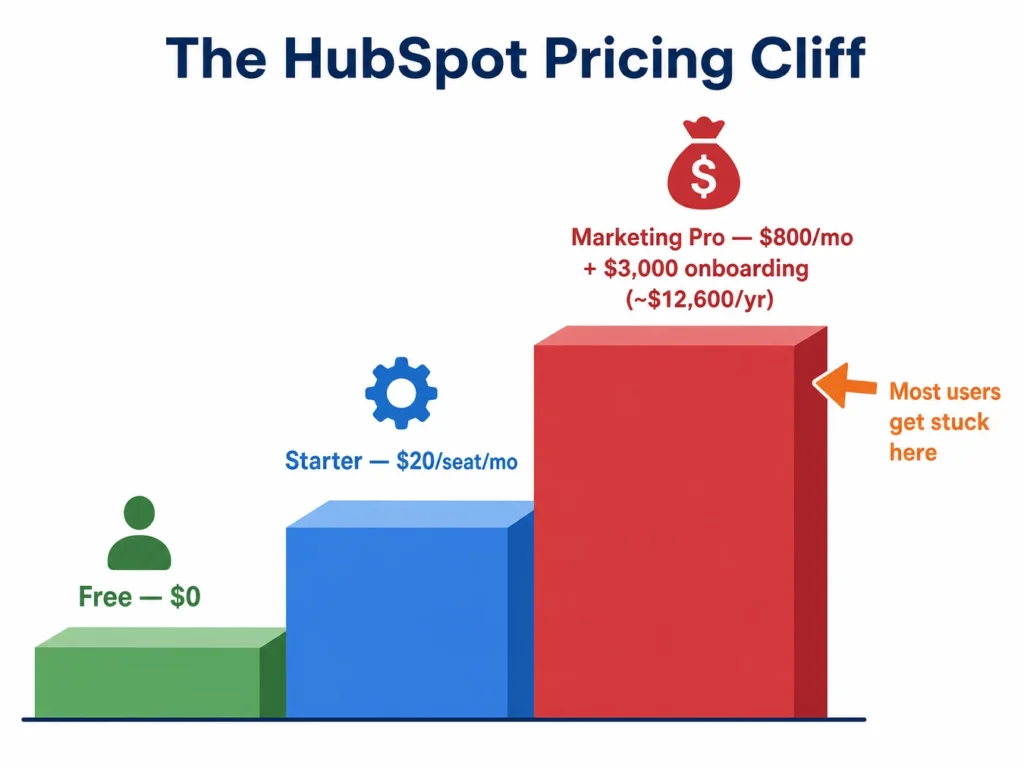
Here is the math nobody puts on the pricing page: Marketing Hub Pro’s true first-year cost is $12,600 ($800 × 12 + $3,000). Add a five-seat Sales Pro deployment and you are near $19,500 before a single overage fee. Contacts beyond your plan cost roughly $250 per month per additional 5,000 contacts. Credits beyond your allotment cost $9 per 1,000.
The cliff is not the list price. The cliff is that the gap between “affordable” and “enterprise” has no middle rung. Starter’s simple workflows cannot grow into Pro’s automation power, so you either stay limited or pay a 40x jump.
This is precisely why most people search for cheaper than HubSpot options. They are not looking for a worse tool; they are looking for the missing middle tier: real automation, real reporting, real segmentation, at a price a small business can swallow. That middle tier exists, spread across several vendors instead of one.
Why the Top Alternatives Lists Keep Getting It Wrong
Most roundup articles on this topic share three weaknesses. They quote list prices without the onboarding math, and they mix CRM and marketing tools in one undifferentiated list. Every figure here includes mandatory fees, and the comparisons split into three lanes, because HubSpot is two products pretending to be one: a sales CRM and a marketing suite. You rarely need to replace both at once; the best move is almost always to replace one lane cleanly and leave the rest of HubSpot in read-only mode. Finally, they assume switching is always right. It is not. Section 10 covers when staying on HubSpot is the correct decision, because sometimes the best alternative to HubSpot is a downgrade to its Starter tier, not a departure.
The Three Lanes: Pick One Before You Compare Anything
Every business that outgrows HubSpot Free or Starter actually outgrows one specific function. Name it, and the shortlist shrinks from twelve tools to three.
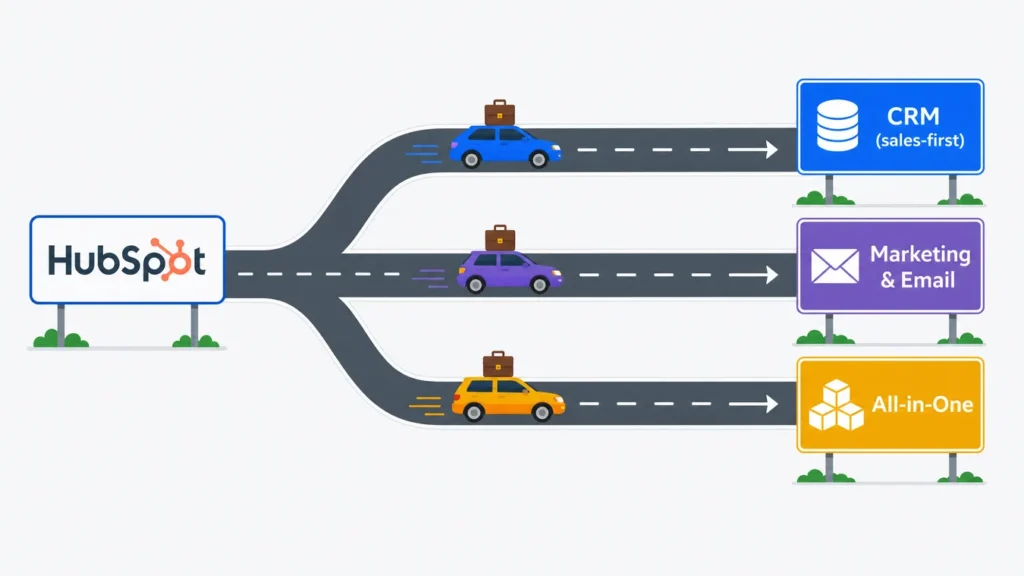
Lane 1 — You need a CRM. Your daily work is pipelines, deals, follow-ups, and contact history. Email marketing is occasional. Look at Zoho CRM, Pipedrive, Freshsales, and monday CRM, and skip the marketing suites entirely.
Lane 2 — You need marketing and email. You live in campaigns, automations, segments, and open rates. The CRM exists mainly to hold contact records that feed your sequences. Your lane is ActiveCampaign, Brevo, Klaviyo, and Constant Contact.
Lane 3 — You need an all-in-one. You want CRM, marketing, service, and maybe billing in one vendor relationship, one login, one support line. Your lane is Zoho One, Salesforce Starter, and Odoo.
Note for lane 3 seekers: all-in-one tools from other vendors are usually cheaper per seat but demand more discipline to configure. HubSpot’s price partly buys you a pre-built operating model; the alternatives below buy you raw capability and let you assemble your own.
#1. ActiveCampaign: The Marketing Hub Pro Replacement
Price: from $15/mo (Starter, annual; $49 Plus, $79 Pro with 3 seats, $145 Enterprise with 5 seats; no free plan, but free migration and a 30-day money-back guarantee)
If Marketing Pro is unaffordable, demo this tool first. ActiveCampaign was built as an automation engine and it shows. Its workflow canvas handles the branching logic, goal-based exits, and conditional content that HubSpot locks behind the Pro wall, on plans starting at fifteen dollars.
The comparison that matters most, activecampaign vs hubspot, comes down to one trade. HubSpot gives you a prettier unified dashboard and deeper content tools. ActiveCampaign gives you automation depth, attribution reporting, and segmentation power at roughly one-tenth the price once you need more than simple workflows. Its Plus plan includes unlimited automation actions, which HubSpot caps even on paid Starter tiers.
Strengths. The automation builder is the best in the price band, supporting branching, goals, and conditional content from the Pro tier. Attribution tracking on Pro answers “which email made money,” a question HubSpot only answers on Marketing Pro. CRM is included in every plan, migration from HubSpot is free, and the 30-day guarantee removes the trial risk.
Trade-offs. No free plan, which matters if you are migrating from HubSpot Free. The UI is functional but dated next to HubSpot’s polish, pricing scales with contact count so large lists become a real line item, and chat automation is limited compared to HubSpot’s service hub.
How it compares to HubSpot: the 3 differences that matter. ActiveCampaign includes CRM in every tier while HubSpot separates sales hub pricing. Unlimited automation actions start at $49, versus HubSpot’s “simple workflows only” on Starter. You pay $79 for three seats of Pro-grade attribution versus $800 plus $3,000 onboarding for HubSpot’s equivalent band.
- Best for: Marketing-led teams, agencies, and any business that hit the Marketing Hub Pro wall and wants 90% of its capability for 10% of its invoice.
View ActiveCampaign’s current pricing and free migration offer →
#2. Zoho CRM: The CRM That Refuses to Charge HubSpot Prices
Price: Free forever (3 users) · $14/user/mo Standard · $23 Professional · $40 Enterprise (annual); Zoho One: $37/user/mo for 50+ apps
In every zoho vs hubspot comparison, Zoho’s argument survives scrutiny: roughly one-sixth of the per-seat price for comparable pipeline, contact, and reporting functionality, plus a genuinely free tier for teams of up to three people. The CRM alone will not replace HubSpot’s marketing suite, which is why Zoho pairs it with Zoho Campaigns for a complete budget stack.
The quiet winner is Zia, Zoho’s AI layer, handling lead scoring, churn prediction, and anomaly detection at lower tiers than many expect. Few budget CRMs ship real AI.
Strengths. A real free tier for three users with full CRM basics. Standard at $14 per user includes reporting and dashboards that cost extra on HubSpot Free, and Zia AI delivers lead scoring and churn prediction without an enterprise contract. The broader Zoho suite lets you add marketing, accounting, and support one app at a time, with free onboarding and no mandatory consultant fees, ever.
Trade-offs. The interface is functional but cluttered; expect a learning curve HubSpot does not impose. Marketing automation lives in a separate product, so you are assembling a stack, not inheriting one. Advanced AI features like call transcription land only at Enterprise, and workflow limits on Standard push growing teams to Professional.
How it compares to HubSpot: the 3 differences that matter. Zoho’s free tier allows three users versus HubSpot’s two, with no branding on your CRM records. A five-user team on Standard costs $840 per year versus $6,900 for HubSpot Sales Pro including onboarding. Zoho charges for capability tiers, not for mandatory onboarding services.
- Best for: Budget-first small businesses that need a serious sales CRM, plus anyone assembling a modular Zoho stack instead of a monolithic suite.
#3. Brevo: The Email Platform That Charges for Emails, Not Contacts
Price: Free forever · $9/mo Starter (5,000 emails/mo) · $18/mo Standard (unlimited automations, A/B tests) · Professional tier via sales
Brevo (formerly Sendinblue) inverts the SaaS email pricing model, which is why it keeps appearing in “cheaper than HubSpot” conversations. You pay for the emails you send, not for the contacts you store. A list of 50,000 contacts you rarely email costs almost nothing; on a contact-based model it becomes a monthly rent payment.
The Standard tier is the value sweet spot: unlimited multi-step automation workflows, A/B testing, AI send-time optimization, and landing pages for $18 per month. Brevo also bundles a lightweight sales CRM add-on (~$27.92/month) if you need pipelines without a full CRM product.
Strengths. Free plan with no credit card, and pay-per-email pricing that protects you as your list grows. Unlimited multi-step automations on the $18 tier outclass HubSpot’s simple workflows on Starter. Built-in SMS, chat, and transactional email mean five communication channels from one vendor.
Trade-offs. The automation builder is capable but less granular than ActiveCampaign’s for complex branching. Reporting is good, not attribution-grade. The sales CRM add-on is an extra subscription with basic functionality, and phone support is limited to higher tiers.
How it compares to HubSpot: the 3 differences that matter. Brevo’s pricing scales with send volume while HubSpot’s scales with stored contacts, so large-list businesses pay dramatically less. Unlimited automation steps land at $18 versus HubSpot’s Pro wall. A built-in chat widget ships free, replacing one of HubSpot’s most-loved free features.
- Best for: Newsletter-driven businesses, bloggers, and list owners whose contact count outgrows their send volume.
#4. Klaviyo: The Ecommerce Answer to HubSpot’s Weakest Flank
Price: Free (250 profiles, 500 emails/mo) · from $20/mo · roughly $100/mo at 5,000 profiles · $150/mo at 10,000 profiles (annual rates)
HubSpot’s ecommerce capabilities were bolted on rather than built in, and Klaviyo exists because of that weakness. If your revenue runs through Shopify or a similar store, Klaviyo’s match is closer to native.
The model is different again: Klaviyo prices on active profiles, and its free tier of 250 profiles with 500 monthly sends is generous enough to run a genuine pilot. Revenue attribution is first-class; you can see exactly how much a flow earned, not just whether it was opened. Current promos include 30% off the data and analytics service, which lowers entry cost for 2026 switchers.
Strengths. The deepest ecommerce email and SMS integration available, with real revenue attribution per flow. Abandoned cart, browse abandonment, post-purchase, and win-back flows come pre-built with ecommerce triggers. Profile-level behavioral data feeds segmentation no general CRM can match. Free tier large enough to validate the platform before paying.
Trade-offs. Not a CRM; you will still want Pipedrive or Zoho alongside it if you need pipelines. Profile-based pricing gets expensive for large lists with low send frequency, the inverse of Brevo’s model. Predictive analytics and loyalty land on higher tiers. SMS pricing is usage-based and can surprise you at volume.
How it compares to HubSpot: the 3 differences that matter. Klaviyo’s ecommerce flows are native and pre-built versus HubSpot’s marketing hub add-ons. Revenue attribution is included in core reporting, not gated behind professional reporting add-ons. At 5,000 contacts, Klaviyo runs about $100/month versus $800+ for HubSpot’s comparable marketing band.
- Best for: Shopify and ecommerce brands whose email revenue is a growth channel, not a chore.
#5. Pipedrive: The Sales-First CRM HubSpot Never Managed to Be
Price: $14/seat/mo Lite · $39 Growth · $59 Premium (most popular) · $79 Ultimate (annual); 14-day free trial; email marketing add-on from $13.33/mo
When small sales teams search for hubspot alternatives for crm specifically, Pipedrive usually ends the search. User forums repeat the same reasoning: the pipeline is the interface, everything else is support. Deals are visual columns your reps actually drag, and nothing about the product pretends to be a marketing suite.
The honest caveat is scope. Pipedrive is a sales CRM, not a marketing platform. If marketing automation is your real need, pair Pipedrive with Brevo or ActiveCampaign rather than forcing it to carry that load.
Strengths. The most intuitive visual pipeline in the category, shortening onboarding to days, not months. $14 per seat on Lite with full pipeline basics; Premium at $59 adds automation, workflows, and reporting. The Campaigns add-on at $13.33/month adds email outreach without a second vendor, backed by a 500+ integration catalog and a 14-day trial with no card.
Trade-offs. Marketing beyond basic email campaigns requires pairing with another tool. No free-forever tier; Lite requires annual commitment for the $14 rate. Add-ons (LeadBooster, Projects, Smart Docs) are priced separately, so watch the extras column. Contact objects are less flexible than HubSpot’s custom object model.
How it compares to HubSpot: the 3 differences that matter. Five seats on Premium cost $4,260 per year versus $6,900 for HubSpot Sales Pro with its required onboarding, and zero mandatory setup fees. The pipeline UI is purpose-built for daily rep use rather than adapted from a marketing product. Email campaign capability is a $13.33 add-on versus a full Marketing Hub subscription.
- Best for: Sales-led small businesses and service teams who want reps to actually use the CRM.
#6. Freshsales: The Middle Path Between Free CRM and a Suite
Price: Free plan · $9/user/mo Growth · $39 Pro · $59 Enterprise (annual)
Freshsales sits in a position few alternatives occupy: meaningfully more capable than the free CRMs, meaningfully cheaper than anything from the suite vendors. Growth at $9 per user includes built-in phone and email, AI-based lead scoring, and workflow automation, which covers what most five-person sales teams actually do all day. Its realistic ceiling is the consideration: beyond roughly fifteen users, buyers tend to outgrow it toward Zoho (same parent company, broader ceiling) or Salesforce. For the small-to-mid range it serves honestly.
Strengths. A free plan with real features, not a demo. Growth at $9 per user undercuts every major CRM’s standard tier, and built-in communication tools reduce tab-switching for small sales teams. AI lead scoring arrives at entry tiers instead of being reserved for enterprise.
Trade-offs. Reporting on the free plan is limited; Growth is where analytics become useful. Marketing automation remains weaker than dedicated platforms, so marketing-led teams should pair it with Brevo or ActiveCampaign. Roadmap transparency has been mixed since the Freshworks reorganization.
How it compares to HubSpot: the 3 differences that matter. A four-user Growth deployment costs $432 per year versus five figures for HubSpot’s professional sales band. Phone and email are built into the base product. No onboarding fees at any tier.
- Best for: Growing small sales teams that want AI scoring and communication tools without suite complexity.
#7. Salesforce Starter: The All-in-One with a Real Enterprise Ceiling
Price: Starter Suite $25/user/mo · Growth Suite ~$50 · Pro Suite ~$100; Sales Cloud Professional $75/user/mo (annual)
Salesforce often appears in hubspot alternatives lists as the heavyweight option, and that framing is half right. The Starter Suite at $25 per user per month bundles sales, service, marketing, and commerce into one small-business product, and it carries something no budget alternative can promise: a ceiling. A company can start on Starter and scale to enterprise capability without ever migrating data or teams again.
The honesty requirement applies here too. Salesforce’s true cost grows in ways not shown on the pricing page: data storage fees, per-user add-ons, and implementation effort mean a five-person team should budget two to three times the list price in year one for a properly configured platform. Still dramatically cheaper than HubSpot Pro.
Strengths. One vendor relationship that scales from startup to Fortune 500. The Starter Suite covers sales, service, and marketing at $25 per user, undercutting HubSpot’s per-seat price for the same bundle. Agentforce AI and the AppExchange ecosystem give room to grow without re-platforming, and a mature consultant network exists for hands-on help.
Trade-offs. Configuration complexity is real; plan for setup time or budget an implementation partner. Storage and add-on pricing accumulate quietly. The UI still carries enterprise DNA that small teams feel as friction, and marketing on Starter is shallower than dedicated platforms like ActiveCampaign.
How it compares to HubSpot: the 3 differences that matter. The all-in-one Starter Suite costs $25 per user versus HubSpot’s $20 per seat for a single hub, but covers four hubs’ worth of functions. There is no mandatory onboarding fee structure for the suite tiers. The platform ceiling eliminates the mid-growth re-migration that HubSpot teams often face moving to Enterprise.
- Best for: Scaling teams that want enterprise-grade capability now without a $10,000 annual marketing bill.
View Salesforce Sales pricing →
monday CRM, Keap, Odoo, and Constant Contact: The Situation-Specific Picks
Four more tools earn a place here, each for one specific situation.
#8. monday CRM fits teams whose sales process is really a project process. CRM plans run from $12 per seat (Basic) to $28 per seat (Pro) with email sequences, quotes, and invoicing, riding on monday’s board architecture. The trade-off: you are buying a work-management tool wearing a CRM costume, needing more manual setup than a purpose-built sales tool, and email sequences only arrive on Pro. Choose it if your team already lives in monday.
#9. Keap (formerly Infusionsoft) is the name that makes you stop and check the price. At a flat $299 per month with every feature included, Keap is not a cheaper option; it is a consolidation option for service businesses wanting booking, quotes, invoices, payments, SMS, and email in one package. The honest math: $3,588 per year flat against roughly $700 to $1,200 for a Zoho or Brevo stack that does 85% of the same work. It serves home-service franchises and local operators who value done-for-you structure over price. Notably, Keap markets itself as the “#1 HubSpot alternative,” which tells you more about their SEO team than about pricing.
#10. Odoo is the wildcard for technical buyers. One app is free for unlimited users; Standard at $24.10 per user per month unlocks every app, including CRM, email marketing, e-commerce, accounting, and inventory, with hosting and support included. On paper it is the cheapest all-in-one here, cheaper even than HubSpot Starter per seat. In reality Odoo rewards teams with at least one technical person; configuration happens on your side. If you have a tinkerer on staff, Odoo is a bargain. If you want a vendor to carry the operating model, look elsewhere.
#11. Constant Contact earns its place as the on-ramp tool. From $8.40 per month on Lite through $56 on Premium, it is the platform you choose when the person sending the email is not a marketer. Drag-and-drop editing, AI copy help, live support, and 300+ integrations make it the friendliest first email platform here. Its ceiling is the limit: advanced automation lives behind Premium, and segmentation does not approach ActiveCampaign or Brevo. It is the right answer for local businesses, nonprofits, and founders sending their first hundred campaigns.
Total Cost of Ownership: The Math HubSpot Hopes You Skip
List prices flatter every vendor; first-year cost settles the argument. The table below assumes a small B2B service business: a five-person team, roughly 2,500 marketing contacts, and the automation set most teams actually run.
| Scenario | HubSpot | ActiveCampaign | Zoho CRM + Campaigns | Brevo Standard |
|---|---|---|---|---|
| Marketing platform, year 1 | $12,600 ($800×12 + $3,000 onboarding) | $588 ($49/mo Plus) | $96–$192 | $216 ($18/mo) |
| Sales CRM, 5 seats, year 1 | $6,900 ($100/seat + $1,500 onboarding) | included in plan | $840 ($14/user/mo) | +$335 (add-on) |
| Year-one total | ~$19,500 | ~$588–$800 | ~$936–$1,032 | ~$216–$551 |
HubSpot’s figures exclude contact overages at roughly $250 per month per additional 5,000 contacts and credits at $9 per 1,000. Brevo and Zoho Campaigns charge on email volume rather than stored contacts, so their costs stay flat as your list grows; HubSpot’s rise with every thousand contacts.
The practical reading: even conservatively, the four alternatives above deliver the core capability a HubSpot Pro buyer actually uses for 3% to 5% of the first-year price. Regret comes from teams that switched without rebuilding their top automations; the migration section fixes that.
Nine Personas, Nine Answers
Find yourself in the left column.
| Your situation | Switch to | Why, in one line |
|---|---|---|
| Small business needing a CRM first | Zoho CRM | Free for 3 users; $14/user Standard covers pipelines, tasks, and reporting |
| Marketing team fleeing Marketing Pro | ActiveCampaign Pro | $79/mo with 3 seats delivers the automation and attribution you actually used |
| Shopify / ecommerce brand | Klaviyo | Native revenue attribution and pre-built ecommerce flows HubSpot never matched |
| Budget-conscious, small list | Brevo Standard | $18/mo with unlimited automations; pay for emails, not contacts |
| Agency with multiple clients | ActiveCampaign Pro | Predictable per-seat pricing and account separation that scales |
| On HubSpot Free, feeling capped | Brevo (free) or Zoho CRM (free) | Real automations and 3 users without HubSpot branding |
| Quoted the $800 + $3,000 Pro wall | ActiveCampaign or Zoho One | Same capability band at $79/mo or $37/user/mo, no onboarding tax |
| Service / local business wanting booking + invoicing | Keap | Flat $299/mo bundles everything; honest price, one-vendor life |
| Scaling team wanting no future re-migration | Salesforce Starter | $25/user all-in-one with an enterprise ceiling |
The “on HubSpot Free” persona gets two options because the right answer depends on whether your bottleneck is marketing (Brevo) or sales workflow (Zoho CRM); both free plans outclass HubSpot Free. The Keap recommendation stands despite Keap not being cheap, because for a specific buyer type it replaces four separate subscriptions, which is a different arithmetic than headline price.
When Staying on HubSpot Is Actually the Right Call
HubSpot remains the right choice in specific circumstances, and pretending otherwise would make everything above less trustworthy.
Stay if you run a large inbound marketing operation where the content studio, native SEO tools, and full-funnel attribution generate revenue exceeding the $12,600 first-year Professional cost. Stay if your team already operates across sales, service, CMS, and operations hubs and switching effort would consume more than the savings for at least eighteen months. Stay if you qualify for the startup or nonprofit programs, which discount professional tiers heavily, or if you need deep native objects and Breeze AI across a unified suite.
There is also a middle option many teams miss: staying on Starter deliberately. At $7 per seat annually, HubSpot Starter is genuinely good value for what it includes. The smartest migration path is often not leaving HubSpot entirely but leaving Marketing Pro behind. Keep Starter for CRM and contacts, and move only your marketing automation to ActiveCampaign or Brevo. This hybrid architecture is how most of the successful switches I have advised actually ended.
How to Switch Without Breaking Anything
The fear that drives people to delay a switch is downtime, not price. Here is the 30-day sequence that removes both.
Export your HubSpot data first. Contacts, companies, and deals all export to CSV in a single afternoon, and the export is yours regardless of billing status. Pick one lane first and resist replacing all five hubs in week one; teams that attempt total simultaneous replacement usually end up with a broken hybrid. Rebuild only your top three automations: the welcome series, the abandoned-quote or cart flow, and the re-engagement sequence. Skip the long tail; half of most companies’ automation library was never touched. Run both tools in parallel for thirty days, keeping HubSpot Starter as a read-only archive while the new platform carries live traffic. Finally, downgrade, rather than delete, the account so your history stays recoverable.
ActiveCampaign and most migration-aware vendors perform the data import for free. The entire process costs one afternoon of exports, two weekends of automation rebuilds, and about $0 in fees.
FAQ
What is the best alternative to HubSpot in 2026?
For most businesses replacing Marketing Hub Pro, it is ActiveCampaign: comparable automation and attribution for under $80 per month with free data migration. Zoho CRM is the best CRM-specific replacement at free-to-$14 per user, and Brevo wins for email-first teams starting at $9.
Is there a free alternative to HubSpot?
Yes. Zoho CRM is free for up to three users, Brevo offers a forever-free email plan with no credit card, Zoho Campaigns covers 2,000 contacts and 6,000 emails monthly at no cost, and Klaviyo is free to 250 profiles. Zoho CRM plus Zoho Campaigns together replace both HubSpot hubs for $0.
Why do people switch away from HubSpot?
Three reasons dominate in 2026: the jump from $20-per-seat Starter to an $800-per-month Marketing Pro tier with a $3,000 onboarding fee, per-contact pricing that punishes list growth, and seat-based charging across every hub.
Is ActiveCampaign better than HubSpot?
Better depends on the tier being compared. Versus Marketing Hub Professional, ActiveCampaign Pro offers similar automation depth at about one-tenth the first-year cost, though it lacks HubSpot’s content studio and free chat widget. Versus HubSpot Starter, HubSpot wins on price and simplicity, which is why the switch makes sense when Starter stops being enough.
How much cheaper are HubSpot alternatives?
Real first-year costs run from roughly $216 (Brevo stack) to $1,032 (Zoho CRM plus Campaigns for a five-person team) versus approximately $19,500 for the equivalent HubSpot Pro deployment including onboarding. Even Keap at $3,588 per year is 82% cheaper.